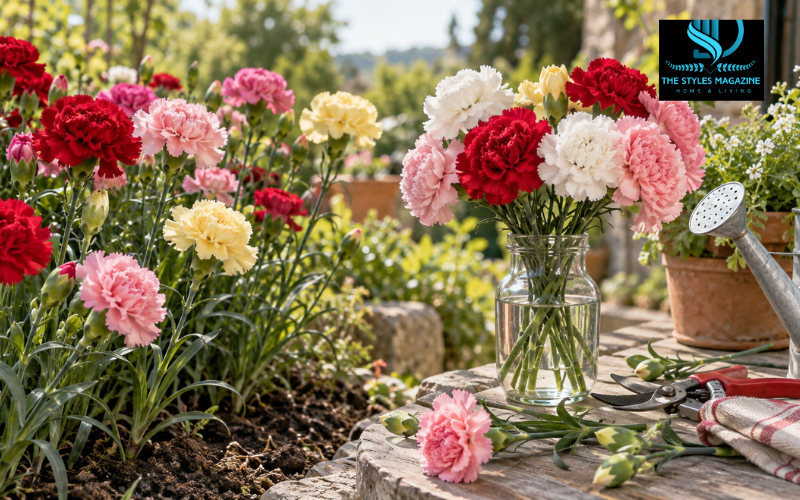
The carnation flower (Dianthus caryophyllus) is easy to recognize by its soft, ruffled petals and elegant appearance. Many varieties also have a light spicy fragrance that is often compared with cloves. Available in colors ranging from classic pink, red, and white to yellow, purple, green, and mixed shades, carnations have become popular in gardens as well as flower arrangements.
Carnations also have a long cultural history. They have been grown as ornamental flowers for centuries and were known in ancient Greece. Today, gardeners value them for their colorful blooms, while florists appreciate their strong stems and good vase life.
There is more to carnations than their appearance. Their colors carry traditional meanings, different plant forms suit different growing spaces, and proper care can keep both garden plants and cut flowers looking attractive for longer. This guide covers carnation meanings, colors, growing conditions, everyday care, prices, names in other languages, and creative uses.
Carnation Flower at a Glance
Carnations belong to the Caryophyllaceae family and the genus Dianthus. The accepted scientific name for the species is Dianthus caryophyllus. It is commonly known as the carnation, border carnation, clove carnation, or clove pink. The plant is generally grown as a herbaceous perennial, although its behavior and lifespan can vary according to the variety and local climate.
The plant usually has slender, grey-green leaves arranged along upright stems. Its flowers may be single or clustered, with petals that often have fringed or softly toothed edges. Traditional forms can have a spicy fragrance similar to cloves, cinnamon, or nutmeg, although scent strength differs between cultivated varieties.
| Feature | Basic Information |
| Scientific name | Dianthus caryophyllus |
| Plant family | Caryophyllaceae |
| Common names | Carnation, border carnation, clove carnation |
| Plant type | Usually herbaceous perennial |
| Preferred position | Full sun |
| Soil | Well-drained soil |
| Common colors | Pink, red, white, yellow, purple, green and mixed |
| Main uses | Gardens, containers, bouquets and cut flowers |
Outdoor flowering time depends strongly on climate and variety. Many garden carnations flower during the warmer months, while some protected perpetual-flowering forms can produce blooms for much longer periods under suitable conditions.
Simple Steps for Growing Carnation Flowers
- Choose a sunny location with good air circulation.
- Plant carnations in fertile, well-drained soil.
- Water regularly, but avoid keeping the soil constantly wet.
- Leave enough space between plants to reduce moisture-related problems.
- Remove faded flowers to keep the plant tidy and encourage continued blooming.
- Support taller varieties if their stems begin to bend.
- Check plants regularly for pests, mildew, rust, or other signs of disease.
Where Carnations Come From and How They Got Their Name
Carnations are strongly connected with southern European and Mediterranean gardening traditions. Modern botanical records from Kew list the native range of Dianthus caryophyllus in the Balkan Peninsula, including areas such as Albania and Greece. The plant has been cultivated far beyond its original range for a very long time.
Its botanical name also has an interesting history. According to Kew, the genus name Dianthus comes from ancient Greek words connected with “divine” or “of the gods” and “flower.” This is why carnations and related Dianthus species are sometimes informally described as “flowers of the gods.”
Historical references connect carnations with ornamental gardening in ancient Greece. Over later centuries, growers selected plants for fuller flowers, longer stems, stronger colors, and improved flowering habits. This gradual cultivation helped turn the carnation from a traditional garden plant into an important cut flower used around the world.
Some stories about carnations are based more on legend than documented botanical history, so it is useful to separate traditional stories from established facts.
Carnation Flower Meaning and Symbolism
The carnation flower meaning is often connected with love, affection, admiration, gratitude, and remembrance. However, flower symbolism is not an exact language. Meanings can change between countries, generations, families, and occasions.
Carnations are also widely associated with January. They are traditionally listed alongside the snowdrop as January birth flowers, making carnation bouquets a popular choice for January birthdays.
The flower is often used when people want to express warm feelings without the strong romantic message commonly associated with roses. Carnations can appear in birthday arrangements, thank-you bouquets, memorial flowers, family celebrations, and seasonal displays.
Color also influences traditional symbolism. A red carnation may communicate something different from a white or pink one. Still, these meanings should be treated as traditions rather than strict rules. Someone may simply choose a yellow carnation because they enjoy its bright color, regardless of older symbolic meanings.
Carnation Colors and What They Traditionally Represent
Color is one of the most attractive features of carnations. Modern cultivated varieties come in a much wider range than the plant’s original pinkish-purple tones.
Red carnations are traditionally associated with admiration, affection, and love. Darker red flowers are sometimes linked with stronger romantic feelings.
Pink carnations are commonly connected with gratitude, fond memories, affection, and maternal love. Their long association with Mother’s Day has helped make pink one of the best-known carnation colors.
A white carnation flower is traditionally associated with pure affection, innocence, remembrance, faithfulness, or good wishes. White varieties are therefore used for both joyful and reflective occasions.
Yellow carnations have sometimes represented disappointment or rejection in older flower symbolism, but today they are frequently chosen simply because they look cheerful and bright. Purple carnations have traditionally been linked with unpredictability or a playful nature.
Striped, green, and bi-colored carnations are increasingly valued for their visual effect. Modern buyers often choose colors according to personal taste, décor, event themes, or the recipient’s favorite shade rather than traditional symbolism.
Carnation Flower Plant Types, Varieties, and Forms
Not every carnation flower plant looks exactly the same. Years of breeding have created many cultivars with different flower sizes, stem lengths, colors, scents, and growth habits.
Standard carnations normally produce one larger main flower on a long stem. These are the familiar carnations often seen in formal bouquets and florist arrangements. Spray or miniature carnations produce several smaller blooms on branching stems, creating a fuller and more relaxed appearance.
Garden or border carnations are grown mainly for outdoor displays. They work well in sunny borders and can also provide flowers for cutting. Dwarf and compact forms are especially useful in pots, patio containers, or smaller gardens.
Perpetual-flowering carnations have been developed particularly for extended flower production. The RHS notes that protected perpetual-flowering carnations can continue flowering for long periods when given suitable warmth and growing conditions.
When choosing a plant, it is better to think about its intended use rather than color alone. Compact plants suit containers, while longer-stemmed cultivars are usually better when the main goal is producing cut flowers.
How to Grow Carnation Flowers Successfully
Carnations generally perform best in a sunny position. Good light encourages stronger growth and better flowering, while very shaded conditions can result in weaker stems and fewer blooms. The RHS recommends full sun and well-drained conditions for Dianthus caryophyllus.
Drainage is especially important. Carnations do not enjoy sitting in constantly wet soil. A fertile soil containing organic matter can support healthy growth, but water should still be able to move through it easily. Raised beds or containers may help in gardens with heavy soil.
Carnations can be started from seed, purchased as young plants, or propagated from suitable cuttings depending on the variety. When planting several carnations, leave enough space for air to move between them. Good airflow helps foliage dry more quickly after rain or watering.
Water young plants regularly while their roots become established. Mature plants generally prefer steady moisture without waterlogging. Container-grown carnations may dry out faster and therefore need more frequent checking.
A balanced fertilizer can be useful during active growth, but excessive feeding is unnecessary. Climate matters too: some carnations survive as perennials outdoors, while less-hardy forms may need winter protection.
Everyday Care for a Healthy Carnation Plant
Routine care does not need to be complicated. The most important point is to keep moisture balanced. Water when the soil begins to dry rather than keeping it permanently wet. If possible, water around the soil instead of repeatedly soaking the foliage.
Removing faded flowers, known as deadheading, can keep plants looking tidy and may encourage further flowering. The RHS recommends regular deadheading for prolonged display in cultivated carnations.
Tall varieties can sometimes lean or bend, particularly after heavy rain or when carrying large blooms. Simple plant supports can protect the stems without making the garden look crowded.
Carnations can face common garden problems. Aphids and slugs may damage young growth, while diseases can include powdery mildew, rust and Fusarium wilt. Penn State describes Fusarium wilt as a disease that may begin with yellowing and wilting in lower leaves before progressing through the plant.
Good drainage, sensible spacing, clean gardening tools, and regular inspection are often more useful than waiting until a problem becomes severe. Plants showing serious disease should be handled carefully to reduce the chance of spreading infection.
Caring for Cut Carnations and Making Them Last Longer
One reason carnations remain so popular as cut flowers is their relatively long vase life. Utah State University Extension reports that vase life can range from about 9 to 28 days under suitable postharvest conditions, although actual results depend on flower quality, maturity, storage, and home care.
Start with a clean vase. Trim a small amount from the bottom of each stem using clean, sharp tools so the flowers can take up water efficiently. Remove any leaves that would sit below the water surface, as decaying foliage can encourage bacterial growth.
Fill the vase with fresh water and use flower food according to its directions if available. Replace cloudy or dirty water and clean the vase when necessary.
Keep the arrangement away from strong heat, direct afternoon sun, and ripening fruit. Carnations are particularly sensitive to ethylene, a natural plant hormone released by ripening fruit and some aging plant material. Exposure can cause flowers to wilt earlier.
These simple habits can make a noticeable difference in how long a bouquet stays attractive.
Popular Uses and Occasions for Carnation Flowers
Carnations work well for many occasions because they are colorful, widely available, and generally durable after cutting. They can be used in hand-tied bouquets, wedding arrangements, centerpieces, buttonholes, memorial displays, birthday flowers, and simple arrangements for the home.
Their association with January makes them a natural choice for January birthday bouquets. Pink and red carnations are also commonly connected with Mother’s Day and expressions of affection.
In gardens, carnations can bring color to borders, containers, patios, and dedicated cutting gardens. Growing them at home also allows gardeners to select unusual colors and fragrant varieties that may not always be available from local florists.
Carnation petals can have culinary uses, but this needs an important caution. The RHS identifies Dianthus caryophyllus as an edible flower with a spicy, clove-like flavor, while also advising people not to eat ordinary bought flowers unless they are specifically sold for eating, because ornamental flowers may have been treated with unsuitable chemicals.
Carnation Flower Price and What Affects the Cost
There is no single worldwide carnation flower price. Prices vary significantly according to location, season, supplier, flower quality, variety, and the way the flowers are sold.
A single loose stem from a flower market will usually be priced differently from a professionally arranged bouquet. Bulk stems purchased for an event are also priced differently from a finished wedding arrangement that includes design work, wrapping, greenery, delivery, and setup.
Stem length and flower quality can affect cost because longer, straighter stems are often more desirable for professional arrangements. Unusual colors, specialty cultivars, or flowers that require additional growing or shipping conditions may also cost more.
Demand can rise around occasions such as Valentine’s Day, Mother’s Day, weddings, and major holidays. Delivery fees and florist labor can add substantially to the final price even when the individual flowers themselves are relatively affordable.
Live carnation plants are a different purchase again. Their price depends on plant size, pot size, cultivar, and nursery.
For accurate buying information, checking current prices from local florists, nurseries, flower markets, and online sellers is more useful than relying on one fixed global figure.
Carnation Flower in French, Chinese, and Other Languages
Flower names change from one language to another. The carnation flower in French is commonly called œillet, while the carnation flower in Chinese is 康乃馨. Collins dictionaries confirm both translations.
Other examples include clavel in Spanish, garofano in Italian, Nelke in German, and カーネーション in Japanese.
Common names can sometimes cause confusion because the same word may refer to different plants in different regions. Botanical names solve much of this problem. Using Dianthus caryophyllus gives gardeners, researchers, nurseries, and plant enthusiasts an internationally recognized way to identify the species.
Carnations in Art, Tattoos, and Crochet Designs
The layered petals and distinctive outline of carnations make them easy to recognize outside the garden. Their shape appears in paintings, embroidery, paper crafts, fabric work, tattoos, and handmade decorations.
A carnation flower tattoo can carry many personal meanings. Some people choose the flower to represent love, gratitude, family, remembrance, or a January birthday. Others choose a particular color because of its traditional symbolism or simply because they like how it looks. Tattoo meaning is personal, so there is no single interpretation that applies to everyone.
A carnation flower crochet design recreates the ruffled appearance by building several layers of yarn petals. Crocheted carnations can be used in handmade bouquets, home decorations, gifts, clothing accessories, or craft displays.
Their popularity in creative work makes sense: a carnation remains recognizable even when its natural shape is simplified. Artists and crafters can also change its colors freely, allowing the flower to fit anything from realistic botanical work to highly personal designs.
Conclusion
The carnation flower has remained popular because it combines beauty with practicality. Its ruffled blooms come in a wide choice of colors, many varieties carry a gentle spicy fragrance, and cut stems can stay attractive for an unusually long time when cared for properly.
Carnations also have layers of cultural meaning. They can represent affection, gratitude, remembrance, love, or personal memories, although these meanings vary between people and traditions. Gardeners can choose compact plants for containers, border types for outdoor displays, or longer-stemmed forms for cutting.
For healthy plants, the essentials are fairly simple: provide plenty of light, use well-drained soil, avoid excessive moisture, remove faded flowers, and watch for pests or disease. For cut carnations, clean water, clean tools, a fresh vase, and protection from heat and ethylene-producing fruit can help extend their display.
Whether grown in a garden, given as a bouquet, used in a celebration, or recreated in a tattoo or crochet project, carnations continue to offer an appealing mix of color, history, symbolism, and everyday usefulness.
FAQs
What Is Special About The Carnation Flower?
Carnations are known for their ruffled petals, attractive colors, light spicy fragrance, and long vase life. They are also widely used to express love, gratitude, admiration, and remembrance.
What Does A Carnation Flower Symbolize?
Carnation symbolism varies by color and culture. In general, carnations are associated with affection, love, gratitude, admiration, remembrance, and family bonds rather than having one universal meaning.
Is A Carnation Flower Easy To Grow?
Carnations can be relatively easy to grow when they receive plenty of sunlight, well-drained soil, moderate watering, and good air circulation. Growing conditions may vary according to climate and variety.
How Long Do Cut Carnation Flowers Last?
Cut carnations are known for good vase life. With clean water, trimmed stems, flower food, and proper placement, many can remain attractive for around one to three weeks.
Can Carnation Flowers Be Eaten?
Some carnation petals can be used as edible flowers, but only flowers specifically grown and sold for food should be eaten. Ordinary florist flowers may have been treated with unsuitable chemicals.
Enjoyed it? Find more exclusive content on The Styles Magazine.
Disclaimer: This article is provided for general informational and educational purposes only. Growing conditions, flowering periods, plant performance, symbolic meanings, and carnation flower prices may vary by climate, location, cultivar, supplier, and local traditions. Any carnations intended for food use should be specifically grown and sold as edible flowers, as ordinary florist or ornamental flowers may have been treated with chemicals not suitable for consumption. For plant disease, pesticide, or food-safety concerns, follow local horticultural or professional guidance.