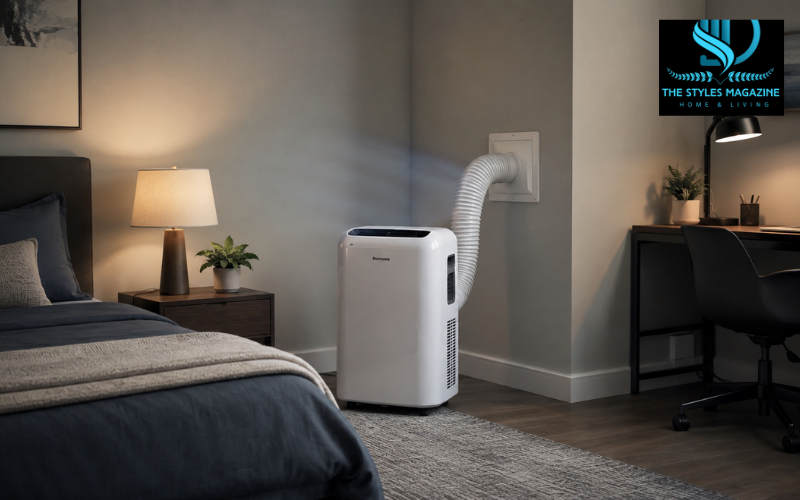
A windowless air conditioner sounds like the perfect solution for a hot room with no window. Many people search for one when they need to cool a bedroom, basement, office, garage, dorm room, or apartment space where a normal window AC cannot be installed. The idea is simple: you want cold air without needing a window. But the truth is a little more important to understand before buying.
A real compressor-based air conditioner does not simply create cold air. It removes heat from the room and sends that heat somewhere else. That means a true air conditioner always needs a way to release hot air outside the space you are trying to cool. If a cooling unit has no hose, no vent, and no outside connection, it is usually not a true air conditioner. In many cases, it is an evaporative cooler, also called a swamp cooler.
This does not mean windowless cooling is impossible. It means you need to choose the right type of product for your room. Some people may do well with an evaporative cooler. Others need a portable air conditioner with alternative venting. For a permanent and stronger cooling setup, a ductless mini-split system may be the best choice.
The right option depends on your room size, climate, budget, venting options, and whether you want temporary or long-term cooling. This guide explains what actually works, what to avoid, and how to choose the best windowless air conditioner for your situation without wasting money on the wrong product.
Quick Guide Table
| Cooling Option | Best For | Needs Exhaust? | Needs Water? | Cooling Power |
| Evaporative Cooler | Hot, dry rooms | No | Yes | Low to moderate |
| Portable AC with Alternative Venting | Rooms without window access | Yes | Usually no refill needed | Moderate |
| Ductless Mini-Split | Permanent room cooling | Outdoor connection | No water tank | High |
What a Windowless Air Conditioner Really Means
The term windowless air conditioner can mean different things depending on what the buyer is looking for. Some people mean they have no window in the room. Others mean they want a cooling unit that does not need an exhaust hose. Some want a unit that does not need water, while others want cooling without an outdoor compressor.
These are not all the same thing. A room with no window can still sometimes use a real air conditioner if there is another way to vent hot air. For example, a portable air conditioner without window access may be vented through a door, wall, ceiling space, or another safe exhaust route. But a windowless air conditioner without exhaust hose is usually not a true AC if it has no other way to remove heat.
This is where many buyers get confused. A product may be advertised as “windowless” because it does not sit in a window. However, it may still need a hose. Another product may be called “portable air cooler,” but it may only use water and airflow. That can help in some climates, but it will not cool like a traditional air conditioner.
Before choosing a unit, it is important to understand what kind of cooling you actually need. If your room is slightly warm and your air is dry, a simple cooler may help. If your room gets very hot and humid, you will likely need a real AC system with proper heat removal.
The Truth About Windowless Air Conditioners Without Exhaust Hoses
A true air conditioner works by collecting heat from indoor air and moving that heat away. This is why window AC units hang partly outside and why portable AC units usually come with an exhaust hose. The hose is not just an extra part. It is how the unit removes hot air from the room.
If you use a real portable AC without venting the hot air, the unit may blow cool air from one side while releasing heat from another side. In the end, the room will not cool properly. It may even feel warmer because the machine itself also produces some heat while running.
This is why shoppers should be careful with any windowless air conditioner without exhaust hose. If the product has no hose, check what type of cooling it uses. Does it have a compressor? Does it use refrigerant? Does it include an exhaust outlet? Does it need water or ice? These details tell you whether it is a true air conditioner or only an air cooler.
Evaporative coolers can be useful, but they are not the same as compressor-based air conditioners. They work by passing air through wet cooling pads. This adds moisture to the air while creating a cooler breeze. In dry places, that can feel comfortable. In humid rooms, it can make the air feel heavy and sticky.
So, if you want strong cooling in a windowless room, do not choose based only on the word “windowless.” Look at how the product handles heat.
Main Types of Cooling Options for Rooms Without Windows
There are three main choices for cooling a room without a window: evaporative coolers, portable AC units with alternative venting, and ductless mini-split systems. Each one works differently, and each one fits a different type of user.
An evaporative cooler is the simplest option. It does not need a window, hose, or outdoor unit. It uses water and airflow to create a cooler breeze. It is usually cheaper to buy and cheaper to run, but it works best only in dry climates.
A portable air conditioner is a real AC unit that uses a compressor and refrigerant. It can cool a room more effectively than an evaporative cooler, but it still needs to exhaust hot air. If there is no window, you need another venting path.
A ductless mini-split is the most powerful and permanent option. It has an indoor cooling unit and an outdoor compressor. It does not need a window, but it does require professional installation and a small wall opening for the connecting lines.
Choosing between these options depends on how serious your cooling problem is. A small dry room may only need an evaporative cooler. A hot bedroom or office may need a vented portable AC. A room used daily in a hot climate may be better served by a mini-split.
Evaporative Coolers for Windowless Rooms
Evaporative coolers are often sold as “air coolers,” “portable coolers,” or sometimes even “windowless air conditioners.” They are popular because they are easy to move, simple to use, and do not require an exhaust hose. You usually add water to the tank, turn on the fan, and the unit blows air through damp pads.
These coolers work best in hot and dry climates. When the air is dry, water evaporates more easily. That evaporation helps lower the air temperature and creates a cooler feeling. In the right conditions, an evaporative cooler can make a small or medium room more comfortable without using as much electricity as a true AC.
However, they are not ideal for every room. In humid areas, the air already has a lot of moisture. When an evaporative cooler adds more moisture, the room can feel damp, sticky, and uncomfortable. It may not reduce the temperature enough to feel useful.
They also need some airflow. A completely sealed room can become too moist over time. For better performance, there should be some way for fresh air to move through the space, such as a door gap, vent, or nearby opening.
An evaporative cooler can be a good budget choice, but it should not be expected to perform like a real air conditioner. It is better for mild cooling, dry weather, and personal comfort rather than heavy-duty room cooling.
Portable Air Conditioners Without Window Access
A portable air conditioner is a better option when you need real cooling. These units use a compressor, refrigerant, and a fan to remove heat from indoor air. They can cool better than evaporative coolers, especially in humid climates. The challenge is that they still need venting.
If you need a portable air conditioner without window access, you must find another safe place for the exhaust hose. Some people vent it through a door using a door seal kit. Others install a small wall vent. In some buildings, it may be possible to route the hose into a drop ceiling, but only if the space is suitable and allowed. A dryer vent may work in limited cases, but it should only be used if it is safe, clean, and not shared with a working dryer.
The most important rule is simple: the hot air must leave the room. Venting it into the same room, a closed closet, or a small hallway can reduce cooling and may make the space warmer. The exhaust route should be short, secure, and sealed as well as possible so hot air does not leak back inside.
This option can work well for renters if no permanent changes are needed. For example, venting through a sliding door or temporary panel may be possible. But if wall drilling is required, renters should get permission first.
Portable AC units can be noisy and take up floor space, but they are often the most practical real AC choice for rooms without usable windows.
Windowless Air Conditioner No Water Options
Many people search for a windowless air conditioner no water because they do not want to keep refilling a tank. This is a common concern, especially for bedrooms, offices, and rooms where people want simple cooling with less maintenance.
The key point is that no-water cooling usually means you are moving away from evaporative coolers. Evaporative coolers need water because water is part of how they cool the air. Without water, they are mostly just fans.
Compressor-based air conditioners do not need a water tank to create cold air. However, they still need exhaust. A portable AC may collect moisture from the air and require occasional draining, but it does not need you to add water like an evaporative cooler. Many modern units also remove some moisture through the exhaust system, depending on the model and humidity level.
Mini-split systems also do not need a water tank. They cool the room through an indoor unit connected to an outdoor unit. They do produce condensation, which must drain away through a small drain line, but the user does not normally refill anything.
So, if you want no-water cooling, your best choices are usually a portable AC with proper venting or a ductless mini-split. If you also want no hose, no water, and no outdoor connection, then you are probably looking for something that does not truly exist as a powerful air conditioner.
Ductless Mini-Split Systems for Rooms With No Windows
A ductless mini-split system is often the best long-term solution for a room with no windows. It does not need a window opening, and it does not require a large air duct system. Instead, it uses an indoor wall-mounted unit connected to an outdoor compressor.
The indoor unit blows cool air into the room. The outdoor unit releases the heat outside. The two parts are connected by thin refrigerant lines, a power cable, and a drain line. These usually pass through a small wall opening.
Mini-splits are popular because they are quiet, powerful, and energy-efficient. They are especially useful for bedrooms, home offices, basements, garages, additions, and rooms that are not connected to central air conditioning.
The main downside is installation. A mini-split usually needs a trained installer. It costs more upfront than a portable AC or evaporative cooler, and it is not usually the best choice for people who need a quick temporary fix.
For homeowners or long-term renters with permission, a mini-split can be the most comfortable choice. It provides steady cooling without taking up floor space, without a window kit, and without the need to refill a water tank.
Best Windowless Air Conditioner Choices by Situation
The best windowless air conditioner depends on what kind of room you have and what problem you are trying to solve. There is no single perfect product for every situation.
If you want the lowest-cost option and live in a hot, dry area, an evaporative cooler may be enough. It is easy to set up, simple to move, and cheaper to run. But it should not be used as a main cooling solution in humid rooms.
If you need real cooling but cannot use a window, a portable AC with alternative venting may be the best temporary choice. It works in most climates as long as the hot air is properly exhausted. This is often useful for renters, small offices, and temporary cooling needs.
If you want the strongest and most permanent solution, a ductless mini-split is usually the best option. It costs more at the beginning, but it can cool more effectively and quietly over time.
For dry climates, choose an evaporative cooler if your expectations are reasonable. For humid climates, choose a portable AC or mini-split. For a no-water option, choose a compressor-based portable AC with venting or a mini-split system.
The right choice is not always the cheapest one. It is the one that matches your room, climate, and cooling expectations.
Windowless Air Conditioner Comparison Guide
Here is a simple comparison to make the decision easier.
| Cooling Type | True AC or Not | Needs Exhaust | Needs Water | Best Climate | Installation Difficulty | Cooling Strength | Best For |
| Evaporative Cooler | No | No | Yes | Hot and dry | Easy plug-and-play | Low to moderate | Budget cooling and dry rooms |
| Portable AC with Alternative Venting | Yes | Yes | Usually no refill needed | Most climates | Easy to medium | Moderate | Temporary real cooling |
| Ductless Mini-Split | Yes | Outdoor unit connection | No water tank | Most climates | Professional installation | High | Long-term strong cooling |
This table shows why product names can be confusing. A unit may be sold as windowless, but that does not always mean it is a true air conditioner. The most important difference is how the unit handles heat. If it cannot send heat away from the room, it cannot cool like a real AC.
How to Choose the Right Windowless Air Conditioner
Start with your climate. If your area is humid, avoid relying on an evaporative cooler as your main cooling source. It may add moisture and make the room feel worse. If your area is dry, an evaporative cooler may be a practical low-cost choice.
Next, think about room size. A small room may cool faster and need less power. A larger room needs stronger cooling. Always check the product’s room-size guidance before buying. A unit that is too small will run constantly and still not make the room comfortable.
Then look at venting. If you choose a portable AC, decide where the hot air will go before you buy it. A door, wall, ceiling space, or approved vent path may work, but the exhaust must not dump heat back into the same room.
Budget also matters. Evaporative coolers are usually the cheapest. Portable AC units cost more but provide real cooling. Mini-splits cost the most upfront but are usually better for long-term comfort.
Other details also matter, such as noise level, energy use, filter cleaning, drainage, and rental rules. Read the product description carefully. Avoid products that promise powerful AC cooling but have no compressor, no refrigerant, and no exhaust system.
Common Mistakes to Avoid Before Buying
One common mistake is buying a swamp cooler for a humid room. It may sound like a windowless air conditioner, but it may not solve the heat problem. Instead, it can make the air feel damp.
Another mistake is expecting a no-hose unit to work like a true AC. If the unit has no way to remove heat, it cannot cool the whole room like a compressor-based air conditioner.
Some buyers also vent a portable AC into the same room, a closet, or a closed hallway. This defeats the purpose because the hot air stays inside the building area. Proper exhaust placement is one of the most important parts of using a portable AC.
Ignoring room size is another problem. A small unit may not handle a large room, especially if the room has poor insulation or gets strong sunlight.
People also forget about drainage and moisture. Portable AC units may collect water from indoor air, especially in humid climates. Evaporative coolers need regular water refills and cleaning. Mini-splits need a proper drain line.
Finally, do not choose only by price. A cheap cooler may be fine for a dry bedroom, but it may be useless in a humid basement. A slightly more expensive option may save frustration later.
Where to Find a Windowless Air Conditioner Near You
If you search for windowless air conditioner near me, you will likely see different types of products, including evaporative coolers, portable AC units, and sometimes mini-split systems. Be sure to read the product details carefully instead of relying only on the title.
Local appliance stores and hardware stores may carry portable AC units and air coolers during warm seasons. Online marketplaces usually offer a wider selection, but product descriptions can sometimes be confusing. Home improvement retailers may also carry several options, so a search like windowless air conditioner Home Depot may show portable ACs, evaporative coolers, and related venting accessories.
Availability can change by location and season. Prices also vary based on cooling power, brand, energy features, and installation needs. Before buying, check whether the unit is a real AC or an evaporative cooler. Also check whether it needs a hose, water tank, drain line, or outdoor connection.
If possible, compare several products before choosing. Look at room coverage, noise level, return policy, maintenance needs, and customer reviews from people using the unit in rooms similar to yours.
Final Recommendation for Windowless Cooling
For a dry climate and a limited budget, choose an evaporative cooler. It can make the air feel cooler, uses less electricity, and does not need an exhaust hose. Just remember that it works best where the air is dry.
For real cooling without window access, choose a portable AC if you can create a safe exhaust route. This is one of the most practical choices for renters and temporary setups. The unit still needs to move hot air away from the room, so venting is not optional.
For the strongest and most comfortable long-term setup, choose a ductless mini-split system. It is quiet, powerful, and does not need a window. It costs more and requires installation, but it is often the best solution for a room used every day.
The most important thing to remember is that a true air conditioner always needs a way to move heat outside. A product with no hose, no vent, and no outdoor connection may help with airflow, but it is usually not a true AC.
Conclusion
A windowless air conditioner can mean several different things, so it is important to look beyond the product name. Some units are evaporative coolers. Some are portable AC units that need alternative venting. Others are ductless mini-split systems designed for long-term cooling.
Do not choose only because a product says “windowless.” Instead, focus on how it cools, where the heat goes, whether it needs water, how large your room is, and what your climate is like. Also consider whether you are allowed to drill, install a vent, or add an outdoor unit.
If you understand these basics, choosing the right windowless cooling option becomes much easier. For dry rooms, an evaporative cooler may be enough. For stronger temporary cooling, a vented portable AC can work well. For the best permanent solution, a ductless mini-split is usually the most reliable choice.
The right windowless air conditioner is the one that matches your room, your weather, and your setup. When you choose with those details in mind, you are much more likely to stay cool, comfortable, and satisfied with your purchase.
FAQs
What Is A Windowless Air Conditioner?
A windowless air conditioner is a cooling unit used in rooms without a normal window. Some are true AC units with alternative venting, while others are evaporative coolers.
Can A Windowless Air Conditioner Work Without An Exhaust Hose?
A true compressor-based AC cannot work properly without releasing hot air somewhere. If there is no exhaust hose, the unit is usually an evaporative cooler, not a real AC.
What Is The Best Windowless Air Conditioner For A Bedroom?
For a bedroom, a portable AC with safe venting works well for temporary cooling. For long-term comfort, a ductless mini-split is usually the better and quieter option.
Is A Windowless Air Conditioner Good For Humid Rooms?
Evaporative windowless coolers are not ideal for humid rooms because they add moisture. In humid areas, a vented portable AC or ductless mini-split is usually better.
Do Windowless Air Conditioners Need Water?
Evaporative coolers need water to cool the air. Compressor-based portable AC units and ductless mini-splits do not need a water tank, but they still need heat removal.
Enjoyed it? Find more exclusive content on The Styles Magazine.
Disclaimer: This article is for general informational purposes only. Cooling performance can vary based on room size, humidity, insulation, installation method, and product design. Always read the manufacturer’s instructions and consult a qualified technician before drilling, installing vents, or setting up a permanent cooling system.