Finding mushrooms in lawn grass can be surprising, especially when they seem to appear overnight. In most cases, however, they are not attacking the grass. A mushroom is simply the visible, spore-producing part of a fungus living below the surface. The larger hidden network, often called mycelium, grows through soil, thatch, old roots, wood, and other organic material.
These fungi help break down dead plant matter and return nutrients to the soil. For that reason, mushrooms may appear even in a green, healthy-looking lawn. Their presence can show that natural decomposition is taking place, although it does not automatically mean every part of the soil is healthy. It may also point to excess moisture, poor drainage, or buried wood. University extension guidance notes that most lawn mushrooms are not signs of turf disease.
The main concerns are appearance and safety. Some wild mushrooms are poisonous, and reliable identification can be difficult. This guide explains why mushrooms grow, how to remove them safely, what different forms may suggest, and how to make the lawn less suitable for repeated outbreaks.
Quick Guide to Mushrooms in Lawn
| Situation | Likely Cause | Best Action |
| Mushrooms after heavy rain | Wet soil and high humidity | Remove them and allow the lawn to dry |
| Mushrooms in one repeated spot | Buried roots, wood, or an old stump | Remove decaying material where practical |
| Mushrooms across a shaded lawn | Limited sunlight and poor airflow | Prune nearby plants and improve air movement |
| Mushrooms in soggy grass | Overwatering or drainage problems | Reduce watering and improve drainage |
| Mushrooms near children or pets | Possible poisoning risk | Wear gloves, bag them, and dispose of them |
| Mushrooms growing in a circle | Possible fairy ring fungus | Aerate, manage thatch, and monitor grass health |
Why Mushrooms Grow in Lawns
Mushrooms need a food source and suitable weather. Their food is usually dead organic material in or beneath the lawn. This may include old tree roots, a buried stump, construction wood, fallen leaves, dead grass, mulch, or a thick layer of thatch. The fungus can remain hidden for a long time and produce mushrooms only when moisture and temperature conditions are right.
Rain and overwatering are common triggers. Soil that stays wet gives fungi the moisture they need to produce fruiting bodies. Compacted soil can make the problem worse because water drains slowly and air moves poorly through the root zone. Low spots, heavy soil, leaking irrigation lines, and runoff from roofs or paved areas can also keep sections of grass damp.
Shade plays a part because it slows evaporation. Grass under dense trees, beside fences, or between closely planted shrubs often remains wet longer than open areas. Limited airflow has a similar effect. When moisture, shade, and decaying material occur together, mushrooms are more likely to return.
Mushrooms in Lawn After Rain
Mushrooms in lawn after rain are very common because the underground fungus already exists before the caps become visible. A wet spell does not usually create a new fungal network overnight. Instead, it gives an established fungus the conditions needed to produce mushrooms. Warm soil, repeated rainfall, high humidity, and wet thatch can lead to a sudden outbreak.
Many mushrooms last only a few days. They may dry, collapse, or darken once the weather becomes sunnier and the soil surface begins to lose moisture. A single outbreak after unusually heavy rain is often temporary and may need no treatment beyond removal if children or pets use the area.
Repeated growth deserves a closer look. Mushrooms that appear after normal watering, remain in the same soggy patch, or return for weeks may indicate overwatering, drainage trouble, compacted soil, or buried organic matter. Standing water, thin grass, algae, moss, and soil that feels wet long after irrigation are further signs that the lawn’s moisture management needs attention.
What Lawn Mushrooms Reveal About Your Soil
The hidden fungal network feeds on dead material rather than healthy grass in most ordinary cases. As it breaks down roots, leaves, and thatch, nutrients become available for plants and other soil organisms. This natural recycling is one reason mushrooms are often described as part of an active soil ecosystem.
Still, mushrooms are not a complete soil-health test. They can grow in healthy turf, but they can also highlight a practical problem. A straight line or cluster where a tree once stood may suggest decaying roots. Mushrooms repeatedly appearing over one buried spot may point to an old stump, timber, or construction debris. Widespread growth after irrigation may suggest the lawn is receiving more water than the grass needs.
A dark green ring around mushrooms can result from fungi releasing nitrogen while they break down organic matter. This pattern is often called a fairy ring. Some fairy rings only change the grass colour, while others can create dry, water-repelling soil and cause thinning or dead turf. Rings that damage grass may require more specific management than harmless scattered mushrooms.
Common Types of Mushrooms in Lawn
The types of mushrooms in lawn areas vary by climate, season, soil, nearby trees, and buried material. Homeowners commonly notice small white or cream caps, tan lawn mushrooms, dark inky caps, puffballs, stinkhorns, and mushrooms arranged in circles or arcs.
Puffballs are round and may be creamy white when young. As they mature, they release dark spores. Inky caps can begin as normal-looking mushrooms and then break down into a dark, ink-like liquid. Stinkhorns have an unusual upright shape and a strong smell that attracts insects. Fairy ring mushrooms grow in curved lines or complete circles. Clusters near a stump or former tree site often grow from decaying wood or roots below ground.
These visual groups are useful for observation, but they are not enough to prove a mushroom is edible or poisonous. Several unrelated species can share the same colour, shape, or growth pattern. Treat every unidentified lawn mushroom as unsafe to eat.
Little White Mushrooms in Lawn
Little white mushrooms in lawn grass often appear during damp weather, after frequent irrigation, or in newly laid turf that requires regular light watering. They may grow alone, in loose groups, or across a large wet area. Some disappear when watering frequency is reduced and the soil surface is allowed to dry between irrigation cycles.
Their pale colour does not make them safe. Both harmless and toxic mushrooms can be white, and important identification features may be hidden under the cap or below the soil. The base of the stem, the presence of gills or pores, changes after bruising, and nearby trees can all matter.
Where young children or pets play, remove small white mushrooms promptly and check the lawn each day during warm, rainy periods. Mushrooms can develop quickly, sometimes between one day and the next. Supervision and regular collection are safer than trying to decide toxicity by colour alone.
Black Mushrooms in Lawn
Black mushrooms in lawn areas may be naturally dark species, older mushrooms beginning to decay, or inky caps that dissolve into dark liquid. Moist soil and buried organic material commonly support these growths, just as they do lighter mushrooms.
Look at the full specimen before assuming the cap was always black. A mushroom may start grey, tan, or white and become dark as it ages. Weather damage, decay, and released spores can also change its appearance. A black patch on grass may sometimes be slime mould or another fungal structure rather than a typical cap-and-stem mushroom.
Unusual dark growth should be professionally identified when it is repeatedly linked with dying grass, grows from the base of a living tree, appears after a suspected poisoning, or cannot be clearly photographed and described. Do not taste it or rely on a phone app to decide whether it is safe.
Are the Mushrooms in My Yard Poisonous?
The honest answer is that some may be, but appearance alone cannot tell you. Wild mushrooms have many look-alikes, and even experienced foragers can make dangerous mistakes. Poison Control advises against eating any wild mushroom unless a qualified identification expert has confirmed it. Cooking does not reliably make a poisonous species safe.
Poisonous mushrooms in lawn areas are especially concerning when children, dogs, cats, or grazing animals can reach them. Possible effects vary widely. They may include vomiting, diarrhoea, stomach pain, drooling, weakness, confusion, poor coordination, hallucinations, breathing trouble, seizures, or damage to the liver or kidneys. Some dangerous effects can be delayed, so the absence of immediate symptoms does not prove that no harm was done.
If a person may have eaten a wild mushroom, contact the local poison-control service immediately rather than waiting for symptoms. For a pet, call a veterinarian or animal poison-control service at once. Take clear photographs of the top, underside, stem, base, and growing area if it is safe to do so. Do not induce vomiting or give a home treatment unless a medical or veterinary professional instructs you to do so.
Lawn Mushroom Identification and Pictures
Useful lawn mushroom identification pictures show more than the top of the cap. Photograph the mushroom from above, from the side, and from underneath. Include the entire stem and its base, which may need to be lifted carefully from the soil. Record whether the underside has gills, pores, folds, or a smooth surface.
Add a size reference such as a ruler or coin, and photograph the wider setting. Nearby trees, mulch, a stump, grass, and the pattern of growth may help an expert. Note whether the mushrooms are single, clustered, or arranged in a ring, and whether they change colour when cut or bruised. Poison specialists and mushroom experts consider several of these features during identification.
Online galleries and identification apps can help narrow the possibilities, but they should not be used to approve a wild mushroom for eating. Lighting can alter colour, important structures may be missing, and similar species can grow in different regions. Expert or laboratory identification is most important when ingestion has occurred, a highly toxic species is suspected, or a precise name is needed for treatment.
Safe Ways to Remove Mushrooms from a Lawn
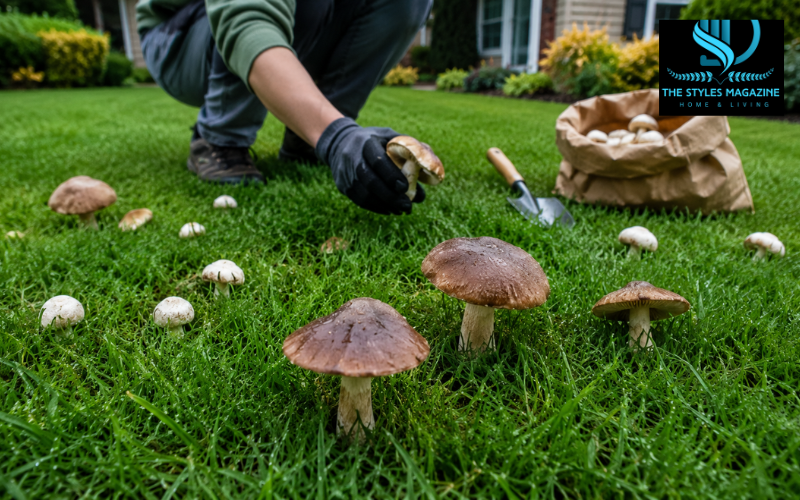
Wear garden gloves and collect mushrooms as soon as you notice them, particularly before children or pets enter the yard. Grip each one near the base and pull or dig it out without scattering pieces. For soft clusters, use a small trowel so the cap and stem can be lifted together.
Place unknown mushrooms in a sealed bag and put them in household waste. Avoid adding them to an open compost pile when accidental contact, pet access, or redistribution around the garden is a concern. Wash your hands after handling them, even if gloves were used.
For a widespread outbreak, mowing with a grass-collection box can remove many caps quickly. Collect and discard the debris instead of leaving broken pieces on the lawn. Mowing or picking improves appearance and reduces immediate exposure, but it does not remove the underground fungus. University extension guidance recommends knocking down or picking mushrooms and removing them from the area.
How to Get Rid of Mushrooms in Lawn
To get rid of mushrooms in lawn grass for more than a few days, focus on the conditions supporting them. First, check the irrigation schedule. Reduce watering when the soil is already moist, repair leaks, and avoid short daily watering unless new turf genuinely requires it. Established grass usually benefits from deeper, less frequent watering suited to the grass type, soil, weather, and local restrictions.
Remove easy sources of decay by raking leaves, twigs, heavy clippings, and loose dead material. If mushrooms return over a buried stump or root system, grinding out the wood may reduce the food source, although removing every old root is rarely practical.
Correct places where water pools. Small surface dips may be levelled, while larger drainage problems may require grading, a drain, or professional assessment. Aerating compacted ground helps water enter the soil rather than sitting at the surface. Remember that visible mushrooms are only fruiting bodies; removing them does not eliminate mycelium spread through the soil or buried material.
Long-Term Prevention and Lawn Care
Good lawn care makes repeated mushroom growth less likely without trying to remove all fungi from the soil. Water early in the morning so grass blades can dry during the day. Apply enough water to reach the root zone, then allow the surface to dry before the next irrigation. Avoid watering simply because a fixed daily timer is running.
Core-aerate compacted areas when appropriate for the grass and local growing season. Aeration creates openings that improve water movement and reduce surface saturation. Dethatch only when the layer is excessive; a small amount of thatch is normal, while a dense layer can hold moisture and undecomposed plant material.
Prune overcrowded shrubs and selected tree branches carefully to increase light and airflow, but do not damage valuable trees simply to remove mushrooms. Keep leaves and rotting debris off the lawn, mow at the recommended height for the grass, and investigate recurring wet areas. These steps address moisture, shade, compaction, and food sources—the main conditions behind nuisance mushrooms.
Treatments That May Not Solve the Problem
Household remedies such as bleach, dish soap, salt, baking soda, or strong vinegar mixtures are often promoted as quick fixes. These products can burn grass, alter soil conditions, harm nearby plants, or create avoidable risks for children and pets. Even when they damage visible caps, they may not reach the underground fungal network.
Fungicides are usually unnecessary for scattered nuisance mushrooms because the mushrooms are not harming the grass and the fungus may be deep in soil or buried wood. University of Maryland Extension guidance states that fungicides will not remove ordinary mushrooms from lawns. Fairy ring is different: where a ring causes dead turf or water-repelling soil, specialist diagnosis and a labelled treatment may sometimes be considered alongside aeration, thatch management, and improved water movement.
Repeated mowing has the same limitation. It removes what can be seen but leaves the cause untouched. Overwatering after treatment may then trigger another outbreak. The most dependable approach is to correct excess moisture, drainage, shade, soil compaction, thick thatch, and decaying debris.
Conclusion: Managing Mushrooms Without Harming the Lawn
Mushrooms in lawn grass usually appear because soil fungi are breaking down organic material under moist conditions. Most are harmless to healthy turf, and a brief outbreak after rain often disappears as the area dries. Persistent growth, however, can point to overwatering, poor drainage, compacted soil, thick thatch, or buried roots and wood.
Remove unknown mushrooms promptly when children or pets use the yard, and never rely on colour or a single picture to decide whether a species is safe. Seek expert identification and contact poison-control or veterinary help immediately if ingestion is possible.
For long-term control, improve the lawn rather than trying to kill every fungus. Better watering habits, core aeration, sensible dethatching, improved light and airflow, debris removal, and drainage repairs can reduce future outbreaks while protecting the grass and the useful soil life below it.
Frequently Asked Questions
Are Mushrooms In Lawn Grass Harmful?
Most lawn mushrooms do not directly harm healthy grass. They usually feed on dead roots, wood, leaves, or thatch. However, some species may be poisonous if eaten by people or animals.
Why Do Mushrooms Appear In My Lawn After Rain?
Rain provides the moisture underground fungi need to produce mushrooms. They may appear suddenly during warm, wet weather and often dry up naturally once the soil surface and surrounding grass become drier.
How Do I Get Rid Of Mushrooms In Lawn Areas?
Wear gloves, pull mushrooms from the base, seal them in a bag, and place them in household waste. For lasting control, reduce excess moisture, improve drainage, aerate compacted soil, and remove decaying debris.
Are Little White Mushrooms In My Lawn Poisonous?
Colour and size cannot confirm whether a mushroom is poisonous. Some harmless and toxic species look similar. Remove unknown white mushrooms from areas used by children or pets and never allow anyone to taste them.
Will Lawn Fungicide Permanently Remove Mushrooms?
Fungicides are usually unnecessary for ordinary lawn mushrooms and may not reach fungi growing deep in soil or buried wood. Correcting overwatering, shade, poor drainage, thick thatch, and organic buildup is more effective.
Enjoyed it? Find more exclusive content on The Styles Magazine.
Disclaimer: This article provides general lawn-care and safety information. Never eat an unidentified wild mushroom. Contact a poison-control service, veterinarian, or mushroom expert immediately if accidental ingestion is suspected.