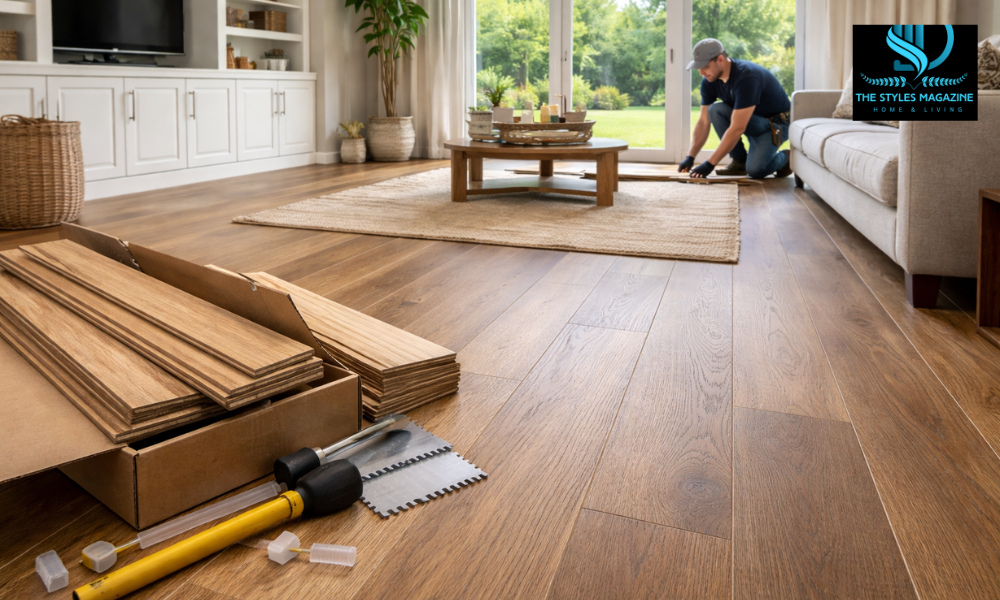
There is a particular sort of photograph that circulates on home accounts and interior design feeds. A newly finished kitchen or living room, shot from the perfect angle, the morning light landing well, the furniture arranged with the confidence of someone who has done this before. The composition is good. The finish is better. And then you notice the thin shadow where the bottom of a cabinet does not quite meet the floor, or the barely-perceptible slope on the parquet that only became obvious when the camera caught it.
The eye forgives most things in a finished room. It does not forgive an uneven floor.
What A Well-designed Room Is Actually Standing On
Interior designers who work on residential projects at any scale will all tell you the same thing, if you ask them off the record. The decision that most often ruins the final look of a room is not the paint colour, not the furniture choice, not the window treatment. It is the one made weeks before any of those choices went in. It is the state of the floor underneath.
Most UK homes, particularly those built before the late nineties, do not have a floor that is flat enough to receive a modern flooring finish without preparation. Concrete slabs dip. Timber subfloors slope between joists. Original screeds crack at the perimeter. The variation is usually only a few millimetres. A few millimetres is more than enough to spoil the appearance of parquet, large-format tile, or wide-plank engineered oak.
Where floor levelling sits in the sequence is after the demolition and before the finish. A polymer-modified compound is poured across the prepared substrate and finds its own level. Within a day, in most cases, the floor is uniformly flat and ready to receive whatever is going on top of it. The step takes half a day. The decision to skip it costs the aesthetic of the project for as long as the floor remains in place.
Why The Eye Notices Even Small Variation
Human visual perception is unforgivingly sensitive to level, in rooms as much as in anything else. The brain uses the room’s horizontal lines, the skirting, the bottom of a cabinet, the plane of a dining table, as reference points for level. When one of those lines is a millimetre or two off true, the brain registers it before the conscious mind does. The impression that something is wrong forms first. The specific reason gets identified afterwards, if at all.
This is why photographs often reveal the problem that was invisible in person. The camera flattens the room into two dimensions. The slope that was within normal tolerance for a standing figure becomes an unmistakable diagonal in the shot. Interior stylists shooting for magazines and brochures will often ask about the substrate before they ask about the lighting. They know what shows up when the shutter closes.
What The Designers Do Differently
The homes you tend to see in the better interior design magazines are not necessarily built from more expensive materials. They are built in the right order. The substrate was corrected before the floor went in. The alignment of the furniture was planned against a floor that was known to be flat. The photograph was shot in a room where every horizontal line genuinely was horizontal.
For a homeowner undertaking a renovation, the practical point is that the floor substrate is the one invisible decision that quietly decides the appearance of every visible one that follows. The budget for it is modest. The cost of skipping it is not.
The Afterlife Of A Well-levelled Floor
A room laid over a properly prepared substrate photographs better from day one. It also ages better. The joints in the parquet stay tight. The tiles do not crack along the slopes that would otherwise have formed. The furniture sits flush. The dishwasher slides in and out without complaint for the next decade.
None of this is visible to a guest walking through the finished room. It is just the quiet reason the room continues to look the way it looked on the first morning. Which is, in the end, what everyone who redesigned a space was hoping for.
Enjoyed it? Find more exclusive content on The Styles Magazine.