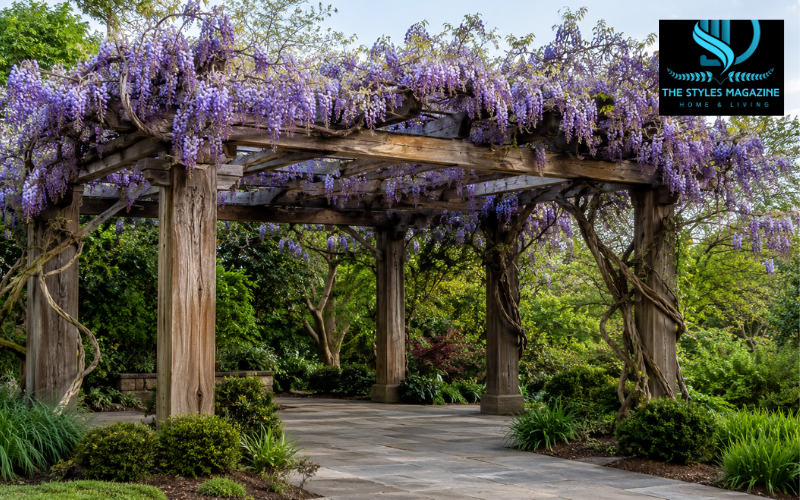
A wisteria trellis is a strong garden structure used to support and guide a wisteria vine as it grows. It may take the form of a wall-mounted wire system, wooden frame, metal arch, arbor, or large pergola. Unlike supports made for light annual climbers, it must carry woody stems, dense leaves, and hanging flowers for many years.
Wisteria is a vigorous climbing plant with stems that twist tightly around nearby supports. Some types can eventually spread well beyond 25 feet, while mature plants grown against walls may cover a much larger area. This makes early planning important. A support that looks suitable for a young plant may bend, rot, or pull away once the vine develops thick, trunk-like stems.
A successful wisteria trellis should be strong, well positioned, easy to inspect, and suitable for regular pruning. The best design will depend on the available space, the style of the garden, the building surface, and whether the plant will grow over a path, patio, wall, or freestanding structure.
Wisteria Trellis Quick Guide
| Trellis Type | Best For | Main Requirement |
| Wooden pergola | Patios and seating areas | Thick posts, strong beams, and weather protection |
| Metal arch | Paths, gates, and entrances | Heavy-gauge, rust-resistant metal |
| Wall-mounted wires | Small gardens and house walls | Strong masonry anchors and spacing from the wall |
| Freestanding arbor | Garden entrances and benches | Secure foundations and reinforced joints |
| Umbrella frame | Decorative garden focal points | Strong central post and balanced overhead frame |
| Fake wisteria trellis | Indoor or temporary displays | Weather-resistant artificial flowers and secure fixing |
Why Wisteria Needs a Heavy-Duty Trellis
A mature wisteria places constant pressure on its support. Its main stems become thick and woody, while new shoots continue to wrap around beams, wires, rails, and posts. Asian wisterias are especially vigorous and can add several feet of growth in a season. Their stems naturally coil tightly around anything they use for support.
This growth habit is why a lightweight decorative panel is rarely enough. Thin plastic lattice, narrow garden wire, weak timber strips, and inexpensive hollow arches may work briefly, but they are not designed for the long-term load of a mature vine. The plant may twist the frame, pull fixings from a wall, or hide damage until the structure begins to fail.
A heavy-duty trellis for wisteria is part of the garden’s permanent structure. It should have solid posts or secure wall anchors, strong joints, weather-resistant materials, and enough open space for pruning.
Warning signs include leaning posts, loose bolts, sagging crossbeams, stretched wires, cracked wood, rusted joints, or gaps developing between a wall and its fixings. These problems should be corrected before allowing more growth to cover the area.
Planning the Location and Size
Wisteria usually flowers best in full sun. A south- or west-facing location is often suitable, although some light shade can be tolerated. Less sunlight may lead to fewer flowers and more leafy growth. The soil should also drain well and leave enough room around the base for watering and maintenance.
Choose a position that can safely contain the plant over time. Keep the main framework away from roof tiles, gutters, downpipes, window frames, vents, utility cables, and weak fencing. Wisteria does not cling directly to walls like ivy, but its searching shoots can enter small spaces and wrap around nearby features.
Think about access before construction begins. You will need to reach the stems for tying, pruning, and structural inspections. A large trellis that cannot be reached safely may become difficult to manage.
For arches and pergolas, allow generous walking clearance beneath the structure. Remember that hanging flowers, leaves, and young shoots will reduce the open space. The final width should also match the mature spread you are prepared to maintain rather than the small size of the vine at planting time.
Best Materials for a Wisteria Trellis
Heavy timber, structural steel, galvanized metal, and stainless-steel cable systems are among the most practical choices. Each can work well when properly designed and installed.
Timber gives pergolas and arbors a warm, traditional appearance. The wood must be suitable for outdoor use and thick enough to remain stable as the vine becomes heavier. Metal is often preferred for narrow arches, modern wall systems, and structures where strength is needed without bulky beams.
Galvanized or powder-coated steel offers good resistance to outdoor weather. Stainless-steel cables can create a clean wall-mounted design, but they must be connected to strong anchors and tensioned correctly. The Royal Horticultural Society recommends 3 mm galvanized steel wires spaced about 30 cm, or one foot, apart when training wisteria horizontally against a suitable wall.
Avoid relying on thin plastic mesh, lightweight bamboo screens, soft garden netting, or small decorative arches. They may guide young shoots temporarily, but they should not be treated as permanent structural support.
Wisteria Trellis Wood Designs
A wisteria trellis wood design suits cottage gardens, traditional homes, patios, and natural landscapes. Durable outdoor timbers such as cedar, redwood, pressure-treated lumber, or other locally suitable structural wood may be used. The best choice depends on climate, availability, treatment method, and local building requirements.
There is no single post or beam size that is safe for every project. The correct proportions depend on the span, structure height, soil, wind exposure, frost conditions, and the expected mature load. Long spans need heavier beams or additional posts to prevent sagging. Large overhead structures should be designed by an experienced builder or structural professional rather than copied from a light decorative pergola.
Use exterior-rated bolts, brackets, screws, and post bases. Small nails and basic fence staples are not suitable for primary joints. Keeping wooden posts above standing water and separating them from damp soil can also reduce decay.
Apply a suitable exterior finish to exposed timber and inspect it regularly. Wisteria can hide moisture damage, loose hardware, and insect activity, so the wood should remain visible enough for routine checks.
Heavy-Duty Freestanding Pergolas and Arbors
A pergola is one of the most attractive ways to display wisteria because the flower clusters can hang naturally from the overhead framework. It can also provide seasonal shade above a patio, walkway, or seating area. Wisterias with long flower clusters are especially effective on open structures where the flowers can hang without being trapped among dense branches.
A freestanding pergola needs firmly installed posts, reinforced beams, secure joints, and foundations suitable for the site. The footings must account for local soil, frost depth, wind, and building rules. Adding a mature vine increases the load and may also increase wind resistance when the plant is covered in leaves.
An arbor is usually smaller and works well at a gate, garden entrance, or transition between two areas. For wisteria, it should still be wider and stronger than a standard rose arbor.
Keep the overhead framework reasonably open. Closely packed slats can trap tangled shoots and make pruning difficult. An open design also allows hanging blooms to remain visible from below.
Wisteria Trellis Arch Ideas
A wisteria trellis arch can frame a path, gate, entrance, or garden view. Rounded metal arches create a softer appearance, while square-topped arches suit modern and formal gardens.
For a mature plant, select a broad, heavy-gauge metal frame rather than a narrow tubular arch sold for light flowers. A double arch with connecting rails offers more stability and creates extra room for training the main stems. Several connected arches can form a flowering tunnel, although this design requires more pruning and regular structural inspection.
Position the main stems along the sides and spread selected branches over the top. Do not allow all the growth to collect in the centre, where it can create a heavy, tangled mass.
Plan enough headroom for people to walk comfortably after the plant fills out. Pruning should keep low shoots, flower clusters, and hanging stems away from faces and pathways. The structure should also be wide enough to prevent thick stems from narrowing the entrance over time.
Building a Wisteria Trellis Against a Wall
A wisteria trellis wall system usually uses horizontal wires, strong cables, or a rigid metal framework. The support should sit away from the wall so air can circulate and the gardener can reach behind the stems for tying, pruning, and repairs.
The wall itself must be sound. Brick, stone, and concrete require suitable masonry anchors placed in stable material. Old mortar, damaged render, loose brickwork, thin cladding, or weak decorative panels may not safely hold a mature vine. Seek professional advice when the wall condition or required fixing method is uncertain.
Horizontal wires allow the main branches to be trained in a broad fan or espalier pattern. The RHS recommends placing the plant roughly 30 to 45 cm away from the foot of a wall, helping its roots access rainwater and allowing space for development.
Inspect the upper shoots several times during the growing season. Remove or redirect growth before it reaches gutters, roof spaces, windows, downpipes, or cables. Never depend on gutters or drainpipes as part of the support.
White Wisteria Trellis Styles
A white wisteria trellis creates a bright, clean appearance that works well in cottage, coastal, romantic, and formal gardens. White-painted wood can soften a large pergola, while powder-coated white metal gives an arch or wall frame a lighter visual effect.
Purple and blue-flowering wisteria stand out strongly against a white background. The contrast makes the flowers easier to see, particularly in shaded seating areas. A white-flowering variety on a white structure produces a quieter, coordinated look that suits pale planting schemes.
Appearance should not be more important than durability. Paint cannot make weak timber suitable for wisteria. Use exterior-grade materials, seal cut ends, and repair peeling or cracked finishes before water reaches the wood.
Powder-coated metal should also be checked for scratches, chips, and rust around bolts or welded joints. Touching up damaged areas early can extend the life of the frame. Keep some stems tied in a way that allows access to painted or coated surfaces when maintenance is needed.
Wisteria Trellis Ideas for Different Garden Sizes
Small gardens can still accommodate wisteria when the plant and support are carefully managed. A compact wall-mounted cable system uses little ground space and allows branches to be trained horizontally. A narrow corner frame can also turn an unused section of a courtyard into a flowering feature.
Medium-sized gardens may suit a strong arch over a path or a small arbor with a bench. Keeping the main framework simple helps prevent the vine from dominating the area.
Large gardens have room for broad pergolas, long walkways, and Japanese-inspired overhead trellises. These designs spread the branches across a wide roof-like framework, allowing flowers to hang below. Because mature wisteria can reach considerable height and width, wide structures must be designed for long-term weight rather than immediate appearance.
An umbrella-shaped trellis is another striking option. The vine is trained up one strong central stem before its branches are spread around a circular frame. This creates a tree-like canopy, but the central support must remain strong and stable as the top becomes wider and heavier.
Decorative, Fake, and ACNL-Inspired Trellises
A fake wisteria trellis can be useful where a living vine would be difficult to maintain. Artificial flowers may suit temporary events, indoor displays, rental properties, covered patios, or deeply shaded spaces. They provide an immediate decorative effect without pruning, watering, falling leaves, or structural pressure from growing woody stems.
However, artificial wisteria should be attached to a frame suitable for its location. Outdoor products must be weather-resistant and securely fixed so that wind cannot pull them loose. A fake display should never be confused with a support strong enough for a real wisteria plant.
The related search phrase “wisteria trellis ACNL” refers to Animal Crossing: New Leaf. In that game, the wisteria trellis is a decorative Public Works Project suggested by big sister villagers. Its broad, sheltered shape can inspire real garden seating areas, but an actual structure must be engineered for weather, people, and the weight of a mature plant.
Game-inspired features may include a square canopy, hanging purple flowers, a bench beneath the frame, and a calm Japanese garden setting.
Training Wisteria Across the Trellis
Training begins while the vine is young and flexible. Select one or more healthy main stems to form the permanent framework. Guide them toward the main post, wire, beam, or side of the arch, then spread suitable side branches into the available space.
Use soft but strong adjustable ties. Avoid bare wire or thin metal ties because they can cut into stems as they thicken, creating weak or damaged areas. A figure-eight tie can hold a heavier stem while keeping a small buffer between the plant and its support.
Check ties at least once or twice during active growth. Loosen, replace, or remove any tie that is becoming tight. Once a branch has become strong and correctly positioned, some temporary ties may no longer be needed.
Do not let major stems coil around thin rails, downpipes, cables, or delicate decorative pieces. Redirect young shoots before they harden. Spreading the framework evenly also prevents too much weight from building up on one side of the trellis.
Pruning, Inspection, and Long-Term Maintenance
Regular pruning controls the size of wisteria, keeps paths and buildings clear, and helps develop short flowering spurs. A common method is to prune twice each year. Summer pruning shortens long, whippy growth after the main flowering period. Winter pruning then reduces those shoots further, usually to two or three buds from older wood.
The exact timing can vary with climate and the plant’s growth cycle, so observe local conditions. Avoid removing the main structural branches unless they are damaged, badly placed, or being replaced.
During pruning, inspect bolts, brackets, cables, anchors, posts, joints, and foundations. Look for movement, rust, rot, cracks, sagging, or stems that have become tightly wrapped around vulnerable parts. Repair structural problems before new growth covers them again.
Common mistakes include building too small, using weak decorative materials, planting beneath gutters, allowing several stems to twist into one heavy rope, using metal ties directly around stems, and waiting too long to prune. Regular attention is much easier than repairing an overgrown vine or replacing a failed support.
Conclusion: Creating a Wisteria Trellis That Improves With Age
A successful wisteria trellis combines strength, suitable materials, thoughtful placement, and regular care. Whether the design is a wooden pergola, metal arch, white garden arbor, wall-mounted cable system, or umbrella-shaped frame, it should be planned around the size and weight of a mature vine.
The most important decision is to build for the future. A young wisteria may look light and easy to control, but its stems can eventually become thick, powerful, and widely spread. Strong foundations, secure fixings, open access, and routine pruning will help the structure remain safe and attractive.
When the support is installed correctly and the vine is trained from the beginning, the result can become more beautiful each year. A well-planned wisteria trellis does more than hold a climber—it creates a lasting garden feature filled with seasonal shade, structure, and hanging flowers.
FAQs About Wisteria Trellises
How Strong Should A Wisteria Trellis Be?
A wisteria trellis should be strong enough to support thick woody stems, dense leaves, and flowers. Heavy timber, structural steel, or firmly anchored metal cables are usually more suitable than lightweight decorative supports.
Can Wisteria Grow On A Wooden Trellis?
Yes, wisteria can grow successfully on a wooden trellis, provided the timber is thick, weather-resistant, and securely joined. The structure should be checked regularly for rot, loose bolts, and bending beams.
Can I Train Wisteria Against A Wall?
Wisteria can be trained against a strong wall using tensioned wires or metal cables. Leave space between the plant and wall, and prevent shoots from reaching gutters, roof tiles, windows, or pipes.
How Often Should Wisteria Be Pruned?
Wisteria is commonly pruned twice a year. Long shoots are shortened during summer, while a second pruning in winter reduces side growth further and helps maintain a neat flowering framework.
Will Wisteria Damage A Weak Trellis?
Yes. Mature wisteria stems can twist, bend, and pull apart weak supports. Thin plastic, lightweight wire, bamboo screens, and small decorative arches may fail as the vine becomes older and heavier.
Enjoyed it? Find more exclusive content on The Styles Magazine.
Disclaimer: This article provides general gardening information. Trellis size, foundations, fixings, and material requirements may vary by location, soil, weather, and building conditions. Consult a qualified professional for large or wall-mounted structures.