When setting up a bedroom, many people focus on the bed, mattress, or décor—but one small detail often gets overlooked: the standard nightstand height. While it may seem like a minor choice, the height of your nightstand plays a big role in your daily comfort and overall bedroom design.
In simple terms, standard nightstand height refers to the typical height range that works well beside most beds. You’ll usually see measurements discussed in inches, centimeters (cm), feet, or even millimeters (mm), depending on your preference or location. Most commonly, nightstands fall within a general height range that suits average bed heights.
However, here’s the key point many people miss: the “standard” size is not a strict rule. The best nightstand height is the one that aligns closely with the top of your mattress. When your nightstand is at the right level, it becomes easy to reach essentials like your phone, water, or lamp without any effort.
So, instead of blindly following a fixed number, it’s important to understand how standard measurements work and how to adjust them based on your specific bed setup.
Standard Nightstand Height by Bed Type
| Bed Type | Bed Height (Approx.) | Ideal Nightstand Height |
| Platform Bed | 18–24 inches | 18–22 inches |
| Standard Bed | ~25 inches | 24–28 inches |
| Tall/High Bed | 30+ inches | 28–32 inches |
What Is the Standard Nightstand Height?
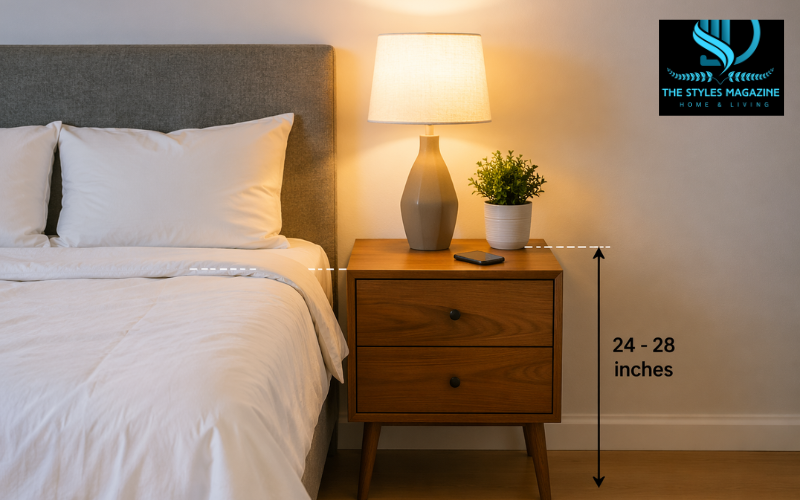
The standard nightstand height typically ranges between 24 and 28 inches. This range works well for most traditional beds and is widely used by furniture manufacturers.
If you prefer other units, this standard height can be understood in different ways. In feet, it usually falls between 2 and 2.3 feet. In centimeters, the standard height of a bedside table is around 61 to 71 cm. For those who prefer precise measurements, this translates to approximately 610 to 710 mm in millimeters.
These variations may sound technical, but they all point to the same idea: a mid-range height that aligns with average mattress levels.
The reason 24–28 inches is considered standard is simple. Most beds, including mattresses and frames, are designed within a certain height range. Furniture designers match nightstands to these average dimensions so that users can comfortably access items without bending too much or reaching too high.
That said, this range should always be treated as a guideline rather than a strict rule. Your personal comfort and your bed’s height should always take priority over any standard measurement.
Why Nightstand Height Should Match Your Mattress Level
The most important rule when choosing a nightstand is not the number—it’s the alignment with your mattress.
Ideally, your nightstand should sit level with the top of your mattress or be slightly higher by about one to two inches. This small difference makes a big impact on how comfortable and practical your setup feels.
When your nightstand is properly aligned, you can easily reach for items without stretching or adjusting your position. Whether you’re turning off a lamp, grabbing your phone, or placing a glass of water, everything feels natural and effortless.
On the other hand, if the nightstand is too low, you’ll find yourself bending down every time you need something. If it’s too high, it can feel awkward and even disrupt the visual balance of your bedroom.
Matching your nightstand height to your mattress ensures a smoother daily routine and creates a more polished and functional space.
Choosing the Right Nightstand Height by Bed Type
Not all beds are the same, which means the ideal nightstand height can vary depending on the type of bed you have.
Platform beds are usually lower to the ground, often ranging between 18 and 24 inches in total height. For these beds, a shorter nightstand works best, typically between 18 and 22 inches. If you’re wondering how tall a nightstand should be for a platform bed, the answer is simple: keep it close to the mattress level without going too high.
Standard beds are more common and usually sit around 25 inches from the floor to the top of the mattress. These beds pair well with the typical standard nightstand height of 24 to 28 inches.
Tall or high-profile beds, especially those with thick mattresses or box springs, can exceed 30 inches in height. In this case, a taller nightstand between 28 and 32 inches is a better fit. This keeps everything within easy reach and maintains visual balance.
Each bed type has its own proportions, so the key is to adjust your nightstand height accordingly instead of relying on a one-size-fits-all approach.
Standard Nightstand Dimensions Beyond Height
While height is the most important factor, it’s not the only one to consider. The overall size of your nightstand also affects how functional and visually appealing your bedroom feels.
The average width of a nightstand usually falls between 18 and 28 inches. This provides enough space for essentials like a lamp, books, or a phone without taking up too much room. In feet, nightstand dimensions typically range from about 1.5 to 2.3 feet wide.
Depth is another important factor, often ranging between 12 and 18 inches. A deeper nightstand offers more storage but can feel bulky in smaller rooms.
When choosing dimensions, it’s important to maintain balance with your bed. A very small nightstand next to a large bed can look out of place, while an oversized one can overwhelm the space.
The goal is to create a setup that feels both practical and visually balanced, where everything fits naturally within the room.
Practical Tips to Find the Perfect Nightstand Height
Finding the right nightstand height doesn’t have to be complicated. A few simple checks can help you make the right choice.
One of the easiest methods is the reach test. Sit on the edge of your bed and extend your hand toward where the nightstand will be. Your hand should naturally land on the surface without needing to reach up or down too much.
Lighting is another important factor. If you use a bedside lamp, the bottom of the lampshade should be around your eye level when you’re sitting in bed. This prevents glare and makes reading more comfortable.
You should also think about storage and surface space. If you need space for books, devices, or personal items, make sure the nightstand provides enough room without feeling crowded.
Avoid choosing a nightstand based only on style. While appearance matters, comfort and usability should always come first.
Design Balance and Bedroom Proportions
A well-designed bedroom is all about balance, and your nightstand plays a key role in achieving it.
The height of your nightstand should complement your bed, not compete with it. When both pieces are aligned properly, the room feels more organized and visually pleasing.
Width also matters. A good rule of thumb is that the nightstand should be about one-third the width of your bed. This helps maintain proportion and prevents the setup from looking uneven.
When everything is in balance, your bedroom feels more comfortable and inviting. Even small adjustments in height or size can make a noticeable difference in how the space looks and functions.
Feng Shui Perspective on Nightstand Height
For those who follow Feng Shui principles, nightstand height is more than just a design choice—it’s about creating harmony and balance in the bedroom.
According to Feng Shui, the bedside table should ideally be level with the mattress or slightly lower. This is believed to support better energy flow and create a calming environment.
Some practitioners suggest avoiding a nightstand that is significantly higher than the bed, as it can feel overwhelming and disrupt the balance of the space.
Symmetry is also important. Using matching nightstands on both sides of the bed is often recommended to create a sense of stability and harmony.
While Feng Shui is based on personal beliefs, many of its guidelines align with practical design principles, making them useful even for those who are not strictly following the practice.
Common Mistakes to Avoid When Choosing Nightstand Height
One of the most common mistakes people make is choosing a nightstand without measuring their mattress height. This often leads to mismatched furniture that feels uncomfortable to use.
Another mistake is ignoring the type of bed. A nightstand that works well with a standard bed may not be suitable for a platform or high-profile bed.
Focusing only on style is another issue. While a nightstand may look great in a showroom, it might not function well in your space if the height is not right.
Lighting is often overlooked as well. A poorly positioned lamp can cause glare or make it difficult to read comfortably.
Avoiding these mistakes can save you time, money, and frustration, while helping you create a more practical and comfortable bedroom setup.
Conclusion
Choosing the right standard nightstand height is less about following a fixed number and more about finding what works best for your specific bed and lifestyle.
While the typical range of 24 to 28 inches provides a helpful starting point, the most important factor is alignment with your mattress. A nightstand that sits level or slightly higher ensures easy access, better comfort, and a more polished look.
By considering your bed type, room proportions, and daily needs, you can select a nightstand that feels natural and functional. In the end, the perfect height is the one that fits seamlessly into your routine while enhancing both comfort and style.
FAQs
What Is The Standard Nightstand Height In Inches?
The standard nightstand height is typically between 24 and 28 inches. However, the best height is one that matches your mattress level for easy access and better comfort.
How Tall Should A Nightstand Be Compared To The Bed?
A nightstand should be level with your mattress or slightly higher by 1–2 inches. This makes it easier to reach items without stretching or bending.
What Is The Standard Height Of A Bedside Table In Cm?
The standard height of a bedside table is around 61 to 71 cm. This range works well for most standard beds but should still match your mattress height.
Can A Nightstand Be Higher Than The Bed?
Yes, a nightstand can be slightly higher than the bed, usually by 1–2 inches. However, too much height difference may feel uncomfortable and affect the room’s balance.
What Size Nightstand Is Best For A Platform Bed?
For platform beds, which are lower, a nightstand between 18 and 22 inches is ideal. It should align closely with the mattress for proper usability.
Enjoyed it? Find more exclusive content on The Styles Magazine.
Disclaimer: This article is for general informational purposes only. Measurements and recommendations may vary based on personal preference, furniture design, and room layout. Always measure your bed and space before making final decisions.