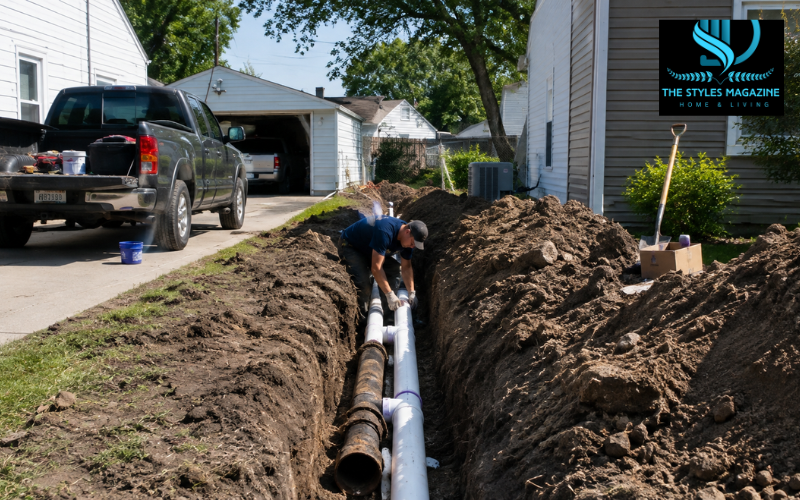
To replace a sewer line means removing, breaking apart, or lining the damaged pipe that carries wastewater away from a home. This pipe usually runs underground from the house to a public sewer main near the street. Homes that are not connected to a public system may instead have a line leading to a septic tank.
A replacement may be needed when the pipe has collapsed, shifted, developed severe corrosion, or suffered repeated root damage. In some cases, only one short section needs attention. In others, the safest long-term choice is to replace the full run.
The cost to replace a sewer line can range from a few thousand dollars to $25,000 or more. Current consumer cost estimates commonly place new sewer pipe work around $50 to $250 per linear foot, with about $150 per foot used as a broad average. The final price depends on the pipe’s length, depth, location, condition, and installation method. Most straightforward residential projects take about one to five working days, although permits, road work, weather, and difficult access can extend the schedule.
Quick Guide Table
| Method | Best For | Digging Required | Main Limitation |
| Traditional excavation | Collapsed, badly misaligned, or bellied pipes | Extensive | Can damage lawns, driveways, and landscaping |
| Pipe bursting | Severely damaged pipes with a usable route | Small access pits | May not suit sharp bends or poor alignment |
| CIPP lining | Cracks, corrosion, and leaking joints | Minimal | Cannot correct major slope or alignment problems |
| Repair sleeve | One small, isolated damaged section | Usually minimal | Not suitable for widespread pipe failure |
Basic Sewer Line Replacement Steps
- Inspect the pipe with a sewer camera.
- Locate underground utilities and obtain permits.
- Choose excavation, pipe bursting, lining, or a spot repair.
- Install or repair the sewer pipe.
- Test the line and complete the required inspection.
- Backfill the area and restore damaged surfaces.
Signs Your Main Sewer Line May Need Replacement
One slow sink is usually a local drain problem. However, several slow drains or backups happening at the same time may point to a blockage or failure in the main sewer line. Toilets may bubble when another fixture drains, and water may return through a shower or floor drain.
Other warning signs include sewage smells inside or outside the home, soft ground over the pipe route, unexplained wet patches, small sinkholes, or an area of grass that suddenly grows faster than the surrounding lawn. These signs do not prove that the pipe needs full replacement, but they justify a professional inspection.
A sewer camera is one of the most useful diagnostic tools. It can reveal cracks, separated joints, heavy corrosion, roots, standing water, and collapsed sections. The contractor should clean the line when needed and provide the video or a written report, not just a verbal recommendation.
Sewer Line Repair or Full Replacement
Not every sewer problem requires a complete replacement. A normal clog may be cleared by cabling or high-pressure cleaning. A small crack, leaking joint, or limited root opening may be suitable for a spot repair, sectional liner, or sleeve. Some local sewer programs even require cleaning before they consider a line structurally damaged because blockages can imitate replacement-level symptoms.
Full replacement becomes more reasonable when the pipe has collapsed, lost its correct slope, separated in several places, or deteriorated throughout most of its length. Old clay, cast iron, and Orangeburg pipes may have several defects rather than one isolated failure.
Age alone should not decide the job. The camera findings, pipe material, alignment, soil movement, repair history, and expected remaining life matter more. Repeated emergency visits and temporary repairs can eventually cost more than one properly planned replacement, especially when backups cause damage inside the home.
Replace Sewer Line Price and Typical Cost Range
A broad replace sewer line price is about $3,000 to $25,000, but simple short runs may cost less and deep or street-level projects can cost more. Current 2026 estimates commonly show a range of roughly $50 to $250 per linear foot, including labor and materials, with location creating major differences.
Traditional excavation may appear cheaper when the pipe is shallow and runs beneath open soil. However, the estimate may not include replacing grass, fencing, concrete, pavers, or a driveway. Trenchless work often carries higher equipment costs but may lower the total bill by reducing surface restoration.
Homeowners should also budget for camera inspection, drain cleaning, permits, utility marking, traffic control, cleanout installation, testing, inspections, hauling, and landscaping or pavement repair. Ask whether the quote covers the entire connection from the house to the legal tie-in point. A low estimate can become expensive if important work is listed as an extra.
Factors That Affect the Cost to Replace a Sewer Line
Length is only one part of the price. A deep pipe requires more digging, shoring, labor, and safety planning than a shallow pipe. A larger pipe may also cost more to replace. Access matters because equipment may need to pass through a narrow side yard or work around buildings and fences.
Soil can change the job as well. Loose soil may need extra support, while hard clay or rock slows excavation. Roots, buried utilities, groundwater, and old foundations can add time. Work beneath a driveway, patio, retaining wall, mature tree, or public road usually costs more than work through an open lawn.
Local labor rates, permit fees, disposal charges, equipment needs, inspection rules, and restoration standards all affect the final figure. For this reason, online averages are useful for early planning but should never replace a written site-specific estimate.
Traditional Sewer Line Replacement
Traditional replacement uses an open trench to expose the old pipe. The contractor removes damaged material, prepares a stable bed, installs the new pipe at the required slope, connects it, tests it, and backfills the trench after approval.
Open excavation is often the best option when the line is badly bellied, crushed, badly misaligned, or surrounded by conditions that prevent trenchless equipment from working safely. It also gives the installer a direct view of the soil and pipe, making it easier to correct bedding or slope problems.
The main advantage is flexibility. Almost every part of the line can be accessed and rebuilt. The main disadvantage is disruption. Lawns, plants, patios, walks, and driveways may need removal and later restoration. Homeowners should confirm exactly which surfaces the contractor will restore and what “restoration” means in the contract.
Sewer Line Repair Without Digging
Sewer line repair without digging usually refers to trenchless methods that use small access points instead of one long open trench. The two most common options are pipe bursting and cured-in-place pipe lining.
During pipe bursting, a bursting head is pulled through the old pipe. It splits or breaks the existing pipe outward while pulling a new pipe into the same path. NASSCO describes pipe bursting as a replacement method that can also increase pipe size and is useful when the existing pipe is too damaged for lining.
Cured-in-place pipe, often called CIPP, places a resin-saturated tube inside the existing pipe and cures it into a new inner pipe. It can be used for full-length rehabilitation or sectional repair. The original route must still be suitable, and major alignment or slope problems may remain. NASSCO and municipal guidance describe CIPP as a method that uses the old pipe as the host for the new liner.
Trenchless work may be limited by collapsed sections, severe bellies, tight bends, nearby utilities, access problems, or local rules. “Trenchless” also does not always mean “no digging”; entry and exit pits may still be necessary.
Sewer Pipe Repair Sleeve and Localized Solutions
A sewer pipe repair sleeve is a short liner or mechanical repair placed over a limited damaged area inside the pipe. It may seal a crack, leaking joint, small hole, or root entry point without replacing the full sewer lateral.
This option is most useful when the rest of the pipe is in good condition and the defect has clear boundaries. The line must be cleaned and measured carefully so the repair covers the entire damaged section. NASSCO notes that CIPP technology can be used for spot or sectional repairs as well as longer lining projects.
A sleeve can reduce digging, cost, and project time, but it does not correct every problem. It cannot restore a badly shifted pipe route, remove a deep belly, or solve widespread deterioration. Before accepting a spot repair, ask the contractor to explain why the surrounding pipe is expected to remain reliable.
Choosing the Right Sewer Line Replacement Method
The right method starts with the defect, not with the sales pitch. Open excavation is often better for severe collapse, major slope failure, or a line that must be rerouted. Pipe bursting is useful when the old route is workable but the pipe itself is badly deteriorated. CIPP lining may suit cracks, corrosion, leaking joints, or other defects when the pipe still provides a usable path.
Price should be compared with expected service life, surface damage, warranty terms, and future access. A cheaper repair is not a saving if it leaves the main cause untouched. On the other hand, full replacement is unnecessary when one small section can be repaired properly.
After viewing the camera recording, ask where each defect is located, whether standing water indicates a belly, whether the pipe is fully collapsed, and whether the recommended method corrects the cause. Also ask what pipe or liner system will be used, how it will be tested, and what the warranty excludes.
Do I Need a Permit to Replace My Sewer Line?
In many places, the answer is yes. Sewer replacement affects sanitation, drainage, and the connection to a public system, so local authorities commonly require plumbing or sewer permits. Work in a street, sidewalk, easement, or public right-of-way may need an additional excavation permit. For example, Mountain View requires permits for sewer lateral repair or replacement and separates private-property building permits from public right-of-way excavation permits.
Permit rules are local, so homeowners should contact the city, county, sewer district, or building department before signing a contract. The authority may also require a licensed contractor, approved materials, testing, and an inspection before the trench is closed.
The homeowner is often responsible for the private lateral, but the legal boundary varies. It may end at the property line, cleanout, curb, or public main. Never assume the city will pay for the section near the street.
Step-by-Step Sewer Line Replacement Process
The process usually begins with cleaning and a camera inspection. The contractor should locate the damaged section, measure the line, identify the connection point, and explain the findings in writing. The chosen method should follow the actual condition of the pipe.
Next come permits and utility locating. In the United States, 811 should be contacted before excavation so participating utilities can mark buried lines. Required notice periods vary by state, so this step should be arranged early.
The crew then digs an open trench or creates access pits for trenchless equipment. The old pipe is removed, broken outward, or used as a host for a liner. New pipe must be connected securely and set at the correct grade so wastewater flows without standing in low areas.
Testing and inspection normally happen before final backfilling. Some local authorities require an underground inspection while the pipe remains visible and a final inspection after the site is restored. The crew then places suitable material around the pipe, fills the excavation in controlled layers, and restores agreed surfaces.
How Long Sewer Line Replacement Takes
Many residential sewer replacements take about one to five working days once permits, markings, materials, and equipment are ready. A short trenchless installation may be completed in a day, while open excavation across a long or difficult route can take several days.
The total calendar time can be longer than the time spent digging. Permit review, utility marking, inspections, special-order materials, traffic control, rain, frozen ground, groundwater, rock, or street work may create delays. A failed inspection can also stop backfilling until a correction is made.
Ask the contractor for both the expected working time and the full schedule from permit application to final restoration. Confirm whether plumbing fixtures can be used during the work. The sewer may be unavailable for part of the day, so the household should receive clear instructions before the line is disconnected.
Cheapest Way to Replace a Sewer Line Safely
The cheapest way to replace a sewer line is not always the estimate with the smallest number. Start by getting at least two or three written proposals based on the same camera findings. A public sewer district homeowner guide notes that bids for similar work can vary widely and advises owners to compare more than one contractor.
Ask each company to separate pipe work, permits, access, hauling, inspection, and restoration costs. Trenchless replacement may save money where a driveway, garden, or finished patio would otherwise be destroyed. Open trench work may be less expensive in a clear lawn with easy access.
A targeted sleeve or spot repair may be the best value when damage is truly isolated. Avoid a temporary patch if the full line is failing. Compare pipe materials, warranty coverage, exclusions, payment terms, inspection responsibility, and the cost of restoring the property. The lowest safe total cost is the option that solves the real problem and reduces the chance of paying twice.
Finding a Reliable Sewer Line Contractor Near You
A search for “replace sewer line near me” or “residential sewer line repair near me” can produce many results, but rankings and advertisements do not prove quality. Check whether the company holds the license required in your area, carries liability insurance, and has direct experience with the recommended method.
Ask for recent local references and examples of similar jobs. A reliable contractor should be willing to show the camera video, identify the damaged footage, discuss more than one workable method, and explain why one option is preferred. Pressure to approve immediate full replacement without clear evidence is a warning sign.
The written estimate should name the pipe or liner material, length, diameter, access points, permits, inspections, restoration work, warranty, payment schedule, and exclusions. Confirm who handles utility marking and public-right-of-way work. Compare the complete scope rather than choosing by headline price alone.
Conclusion: Planning a Sewer Line Replacement With Confidence
Before you replace a sewer line, confirm the problem with a clear inspection and understand whether the damage is isolated or widespread. Cleaning, a repair sleeve, or lining may solve some defects, while collapse, major movement, and poor slope may require pipe bursting or open excavation.
Compare the full cost of each method, including permits, inspections, access, and property restoration. Check local rules, use qualified professionals, and make sure the new pipe or liner is tested before the work is covered.
A sewer replacement is a major home project, but careful diagnosis and a detailed contract can prevent many costly mistakes. The best plan is the one that corrects the actual cause, meets local requirements, and provides a durable route for wastewater for years to come.
Frequently Asked Questions
How Much Does It Cost To Replace A Sewer Line?
Sewer line replacement commonly costs between $3,000 and $25,000. The final price depends on pipe length, depth, access, replacement method, local labor, permits, and surface restoration.
How Long Does Sewer Line Replacement Take?
Most residential sewer line replacements take one to five working days. Complex excavation, permit delays, road work, bad weather, or difficult underground conditions may extend the project.
Can A Sewer Line Be Repaired Without Digging?
Yes. Pipe bursting, CIPP lining, and sectional repair sleeves can reduce digging. However, trenchless repair may not work for collapsed, badly bellied, or severely misaligned sewer pipes.
Do I Need A Permit To Replace My Sewer Line?
Most local authorities require a plumbing or sewer permit. Work near a road, sidewalk, easement, or public sewer connection may also require inspections and additional excavation permits.
Is Repairing A Sewer Line Cheaper Than Replacing It?
A localized repair is usually cheaper when damage affects only one section. Full replacement may provide better value when the pipe has several defects, repeated backups, or widespread deterioration.
Enjoyed it? Find more exclusive content on The Styles Magazine.
Disclaimer: Sewer line costs, permit rules, and repair options vary by location and property conditions. Always obtain a professional camera inspection and confirm local requirements before beginning work.