An air-conditioning filter captures dust, pollen, pet hair and other airborne particles before they enter the indoor part of your cooling system. It helps protect the equipment and can reduce the amount of dust that is circulated around your home. As the filter collects dirt, however, it gradually becomes harder for air to pass through it.
Learning how to replace an AC air filter is usually simple, but the method depends on the type of cooling system in your home. A central HVAC system may have a disposable filter near the air handler or behind a return-air grille. Wall-mounted and window air conditioners often use washable mesh filters instead.
Using the correct size is essential because gaps can allow unfiltered air to pass around the filter. Direction matters as well: a disposable filter must face the way air moves through the system. This guide explains how to identify, locate and replace filters in central HVAC systems, ceiling returns, wall units and window air conditioners.
Quick-Answer Definition:
To replace an AC air filter, switch off the system, remove the old filter, match its size, and install the new one with its airflow arrow pointing toward the blower or air handler.
Quick Guide Table
| AC system or filter location | Typical filter type | Basic action | Important point |
| Central HVAC or furnace | Disposable fibreglass or pleated filter | Replace with an approved matching filter | Point the arrow toward the blower or air handler |
| Ceiling return grille | Usually disposable | Open the grille and replace the filter | Use a stable step stool and support the grille |
| Wall return grille | Usually disposable | Remove and replace the fitted filter | Point the arrow away from the room and into the duct |
| Ductless wall unit | Usually washable mesh | Remove, clean and dry the filter | Follow the model’s cleaning instructions |
| Window AC unit | Usually washable mesh | Vacuum or wash as permitted | Reinstall only when completely dry |
Steps to Replace an AC Air Filter
- Turn off the AC or HVAC system and wait for the fan to stop.
- Open the filter cabinet, slot or return-air grille.
- Note the old filter’s size and airflow-arrow direction.
- Remove the dirty filter carefully without shaking it.
- Clean accessible dust from the filter holder.
- Insert the correct replacement with its arrow pointing toward the blower.
- Close the cover securely and turn the system back on.
Why Replacing an AC Air Filter Matters
A clean filter allows air to move through the system more easily. When a filter becomes heavily clogged, the indoor fan must work against greater resistance. This may reduce airflow, make cooling less effective and place avoidable strain on compatible HVAC equipment. In some systems, restricted airflow can contribute to an evaporator coil freezing or the unit shutting down.
Replacing the filter also prevents accumulated dust from remaining in the airflow path. A standard HVAC filter is mainly intended to protect the equipment, although filters with suitable particle-capture ratings may also help reduce some airborne particles when they fit correctly and the system is running.
The effect on air quality and energy use varies from one home to another. Filter type, system design, duct condition, indoor pollution sources and how often the AC operates can all affect the result. A fresh filter will not solve every cooling or air-quality problem, but timely replacement is an important part of routine maintenance.
Identify Which Air Filter You Need to Replace
Before buying anything, determine which kind of filter your system uses. A central air conditioner normally shares its indoor fan, ducts and filter with the heating system. For this reason, the AC filter may be labelled as a furnace, air-handler or HVAC filter.
In some homes, the filter sits in a narrow slot beside the furnace or indoor air handler. In others, it is fitted behind a large return-air grille on a wall or ceiling. A property may have one main filter, several return-grille filters or, less commonly, filters in more than one approved location. Do not add an extra filter unless the system manufacturer or an HVAC professional confirms that the arrangement is suitable.
A ductless wall-mounted air conditioner normally has one or more reusable mesh screens behind its front panel. A through-the-wall or window unit may use a similar washable screen. These filters are handled differently from disposable pleated HVAC filters.
Searches such as “replace air conditioner filter car” or “replace air filter in car” refer to a different job. Cars can have an engine air filter and a cabin air filter, neither of which is the same as a household AC filter. Vehicle filters should be changed according to the vehicle’s manual.
What to Prepare Before Starting
For a central system, have the correct replacement filter ready before removing the old one. If your unit uses a reusable filter, check its manual to confirm whether it can be vacuumed, rinsed or washed. Never wash a disposable filter unless its instructions specifically say that it is reusable.
You may also need a soft cloth, a vacuum cleaner with a brush attachment and a stable step stool for a ceiling return. Gloves can keep dust off your hands, while a suitable protective mask may be helpful when handling a heavily soiled filter. Avoid brushing or shaking collected dust into the room.
Keep the model number or owner’s manual nearby, especially if the filter location is unfamiliar. Switch the equipment off before opening a filter slot or grille. For a plug-in window unit, unplug it. If access requires removing an equipment service panel rather than an ordinary filter cover, stop and follow the manufacturer’s isolation instructions or contact a technician.
Finding the Air Filter in Your Home
Begin by looking near the indoor air handler or furnace. This equipment may be in a utility cupboard, basement, loft, garage or dedicated plant area. Look for a narrow slot in the return duct, a small filter door or a labelled cabinet next to the blower section.
If no filter is visible there, check the larger wall and ceiling grilles. A return-air grille draws room air back toward the equipment and is usually larger than a supply vent that blows cooled air into a room. Some return grilles have latches that allow the front to swing open and reveal a filter.
For a ductless wall unit, the filters are normally behind the lift-up front cover. Window and through-the-wall units commonly place the filter directly behind the indoor-facing grille.
If your home has several large return vents, inspect each one without assuming every grille contains a filter. Consult the system documents if you find filters both at the return grilles and beside the air handler. An unplanned double-filter arrangement can create excessive airflow resistance.
Choosing the Correct Size and Filter Type
The easiest way to identify the required size is to read the numbers printed on the old filter’s frame. A label such as 20 × 20 × 1 usually represents nominal dimensions rather than exact measurements. The filter’s actual dimensions may be slightly smaller so that it can slide into a matching slot. Compare the complete label and, when necessary, measure the filter and slot carefully.
Thickness matters as much as length and width. A one-inch filter should not be replaced with a thicker one unless the cabinet was designed for it. Never bend, crush or force a filter into place.
Disposable fibreglass filters are basic equipment-protection filters. Pleated filters have more surface area and can usually capture a wider range of particles. Washable filters are designed for cleaning and reuse, but only systems made for them should use them.
MERV, or Minimum Efficiency Reporting Value, is a rating used to compare how well central HVAC filters capture particles of certain sizes. A higher number indicates greater particle-capture ability, but it can also affect airflow depending on the filter and system. The best choice is therefore the highest suitable rating approved for your equipment—not automatically the highest rating sold. The US Environmental Protection Agency recommends considering system-fan and filter-slot capability and seeking professional advice when necessary. Its current MERV guidance also stresses following the manufacturer’s replacement instructions.
How to Replace an Air Filter in a Central AC or HVAC System
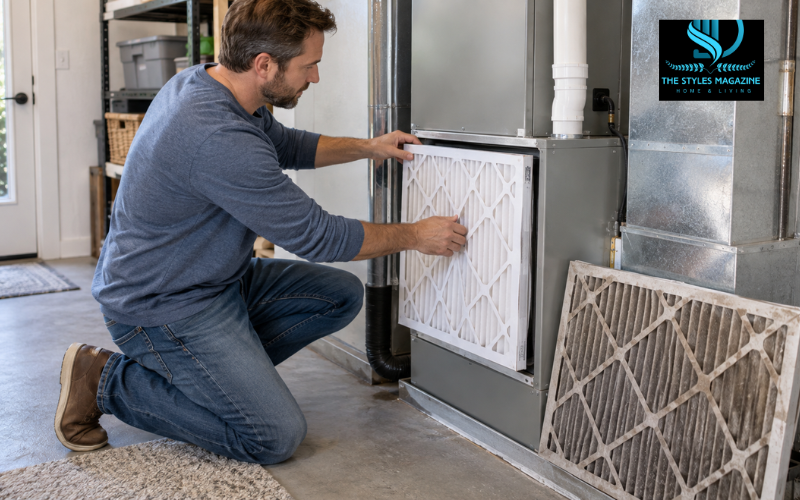
Replacing a central HVAC filter normally takes only a few minutes once you know its location. Use this basic process:
- Set the HVAC system to off at the thermostat and wait for the fan to stop.
- Open the approved filter door, cabinet or return-air grille.
- Before moving the old filter, note its dimensions and the direction of its airflow arrow. Taking a photograph can help.
- Slide the filter out slowly and keep it level so loose dust does not fall into the cabinet or room.
- Use a vacuum or soft cloth to remove accessible dust from the filter holder. Do not reach into the blower area or disturb wires and other components.
- Slide the new filter into the tracks without bending it. The airflow arrow should point toward the furnace, air handler or blower.
- Close and secure the grille or filter door.
- Turn the system back on and listen for normal operation.
This general method applies to many systems, but layouts vary. Carrier and other manufacturers may place filters in different positions depending on the model and installation. Always follow the manual for your particular equipment. Trane’s current homeowner guidance likewise advises switching the system off, matching the size and pointing the arrow toward the furnace or air handler.
How to Change a Home Air Filter in the Ceiling
A ceiling-return filter requires extra care because you must work overhead. Switch off the HVAC system and place a stable step stool on a level surface. Do not stand on furniture, and ask another adult to steady the grille if it is large or heavy.
Release the grille latches while supporting the cover with one hand. Many covers swing downward on hinges. Hold the old filter in place as the grille opens so it does not fall. Remove it slowly and place it directly into a rubbish bag if it is dusty.
Clean accessible dust from the grille and frame without pushing debris into the duct. Fit the replacement flat inside the holder, making sure it is not bowed and that all edges are supported. At a return grille, the arrow normally points away from the room and into the duct toward the air-handling equipment. Confirm this against any label on the grille or the system manual.
Close the grille carefully, secure every latch and then restart the system. If the cover will not close easily, check the filter size rather than forcing it.
Replacing the Filter in a Wall Air Conditioner
First identify whether you are looking at a wall return for a ducted system or a self-contained wall-mounted air conditioner. A return grille leads into ductwork and may hold a disposable filter. A ductless mini-split or through-the-wall unit normally contains reusable screens behind its front cover.
For a wall-mounted appliance, turn it off and disconnect its power if the manual instructs you to do so. Open the front panel using the handles or release points provided. Do not force the cover, as its plastic clips can break.
Slide the mesh filters out gently. Light dust may be removed with a vacuum on a low setting. If the manufacturer permits washing, rinse or wash the screens as directed. Avoid harsh chemicals, stiff brushes and hot water unless the manual specifically approves them.
Let every washable filter dry completely in a shaded, ventilated place before reinstalling it. Operating the unit with a wet or missing filter may cause problems. Some models also contain small deodorising or specialised filters with separate replacement schedules, so check the instructions rather than washing every filter you find.
Changing the Filter in a Window AC Unit
A window air conditioner usually has a reusable mesh filter behind its indoor front grille. Turn the unit off and unplug it before beginning. Open or remove the grille according to the manual, then pull the filter out by its tab or frame.
Vacuum loose dust from the screen. If it is washable, clean it according to the manufacturer’s directions. A mild cleaning method may be permitted, but the manual should decide which products and water temperatures are safe. Do not scrub so hard that the mesh stretches or tears.
Allow the filter to become completely dry before sliding it back into its tracks. Reattach the grille and confirm that it sits securely before reconnecting the power.
A window-unit filter should not be replaced with a cut piece of central HVAC filter unless the manufacturer approves that material. An improvised filter can restrict airflow, shed fibres or interfere with the unit’s fit.
Getting the Airflow Arrow Direction Right
The arrow on the edge of a disposable filter shows the direction in which air should travel through it. It does not point toward the room. In a central system, the arrow normally points toward the blower, furnace or air handler because return air moves from the rooms back to that equipment.
For a filter installed beside the air handler, the arrow points into the unit. At a wall or ceiling return, it usually points into the grille or duct, away from the occupied room. System layouts can differ, so use equipment labels and the owner’s manual when the direction is unclear.
A useful clue is the old filter’s position, provided it was installed correctly. You can photograph it before removal and mark the correct direction on the nearby filter door for future changes.
Installing a filter backward may reduce its stability or performance, depending on its construction. If the new filter has no arrow, check its packaging and instructions. Do not guess based only on the colour or appearance of each side.
How Often an AC Air Filter Should Be Changed
There is no single replacement interval that suits every system and household. The manufacturer’s instructions should be your starting point. Many common one-inch disposable filters are checked monthly and may need replacement within roughly 30 to 90 days, but actual timing depends on use and indoor conditions.
Inspect the filter more often during heavy cooling seasons. Homes with shedding pets, indoor smoke, open windows, renovation dust or high outdoor pollution may soil filters faster. A household concerned about allergies may also choose to inspect its approved filter frequently, although a filter change is not a substitute for medical advice or control of pollution sources.
Thicker media filters can sometimes remain in service longer, but thickness alone does not provide a reliable schedule. System runtime, filter area and particle load all matter. Replace a filter when it is visibly loaded with dust or when the manufacturer’s limit is reached. Do not wait for it to become completely blocked.
Write the installation date on the filter frame and set a phone or calendar reminder. A regular visual check is more dependable than assuming every filter lasts the same number of months.
Common Replacement Problems and When to Call a Professional
If a new filter slides around, leaves gaps or will not enter the slot, recheck all three dimensions. A filter that keeps being pulled out of place may have the wrong size, a damaged holder or a missing retaining clip. Do not secure it with loose materials that could be drawn into the blower.
When no airflow arrow or equipment label is visible, consult the manual using the model number. A technician can confirm the direction if the return and supply arrangement is unclear.
A filter that turns dark unusually quickly may reflect heavy dust, building work, smoke, duct leakage or long system runtime. A new filter that bends inward may indicate an incorrect fit or excessive restriction. These signs deserve investigation rather than a switch to an arbitrary filter.
Call a qualified HVAC professional if weak airflow continues after replacement or if you notice ice, leaking water, a burning smell, unusual sounds or repeated shutdowns. Turn the equipment off if continued operation appears unsafe. Professional help is also appropriate when the filter compartment is inaccessible, damaged or missing, or when opening it would expose electrical or moving parts.
Remember that household instructions do not explain how to replace an air filter in a car. Use the vehicle manual or appropriate automotive guidance for cabin and engine filters.
Conclusion
Knowing how to replace an AC air filter helps you handle one of the simplest parts of routine cooling-system care. The important details are easy to remember: identify the correct filter location, match the complete size, use a filter approved for the equipment and install it in the proper airflow direction.
Check the filter regularly instead of depending on a universal schedule. Disposable central HVAC filters generally need replacement, while many wall and window-unit screens are designed to be cleaned and reused. In every case, follow the instructions for the exact model.
If you cannot identify the filter, are uncertain about its direction or notice equipment problems after changing it, contact a qualified HVAC professional. A careful check is safer than forcing the wrong filter into an unfamiliar system.
Frequently Asked Questions
How Often Should I Replace My AC Air Filter?
Check a common one-inch filter monthly and follow the manufacturer’s schedule. Many require replacement within 30 to 90 days, although pets, smoke, dust and frequent AC use may shorten that period.
Which Direction Should The Ac Filter Arrow Point?
The arrow should normally point in the direction of airflow, toward the furnace, blower or indoor air handler. At a return grille, this usually means pointing away from the room and into the duct.
Can I Wash And Reuse An Ac Air Filter?
Wash a filter only when the manufacturer identifies it as reusable. Most central HVAC filters are disposable, while many window and ductless wall units have washable mesh screens that must dry completely before reinstallation.
What Happens If I Install The Wrong Filter Size?
A filter that is too small may leave gaps that allow unfiltered air through. An oversized or excessively thick filter may not fit properly and should never be bent or forced into the holder.
Is A Car Air Filter The Same As A Home Ac Filter?
No. Cars normally have separate cabin and engine air filters. Their locations, sizes and replacement methods differ from household HVAC filters, so follow the instructions in the vehicle’s owner’s manual.
Enjoyed it? Find more exclusive content on The Styles Magazine.
Disclaimer: This article provides general information about replacing air filters in common home air-conditioning and HVAC systems. Filter locations, sizes, airflow requirements and maintenance procedures vary by manufacturer and model. Always read your equipment manual and use a filter approved for your system. Switch off the equipment before opening an ordinary filter compartment, and never remove electrical or mechanical service panels unless you are qualified to do so. Contact a licensed HVAC professional if the filter is inaccessible, the correct direction is unclear, or the system shows ice, leaks, burning smells, unusual sounds or repeated shutdowns.