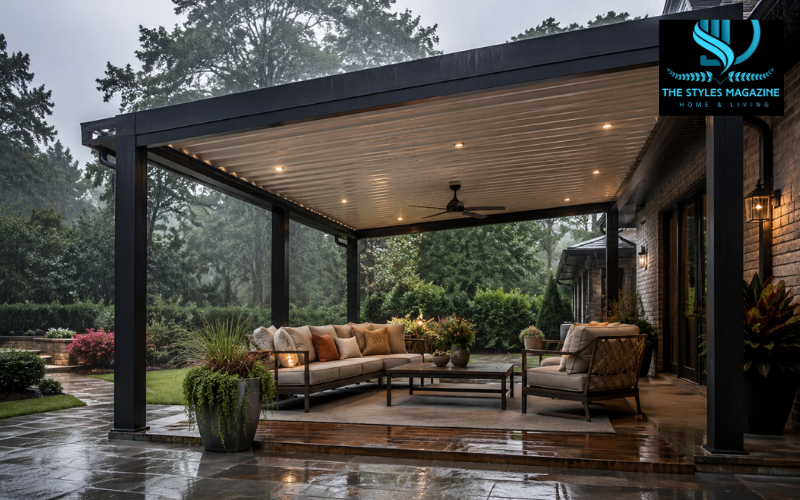
A pergola roof is a covering installed above a pergola’s beams or rafters. A traditional pergola has an open top that creates broken shade rather than full protection. Adding a roof makes the space more practical for dining, relaxing, cooking, and entertaining.
The right covering can reduce direct UV exposure, protect furniture, and make an outdoor area usable through more of the year. It still does not turn a pergola into an indoor room. Performance depends on the material, installation, drainage, and local weather.
Main choices include adjustable louvers, retractable fabric, polycarbonate panels, solid wood or metal coverings, and climbing plants. Each offers a different balance of shade, daylight, protection, appearance, cost, and care. This guide also covers kits, attached designs, installation, drainage, permits, and safety.
Quick Pergola Roof Comparison Guide
| Pergola roof type | Best for | Rain protection | Natural light | Maintenance |
| Louvered roof | Adjustable shade and airflow | High when fully closed | Adjustable | Low to moderate |
| Retractable fabric | Flexible seasonal shade | Low to moderate | Adjustable | Moderate |
| Polycarbonate panels | Rain protection with daylight | High | High | Moderate |
| Wood roof | Traditional appearance and full shade | High with waterproofing | Low | High |
| Metal roof | Long-term weather protection | High | Low | Low |
| Climbing plants | Natural filtered shade | Low | Filtered | High |
Quick Buying Checklist
- Decide whether you need shade, rain protection, natural light, or all three.
- Check whether the existing pergola frame can safely support the roof.
- Choose a material suited to local heat, rain, wind, snow, and coastal air.
- Plan the roof slope, gutters, and downspouts before installation.
- Compare DIY kits with custom or professional installation.
- Check local permits, building rules, and property restrictions.
What a Pergola Roof Can—and Cannot—Do
A partly covered pergola can make harsh sunlight more comfortable while keeping the area bright and open. Fixed slats, shade cloth, or leafy vines are useful when the main goal is filtered shade. They may reduce heat and glare, but gaps still allow rain and low-angle sunlight to enter.
A solid roof, closed louver system, or waterproof membrane can offer stronger rain protection for dining sets, grill areas, and outdoor electronics. Wind-driven rain may still enter from the sides, and electrical equipment must remain suitable for outdoor use.
Roof performance depends on more than the visible material. Pitch, flashing, sealed joints, gutters, downspouts, and connections to the frame all matter. Building guidance also treats patio covers as structures that may need to resist wind, snow, and other loads, so the existing pergola cannot simply be assumed strong enough for a new roof.
A solid roof may reduce indoor daylight or trap warm air. Open louvers and retractable roofs improve ventilation, while clear panels preserve light but may add heat. Roof height, nearby walls, and sun direction should influence the design.
Pergola Roof Ideas and Types at a Glance
The best pergola roof ideas begin with a clear goal. Louvers control sun and airflow, retractable fabric offers flexible shade, polycarbonate preserves daylight, fixed wood or metal creates stronger shelter, and plants provide seasonal beauty with limited weather protection.
| Pergola roof type | Weather protection | Natural light | Maintenance | Expected durability |
| Adjustable aluminum louvers | High when properly closed and drained | Adjustable | Low to moderate | High |
| Retractable fabric canopy | Good for sun; rain protection varies | Adjustable | Moderate | Moderate |
| Polycarbonate panels | High for rain and UV protection | High, depending on tint | Moderate | Moderate to high |
| Solid wood roof | High with a waterproof layer | Low | High | High with regular care |
| Metal or insulated panels | High | Low unless clear sections are added | Low to moderate | High |
| Climbing plants | Low for rain; moderate seasonal shade | Filtered | High | Depends on plant health |
Products within the same group can perform differently. Open-weave shade cloth is not equal to a waterproof membrane, and a basic louver kit may not drain like an engineered system.
Pergola Roof Louvers for Adjustable Shade and Ventilation
Pergola roof louvers are horizontal slats that rotate within the roof frame. A manual system may use a handle or crank, while a motorized version uses a remote, wall switch, app, or connected control.
When fully open, the slats expose the sky. At an angle, they reduce glare while allowing warm air to escape. When closed, interlocking louvers can form a protective roof.
Better systems guide water from closed slats into built-in gutters and channels in the posts. Some motorized products also offer rain or wind sensors. These features are available in current systems, but weather resistance remains product-specific.
Louvers suit sunny or changeable climates because they provide ventilation, shade, and rain cover. Drawbacks include price, moving parts, electrical needs, and gutter cleaning. In snowy areas, follow the maker’s winter-use instructions.
No adjustable roof should be described as completely waterproof unless the manufacturer clearly supports that claim. Small amounts of water may enter during heavy storms, strong wind, or when drains are blocked.
Retractable Fabric Canopies for Flexible Coverage
A retractable canopy moves along tracks or support wires. Manual models normally use a pull cord or crank, while motorized models open and close with a switch or remote.
When the canopy is extended, the fabric provides shade. When it is pulled back, the pergola returns to an open-top design. This flexibility is useful for people who want shade during hot afternoons but prefer open sky in cooler weather.
Material choice is important. Breathable shade fabric reduces sunlight but may not stop rain. A tensioned waterproof membrane can provide better rain protection when paired with the correct slope and gutter system. Some newer motorized fabric systems combine a waterproof upper layer with integrated drainage, showing how this category ranges from simple shade covers to more complete weather systems.
Fabric roofs suit patios where flexible shade matters more than heavy-duty protection. Keep the material clean and dry before storage. Unless rated for severe weather, retract it before high winds, hail, or heavy snow, following the product’s stated limits.
Polycarbonate Pergola Roof Panels
Polycarbonate is lightweight, impact resistant, and available in several forms. Clear panels admit the most daylight, while tinted sheets reduce glare and heat. Corrugated panels suit simple projects, multiwall sheets add air spaces, and solid sheets offer a glass-like look but need careful support.
Quality panels may provide high light transmission while including a UV-protective surface. Current roofing products are also available in different tints and profiles to balance daylight and shade. Polycarbonate does not rust, and its low weight can make it easier to handle than glass or heavy metal roofing.
Installation still requires care. Plastic expands and contracts, so holes, fasteners, overlaps, and support spacing must follow the maker’s instructions. Poor sealing can trap condensation or dirt, and the roof needs enough slope to drain.
Pergola roof panels can be a practical DIY choice for a sound, square frame with simple dimensions. Professional installation is safer when the pergola is attached to a house, the roof is high, or local snow and wind loads are significant.
Panels should be cleaned with soft tools and products approved by the manufacturer. Rough brushes and harsh chemicals may scratch the surface or damage its protective coating.
Wood Pergola Roof Designs
A wood pergola roof creates a warm, traditional appearance. Options include closely spaced slats, solid boards, tongue-and-groove planks, plywood with shingles, or decorative boards installed below a separate waterproof layer.
A slatted wood covering provides shade but remains open to rain. For dependable weather protection, the visible wood normally needs a complete roofing assembly above it.
Wood can match fences, decks, garden features, and older homes more naturally than modern metal systems. It is also easy to cut and customize. The trade-off is maintenance. Exposed wood may absorb moisture, crack, fade, or develop rot if water becomes trapped around the joints.
Regular inspection, cleaning, staining, sealing, and repair help preserve both its appearance and strength. The maintenance schedule depends on the wood species, finish, weather exposure, and local climate.
A solid wood roof is much heavier than fabric or thin polycarbonate. Before adding one to an existing pergola, the posts, beams, fasteners, and foundations should be checked for the extra weight and local weather demands. Roof coverings should be fitted according to code and manufacturer instructions so the assembly sheds water correctly.
Metal Pergola Roof Options
Metal roofing includes corrugated steel, standing-seam sheets, powder-coated aluminum, and insulated sandwich panels. These materials can create a durable, low-maintenance roof with full shade and strong rain protection.
Aluminum is light and naturally resistant to corrosion. Coated steel is strong but needs protected cut edges and suitable fasteners to reduce the chance of rust.
Insulated panels are useful where summer heat or rain noise is a concern. A basic single-skin metal roof can become hot in direct sunlight and may sound loud during heavy rain. A light-colored finish, ventilation gap, ceiling lining, or insulated panel can improve comfort.
Condensation may form below uninsulated metal when warm, moist air meets a cooler surface. Good airflow and an appropriate condensation-control layer can reduce this problem.
Metal suits modern pergolas, outdoor kitchens, and low-maintenance spaces. Coastal projects need a suitable grade and coating. Powder-coated aluminum generally needs cleaning and inspections rather than repeated staining.
Natural Green Roofs with Climbing Plants
Climbing plants can turn an open pergola into a leafy garden retreat. Grapevines create broad summer shade and lose their leaves in winter in many climates. Jasmine can provide fragrance and evergreen growth in suitable regions.
Wisteria produces impressive flowers, but it becomes heavy and woody as it matures. It needs strong supports and regular pruning to prevent uncontrolled growth.
A planted roof develops slowly and requires training, pruning, watering, and cleanup. Leaves and flowers may fall onto furniture, while dense growth can hold moisture against wood or block gutters.
A natural green roof is best chosen for appearance, habitat, and filtered shade rather than dependable rain protection. Rain passes through foliage, and wet leaves may continue dripping after a storm.
The pergola frame should be designed for the plant’s mature weight, not only its size at planting. Weak rafters or decorative lattice may not safely support large, established vines.
Choosing the Best Pergola Roof Material
There is no single best pergola roof material for every home. Aluminum louvers are a strong choice for adjustable comfort and low upkeep. Steel or insulated metal panels suit people who want permanent shelter.
Wood fits traditional landscapes but requires more care. Polycarbonate is useful when daylight matters, while fabric offers flexible shade without the heavy appearance of a solid roof. Plants provide the most natural look but the least predictable protection.
Climate should guide the decision. In snowy regions, the roof and supporting structure must be rated for local snow loads. In exposed or storm-prone locations, wind resistance and secure foundations become major concerns.
Coastal air may speed corrosion if the hardware and finishes are unsuitable. In very hot areas, clear roofing can make the space uncomfortable unless tint, shade, or ventilation is included.
Consider long-term cost, not only the purchase price. Wood or fabric may need more frequent care, while aluminum can reduce routine work. The best match safely delivers the shade, rain protection, daylight, and maintenance level the owner wants.
Planning a Pergola with a Roof Attached to the House
A freestanding pergola carries its roof through its own posts and foundations. A pergola with a roof attached to the house normally relies partly on a ledger or another structural connection.
That connection must safely transfer the roof’s weight without allowing water into the wall. Simply fastening a beam through siding is not a dependable attachment method.
Flashing is essential where the new roof meets the building. The design should also work with existing eaves, gutters, windows, doors, vents, and exterior finishes.
Poor planning can direct water toward the foundation, interfere with a door, block an emergency escape window, or reduce daylight inside the home.
An attached roof should not be treated as a cosmetic upgrade. Model-code provisions recognize both attached and detached patio covers and include structural requirements, although the rules adopted in each area differ. A local building department or qualified designer can confirm permits, connection details, and required loads.
Pergola Roof Kits, Custom Systems, and DIY Installation
A pergola roof kit supplies matched parts and instructions. Panel kits may include sheets, profiles, seals, and fasteners. Retractable kits add tracks and controls, while louvered kits may include slats, drainage pieces, and manual or motorized hardware.
Before ordering a kit, measure the pergola at several points. Confirm that the frame is square, level, and structurally sound.
Check the kit’s maximum span, required support spacing, drainage direction, frame compatibility, and stated wind or snow rating. The dimensions printed on a product listing may refer to the roof size rather than the space between the posts.
Do not replace supplied hardware with random screws. Roofing fasteners, washers, seals, and corrosion resistance all affect the finished roof’s safety and ability to keep out water.
Straightforward shade canopies and small corrugated panel roofs may be suitable for experienced DIY homeowners. Motorized systems, house attachments, tall structures, electrical work, and heavy roofs are better handled by qualified installers.
Custom construction is often more suitable when the pergola has an unusual shape, must connect to an existing roofline, or needs to meet demanding local wind and snow conditions.
Roof Pitch, Drainage, Permits, and Structural Safety
Even a roof that appears nearly flat needs enough slope to move water toward a safe outlet. Without proper drainage, water can collect, stain the roof, overload parts of the structure, or leak through joints.
The required pitch varies by roof material and product. The manufacturer’s minimum slope should guide installation rather than a guessed angle.
Gutters and downspouts should direct water away from seating areas and the house foundation. An attached roof needs correct wall flashing, while every roof needs a drainage route that will not flood a neighboring property or create a slippery walkway.
Adding roofing also changes how wind acts on a pergola. An open frame allows much of the air to pass through it. A solid covering can act like a sail and place greater force on the posts, anchors, fasteners, and footings.
Building standards require patio covers and similar structures to account for wind and, where relevant, snow loads.
Permit requirements vary by location and project size. Before work begins, check local building and zoning rules, property setbacks, underground utilities, and homeowners’ association restrictions. Electrical wiring, heaters, fans, plumbing, and outdoor kitchens may introduce additional requirements.
Cost, Maintenance, and the Final Buying Decision
Pergola roof cost depends on the size, material, frame condition, access, drainage, automation, engineering, and installation labor. A simple fabric shade or small panel kit normally requires fewer parts than a custom motorized louver system.
Attaching a roof to a house, strengthening foundations, adding electrical controls, or designing for high winds and heavy snow can increase the total cost.
Maintenance varies. Fabric needs cleaning and eventual replacement, wood requires coating and decay checks, and polycarbonate needs gentle washing. Metal and aluminum require less routine care, but gutters, hardware, finishes, and moving parts still need inspection.
Before choosing, decide which benefit matters most: maximum shade, dependable rain protection, adjustable daylight, a natural appearance, or low maintenance.
Then confirm that the existing frame can carry the roof, that rainwater has a clear exit, and that the system is suitable for the local climate. A roof that meets these practical needs usually provides better long-term value than one chosen mainly for appearance.
Conclusion: Selecting a Pergola Roof That Fits the Space
A pergola roof can turn a lightly shaded frame into a more comfortable and useful outdoor living area, but every design involves trade-offs.
Louvers offer control over sunlight and ventilation. Fabric provides flexible shade. Polycarbonate preserves natural light. Solid wood or metal creates permanent shelter, while climbing plants bring natural beauty and seasonal character.
The right choice should match the pergola frame, local climate, available budget, and intended use. It should also manage rain safely, withstand expected wind and snow, and comply with local requirements.
By placing structural safety, drainage, durability, and realistic maintenance ahead of temporary design trends, homeowners can choose a pergola roof that remains attractive and practical for many years.
Frequently Asked Questions
What Is The Best Roof For A Pergola?
The best pergola roof depends on your needs. Louvers offer adjustable comfort, polycarbonate keeps the area bright, while metal or solid roofing provides stronger long-term rain protection.
Can A Pergola Roof Be Completely Waterproof?
A properly installed solid roof or closed louver system can provide strong rain protection. However, wind-driven rain may still enter from the open sides during severe weather.
Do Pergola Roof Panels Make The Area Too Hot?
Clear panels can increase heat in strong sunlight. Tinted, reflective, or multiwall polycarbonate panels help reduce heat while still allowing useful natural light into the covered area.
Can I Add A Roof To An Existing Pergola?
Yes, but the frame, posts, beams, fasteners, and foundations must be checked first. Adding a roof increases weight and wind pressure, so reinforcement may be required.
Does A Pergola Roof Require Planning Permission?
Permit requirements depend on local building rules, roof size, height, location, and whether it attaches to the house. Always check with the local authority before construction begins.
Enjoyed it? Find more exclusive content on The Styles Magazine.
Disclaimer: This article provides general information only. Building codes, permits, structural needs, and product requirements vary, so consult local authorities or a qualified professional before installation.