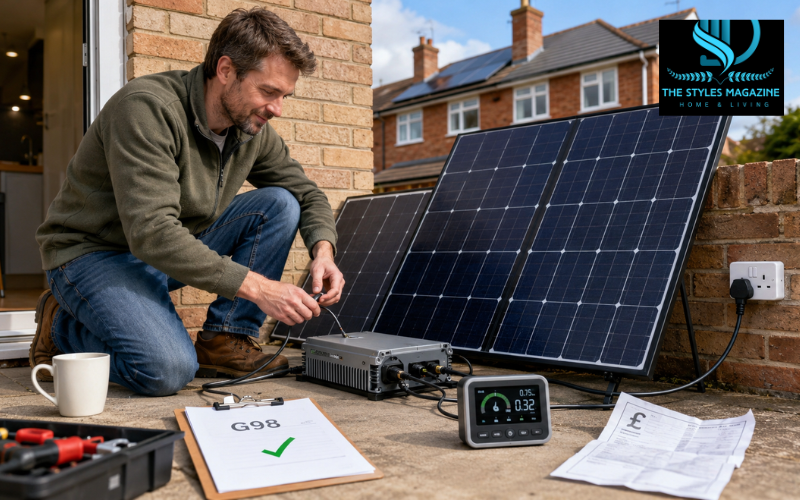
The British energy market has been a rollercoaster for consumers over recent years. With electricity bills remaining stubbornly high, many households are looking at renewable energy as a permanent escape route from extortionate grid tariffs. For millions of people living in urban apartments, rental properties, or homes without suitable roof spaces, traditional rooftop solar installations are out of reach. The scaffolding costs, structural assessments, and heavy engineering fees can easily push the initial investment past several thousand pounds, before even accounting for the premium rates charged by certified solar electricians.
This financial barrier has driven immense interest in a simpler alternative: plug and play solar. The concept is highly appealing. Instead of mounting permanent arrays and rewiring your consumer unit, you simply place portable panels on a balcony or terrace and connect the system directly into a standard household wall outlet. But this simplicity immediately raises an important regulatory question for British consumers: Is plug and play solar actually legal in the UK, and how do you navigate the compliance framework without paying steep electrician fees?
The Legal Framework: Understanding G98 in the UK
To understand the legality of plug and play solar in the United Kingdom, you must look at the rules set by the Energy Networks Association and the Office of Gas and Electricity Markets. The primary regulation governing small scale energy generation systems connected to the public grid is known as Engineering Recommendation G98.
Under the G98 framework, micro generation equipment that has a rated output of 16 Amps or less per phase, which equates to roughly 3.68 kilowatts at standard UK voltage, is permitted to connect to the electricity network. The great advantage of the G98 pathway is that it operates under a notify commission procedure. This means that householders do not need to seek advance permission from their local Distribution Network Operator before setting up their system. Instead, you or your equipment provider must notify the network operator within 28 days of the system being commissioned.
However, while G98 simplifies the grid relationship, British wiring regulations create a separate hurdle. The UK electrical standard known as BS 7671 dictates that any power generating source feeding into a domestic property must be installed safely to prevent backfeeding or overloading existing circuits. This is where traditional plug and play kits imported from continental Europe run into a legal grey area in the UK. If a system lacks the correct safety certification or continues to export electricity when the grid goes down, it violates UK safety laws.
Bypassing the Electrician Fees Safely and Legally
The reason traditional solar installations require an expensive electrician is that they are hardwired into the main consumer box, requiring structural modifications and dedicated circuits. To avoid these fees legally, the hardware itself must possess the intelligence and safety mechanisms to comply with UK grid standards natively.
The solution lies in choosing smart micro energy storage systems that feature built in island protection and precise power dispatch capabilities. When a device is fully certified and operates below the strict threshold of domestic sockets, it changes the entire compliance equation. By utilizing intelligent systems, you ensure that no power leaks back into the grid uncontrollably, satisfying both the spirit of G98 and the safety requirements of BS 7671 without altering your home infrastructure.
Choosing the Right System Setup for the UK Market
When navigating this landscape, your choice of hardware dictates how effectively you can bypass installation costs while maximizing financial returns. Modern energy solutions have evolved to split into two distinct technical approaches, depending on whether you are building a new solar setup or modifying an existing home.
For households looking to establish a brand new micro solar setup from scratch, a direct current coupled system is the most efficient route. A prominent example of this architecture is the Conow Lyra 2500 Pro. This specialized unit integrates a four channel Maximum Power Point Tracking solar controller directly into its chassis, allowing up to 2400 Watts of solar panel power to feed straight into the battery. Because the panels link directly to the storage unit, there are no complex alternating current conversions happening outside, achieving a significantly higher energy efficiency during the charging process. The power is stored locally and dispatched smoothly into the home network via a standard plug connection, keeping the installation completely within the plug and play domain.
Conversely, many urban residents or tenants face a different challenge: they either cannot mount external solar panels due to strict lease agreements, or they already own a basic balcony solar kit and want to upgrade it. For these scenarios, an alternating current coupled system is the ideal solution. The Conow Lyra 2500 AC is designed specifically for this type of flexibility. Instead of connecting panels directly to the battery, this unit plugs straight into a standard domestic socket. It acts as an intelligent energy sponge, reading the power flow within your household through smart utility meters. If your balcony panels are producing an excess supply of electricity during the day, the unit detects the surplus and absorbs it directly from the household ring main.
Maximizing ROI Under UK Smart Tariffs
The unpredictable British weather is a common concern for anyone considering solar energy. Gloomy winter days can severely limit the output of compact balcony panels. However, plug and play systems equipped with smart energy management software can overcome this limitation by interacting with the UK energy market.
The UK has seen a massive rise in dynamic and time of use electricity tariffs, such as those offered by modern digital energy providers. These tariffs mean that electricity prices fluctuate throughout the day, dropping significantly during the late night hours or when wind generation peaks across the national grid. By leveraging an intelligent energy management system, a plug and play battery can execute automated electricity price arbitrage.
During the winter months when solar generation is low, the system can automatically draw cheap electricity from the grid during the lowest night time price valleys. It stores this low cost energy inside its durable Lithium Iron Phosphate cells, which are rated for over 6000 cycles. Then, during the peak evening hours when grid tariffs skyrocket as millions of families turn on appliances, the system discharges its power to run your household essentials like refrigerators and home electronics. This means the system lowers your bills every single day of the year, regardless of whether the sun is shining.
Financial Payback and Independence
Traditional residential solar systems often carry a financial payback period stretching between eight and twelve years due to the massive upfront labor costs. By eliminating the need for scaffolding rentals, structural engineering reports, and premium electrician fees, every pound of your investment goes directly into the hardware asset that you own.
With an official hardware price sitting around 649 Euros for a standard 2560 Watt hour unit, a well managed system combining solar capture with smart tariff arbitrage can save a British household between 300 and 600 Euros annually on electricity expenses. This condenses the return on investment timeline down to just two or three years. Because these units are completely modular and portable, tenants can simply unplug the device and take it with them when moving properties, preserving their green investment for the long term. Plug and play solar is not just legally viable under G98 compliance; when paired with smart storage technology, it is the most accessible path to energy independence in the UK today.
Enjoyed it? Find more exclusive content on The Styles Magazine.