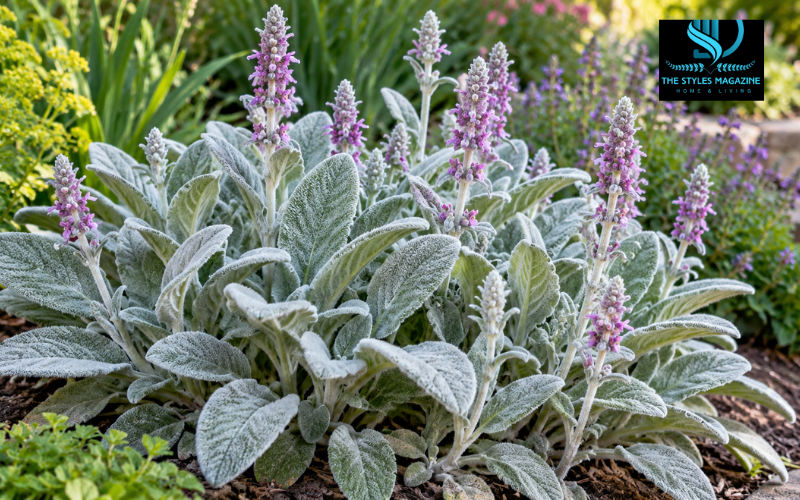
Lambs ear is one of those garden plants that is easy to recognize once you have touched it. Its soft, woolly leaves feel almost like fabric, while their silver-gray colour gives beds and borders a calm, attractive look. The plant gets its common name because the leaves are often compared to the soft ears of a young lamb.
Its botanical name is Stachys byzantina, and it belongs to the mint family, Lamiaceae. Unlike many members of that family, lambs ear is usually grown for its foliage rather than for fragrance or culinary use.
Gardeners often use lambs ear as a perennial ground cover, pathway edging, border plant, or foliage plant. It can also work well in gravel gardens and sensory gardens. Although it produces pink to purple flowers during summer, its silver leaves are usually the main attraction.
This guide explains what lambs ear looks like, where it grows best, how to care for it, how it performs in pots, how it spreads, and how to distinguish it from similar fuzzy plants such as mullein. It also looks carefully at safety and traditional medicinal-use claims.
Quick Answer:
Lambs ear (Stachys byzantina) is a soft-leaved perennial known for its silver-gray, fuzzy foliage. It grows best in sunny, well-drained areas and is commonly used for edging, ground cover, and sensory gardens.
Quick Guide Table
| Feature | Lambs Ear Details |
| Botanical Name | Stachys byzantina |
| Plant Type | Herbaceous perennial |
| Best Light | Full sun; some light shade in hot climates |
| Soil | Well-drained, dry to moderately moist soil |
| Water Needs | Moderate while establishing; lower once established |
| Foliage | Soft, woolly, silver-gray leaves |
| Flowers | Pink to purple flower spikes |
| Blooming Time | Late spring to summer |
| Common Uses | Ground cover, edging, borders, pots, sensory gardens |
| Main Care Concern | Avoid consistently wet soil and poor drainage |
Simple Lambs Ear Care Steps
- Plant lambs ear in a sunny location with good air circulation.
- Use soil that drains well and does not stay waterlogged.
- Water regularly while the plant is becoming established.
- Reduce watering once mature, but do not allow severe drought for long periods.
- Remove damaged or rotting leaves when needed.
- Cut back flower stalks after blooming if you prefer a tidy silver carpet.
- Divide overcrowded plants when they begin spreading beyond their space.
Lambs Ear Plant Profile at a Glance
Stachys byzantina is a herbaceous perennial in the Lamiaceae family. Missouri Botanical Garden lists its native range as Turkey, Armenia, and Iran. It commonly grows in USDA hardiness Zones 4 to 8, although performance can vary according to local climate, winter moisture, soil conditions, and cultivar.
The leafy part of the plant normally stays quite low. Missouri Botanical Garden describes the foliage as forming a mat roughly 4 to 6 inches above the soil, while flowering stems may rise to around 10 to 18 inches or more depending on the plant and growing conditions. Mature plants commonly spread about 1 to 1.5 feet, although individual cultivars can grow wider.
In warmer areas, the leaves may remain attractive for much of the year. In colder or wetter climates, foliage can become damaged during winter and fresh growth returns when conditions improve.
The easiest identifying features are its thick silver-gray leaves, dense woolly hairs, spreading growth and upright summer flower stems.
What Lambs Ear Looks Like Through the Growing Season
The leaves are the feature that makes lambs ear stand out. They are usually elongated or tongue-shaped, with a thick covering of fine hairs. These hairs give the foliage its famous velvety texture and create its pale silver or gray-green appearance.
In spring, new leaves emerge close to the ground and gradually develop into a wider mat. Young plants may initially look like small individual rosettes. As they mature, the stems spread outward and the plant starts filling the space between those rosettes.
By early or midsummer, mature plants may produce taller flower stems above the leaves. After flowering, some plants can look less tidy around the centre or base. Removing old flower stalks and damaged leaves can improve their appearance.
What happens during autumn and winter depends strongly on climate. In mild conditions, lambs ear can remain evergreen or semi-evergreen. Harsh winters can damage much of the exposed foliage. Excessive winter moisture can also be more troublesome than cold itself because the dense hairs hold moisture around the leaves.
Lambs Ear Flower: Colour, Blooming Time, and Garden Value
Although lambs ear is mainly a foliage plant, mature plants can produce attractive flower spikes. Upright, woolly stems rise above the silver leaves and carry small flowers that are usually pink, pinkish-purple, or purplish.
Missouri Botanical Garden gives a typical flowering period of May through July, while exact timing can vary by climate and cultivar. RHS guidance also describes flowering during late spring and summer.
The flowers are not large or dramatic, but they add height and a softer cottage-garden appearance. RHS also notes that the flowers are visited by insects.
Whether to leave the stalks is largely a matter of preference. Gardeners who enjoy a more natural look may keep them until flowering finishes. Others remove them because they want the planting to remain a neat carpet of silver foliage. Some cultivars, including ‘Silver Carpet’, are especially valued for their foliage and produce fewer flowers.
The Best Place to Grow Lambs Ear
Lambs ear generally performs best in full sun. Strong light helps maintain compact growth and attractive silver foliage. RHS recommends a sunny, well-drained position, while Missouri Botanical Garden notes that light afternoon shade may be useful in places with particularly hot summers.
The plant works particularly well toward the front of a flower border where its texture can be appreciated. It is also useful beside pathways, between taller perennials, in gravel gardens, informal cottage-style planting, rock gardens, and small ground-cover areas.
Good air movement is valuable. Lambs ear is less comfortable in shady, crowded areas where its foliage stays damp for long periods. Too much shade can slow the drying of the leaves and encourage leaf problems, especially in humid weather.
In the UK, a bright, open position with good drainage is usually more important than trying to provide extra shelter. In very hot climates, a little afternoon shade can help without keeping the plant constantly shaded.
Soil, Water, and Drainage Needs
Good drainage is one of the most important parts of growing lambs ear successfully. The plant handles relatively dry soil far better than waterlogged ground.
RHS recommends moderately fertile, well-drained soil and lists chalk, loam, and sand among suitable soil types for commonly grown forms. It can tolerate a range of soil pH levels as long as drainage is good.
Newly planted lambs ear should receive enough water to help roots establish, especially during dry weather. Once established, the plant becomes reasonably drought tolerant and normally needs less frequent watering.
Drought tolerance does not mean it should never be watered. During prolonged heat and drought, especially in containers, additional water may still be necessary.
The bigger mistake is repeated overwatering. Constantly wet soil and foliage can encourage rot and leaf spotting. Missouri Botanical Garden specifically notes that humid climates and excessive leaf moisture can lead to foliage decline.
Water the soil rather than regularly soaking the fuzzy leaves where possible.
Lambs Ear Care Throughout the Year
Lambs ear care is relatively simple when the plant is growing in the right position.
At the beginning of the growing season, remove dead, badly damaged, or rotting foliage left from winter. This gives fresh leaves more room and helps improve airflow around the plant.
During spring and summer, watering should be based on conditions rather than a strict schedule. Established plants growing in the ground usually cope well with occasional dryness. If leaves remain wet or the soil stays waterlogged, reduce unnecessary watering and check the drainage.
Flower stalks can be removed after flowering, or earlier if you are growing lambs ear mainly for a clean carpet of foliage. Damaged summer leaves can also be picked away.
Over time, a mature clump may become crowded or spread farther than wanted. Dividing the plant in spring is a practical way to refresh it and control its size. RHS also recommends division or the removal of rooted sections as a propagation method.
Growing Lambs Ear in Pots
Growing lambs ear in pots is possible and can be useful when garden space is limited or when you want its silver foliage near a patio or seating area.
Choose a container with several drainage holes. A free-draining potting mixture is much more suitable than heavy compost that remains wet for days. Place the pot somewhere that receives plenty of sunlight.
Container-grown plants need a slightly different watering approach. Pots dry out faster than open ground, particularly during hot weather, so check the compost rather than assuming a drought-tolerant plant never needs water. Water when necessary, then allow excess moisture to drain freely.
Avoid leaving the container permanently standing in water.
Because lambs ear spreads, an established plant can eventually fill its pot. When the container becomes crowded, divide the plant and replant a healthy section into fresh growing medium.
In cold areas, remember that roots in containers experience colder conditions than roots protected by surrounding garden soil. Good winter drainage remains especially important.
How Lambs Ear Spreads and How to Keep It Under Control
Lambs ear naturally develops into a broad mat rather than staying as one narrow upright plant. Creeping stems travel across the surface of the soil and can root as they grow.
This habit makes the plant useful for ground cover and edging because several plants can gradually join together. Missouri Botanical Garden notes, however, that it can become mildly aggressive in rich soil.
That does not mean lambs ear should automatically be described as invasive everywhere. Its behaviour depends on climate, soil, cultivar, maintenance, and local growing conditions.
If it moves beyond the area you intended, trim back spreading stems or remove rooted sections around the edge. Larger, crowded clumps can be lifted and divided.
Regular light control is normally easier than waiting until the plant has occupied a much larger section of the border.
Lambs Ear Plant Uses and Benefits in the Garden
Most lambs ear plant uses and benefits come from its unusual foliage and adaptable garden habit.
Its low growth makes it useful at the front of borders and along pathways. The silver foliage contrasts especially well with green-leaved plants, dark flowers, ornamental grasses, roses, and many colourful perennials.
It also suits gravel gardens because both lambs ear and this garden style favour good drainage. RHS recommends the plant for uses including cottage gardens, flower borders, edging, ground cover, gravel gardens and underplanting around roses and shrubs.
The soft leaves also make lambs ear popular in sensory gardens, where plants are chosen for interesting textures, scents, sounds, colours, or other sensory qualities.
Flowering plants can provide additional interest for visiting insects. Once established, their drought tolerance can also be useful in gardens where reducing frequent watering is a goal.
These are practical horticultural benefits. They should be kept separate from claims about medicinal effects.
Is Lambs Ear Poisonous? Safety and Medicinal-Use Claims
People searching for “lambs ear plant poisonous” often want to know whether touching, eating, or growing the plant is safe.
For normal ornamental gardening, lambs ear is widely grown as a garden plant. However, gardeners should not treat that fact as proof that every part is safe to eat in every quantity or for every person or animal. Correct plant identification is especially important because fuzzy leaves alone are not enough to identify Stachys byzantina.
If a child, adult, or pet has eaten an unknown amount of a plant and develops symptoms, seek advice from an appropriate medical, poison-control, or veterinary professional rather than relying on a gardening article.
Lambs ear medicinal uses also require careful wording. Stachys byzantina and other species in the Stachys genus have histories of traditional use in different cultures. Published scientific reviews document traditional uses, and recent laboratory and animal research has investigated compounds and possible biological activity. However, this does not establish lambs ear as a proven treatment for diseases in humans.
Claims that it can cure wounds, inflammation, infections, or other conditions should therefore not be presented as established medical facts.
Lambs Ear vs Mullein: How to Tell Them Apart
Lambs ear and common mullein can look surprisingly similar when they are young because both have soft, gray-green, hairy leaves.
Lambs ear, Stachys byzantina, is a spreading perennial. It produces relatively compact rosettes that gradually join together to form a low mat. Its flowers are usually pink to purple and appear on stems above the silver foliage.
Common mullein, Verbascum thapsus, behaves very differently. It is normally a biennial. During its first year it forms a large ground-level rosette of fuzzy leaves. In the following year it can produce a very tall central flower stalk covered with yellow flowers. North Carolina Extension notes that mature common mullein can reach around 6 to 10 feet when flowering.
Mullein leaves are also generally much larger than typical lambs ear leaves.
When comparing lambs ear vs mullein, look at the entire plant rather than simply touching one leaf. Growth habit, leaf size, flower colour, flower-stem height and arrangement all provide better clues.
Lambs Ear Where to Buy and What to Look for Before Purchasing
If you are searching for lambs ear where to buy, established garden centres, perennial nurseries and reputable online plant nurseries are usually the most practical places to start.
Buying a young plant rather than seed gives you an established root system and allows you to inspect its foliage and growth habit immediately. When choosing one, look for healthy silver leaves and firm growth. Avoid plants showing widespread rot, badly damaged foliage, severe spotting, or an unpleasantly wet growing medium.
It is also worth checking the cultivar name.
‘Big Ears’, also known under names including ‘Helene von Stein’, is valued for larger leaves and strong foliage. RHS describes it as mat-forming and drought resistant.
‘Silver Carpet’ is another popular form and is often chosen when gardeners want a low silver ground cover with limited flowering. It is hardy but benefits from protection against excessive winter wet.
Choosing according to your available space and preferred appearance is usually more useful than simply buying the first plant labelled “lambs ear.”
Conclusion
Lambs ear is a useful choice when you want a perennial that offers something different from ordinary green foliage. Its soft silver leaves create texture and contrast, while its spreading habit makes it useful for borders, edging, ground cover, gravel gardens and suitable containers.
The key to growing it well is simple: give it plenty of light and excellent drainage. Established plants tolerate dry conditions well, while consistently wet soil and damp foliage are much more likely to cause problems.
Its summer flowers can be kept for extra height and insect interest or removed when a cleaner silver carpet is preferred. Spreading plants are also easy to control by removing rooted sections or dividing crowded clumps.
Before planting lambs ear, consider your local climate, sunlight, soil drainage and available space. If those conditions suit this dry-loving perennial, Stachys byzantina can provide years of distinctive colour and texture without demanding a complicated care routine.
FAQs
Does Lambs Ear Come Back Every Year?
Yes. Lambs ear is a perennial plant, so healthy established plants normally return each year. Its winter appearance varies depending on local temperatures, drainage, rainfall, and growing conditions.
Does Lambs Ear Prefer Sun Or Shade?
Lambs ear generally grows best in full sun. In very hot climates, some afternoon shade can be helpful, but too much shade and moisture may lead to weaker growth and foliage problems.
Can Lambs Ear Grow In Pots?
Yes. Lambs ear can grow successfully in containers. Choose a pot with drainage holes, use free-draining compost, provide good sunlight, and avoid keeping the growing medium constantly wet.
Is Lambs Ear The Same Plant As Mullein?
No. Lambs ear and mullein both have fuzzy leaves, but they are different plants. Lambs ear spreads into low mats, while common mullein develops a large rosette and tall yellow flower stalk.
Does Lambs Ear Spread Quickly?
Lambs ear gradually spreads through creeping stems that can root as they grow. In favourable conditions it may spread strongly, but it can usually be controlled by trimming or dividing established clumps.
Enjoyed it? Find more exclusive content on The Styles Magazine.
Disclaimer: This article about lambs ear is provided for general gardening and educational purposes only. Growing conditions can vary depending on climate, soil, location, and plant variety. Any references to traditional medicinal uses should not be considered medical advice or proof of effectiveness. Always seek appropriate professional advice for plant ingestion, health concerns, pet safety, or suspected poisoning.