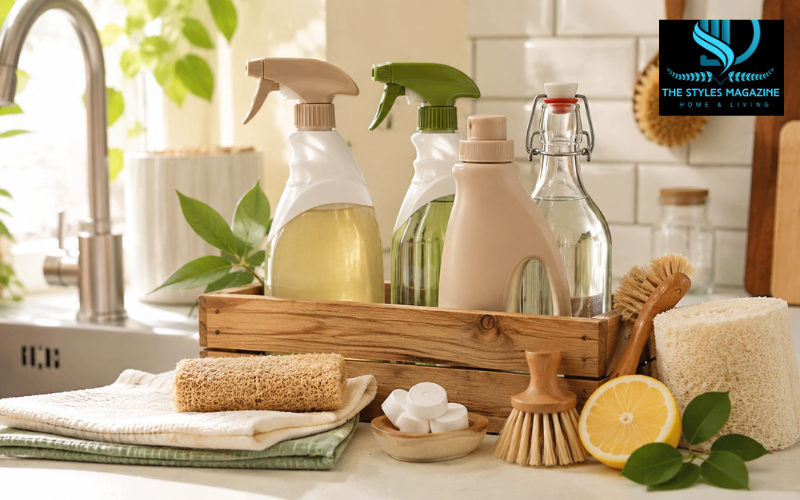
Eco friendly cleaning products are designed to clean everyday household messes while giving more attention to ingredients, packaging, waste, and environmental impact. They may use plant-derived surfactants, concentrated formulas, refill systems, recyclable packaging, or ingredients that meet independent safety standards. However, a green-looking bottle or the word “natural” does not automatically make a cleaner environmentally responsible.
A useful way to choose greener products is to look at the complete picture. Consider how well the cleaner works, what ingredients it contains, how much product you need, whether the container can be reused or recycled, and whether environmental claims can be independently verified.
This guide covers some of the best eco friendly cleaning products for different jobs, popular brands, useful ingredients, certifications, greenwashing, DIY alternatives, buying options, and considerations for businesses. The goal is not to suggest that every conventional cleaner is bad, but to help you make more informed choices.
Quick Guide Table
| Type | Best For | Main Benefit | What to Check |
| Refill tablets | Everyday surfaces | Less packaging and shipping weight | Ingredients and surface compatibility |
| Concentrated cleaners | Multi-purpose cleaning | More uses from one bottle | Correct dilution instructions |
| Plant-based cleaners | Routine household cleaning | Uses plant-derived cleaning agents | Full ingredient transparency |
| Enzyme cleaners | Laundry and stains | Breaks down specific stains | Fabric suitability |
| Fragrance-free cleaners | Sensitive households | Avoids added fragrance | Independent certifications |
| Bulk cleaners | Businesses | Lower cost per use | Storage, dilution, and safety data |
Simple Steps for Choosing Eco Friendly Cleaning Products
- Check the full ingredient list instead of relying only on words such as “green” or “natural.”
- Choose a cleaner designed for the specific surface or cleaning job.
- Look for concentrated, refillable, reusable, or lower-waste packaging when practical.
- Compare cost per use, not just the bottle price.
- Look for credible certifications such as EPA Safer Choice, MADE SAFE, or Leaping Bunny, while understanding that each certification checks different things.
- Follow dilution, ventilation, storage, and surface-care instructions on the label.
What Makes a Cleaning Product Eco Friendly?
There is no single feature that makes a household cleaner eco friendly. A more useful assessment combines formula, performance, packaging, concentration, and transparency.
Ingredients matter because cleaners eventually need to be used, rinsed, or disposed of. Products may use readily biodegradable surfactants, mineral-based cleaning agents, enzymes, or other ingredients selected with environmental considerations in mind. Transparency is also valuable because a detailed ingredient list makes it easier to understand what you are buying.
Packaging deserves equal attention. Concentrates, powders, tablets, and refill systems can reduce the amount of ready-to-use liquid and packaging that manufacturers need to transport. Blueland, for example, sells cleaning tablets that are mixed with water at home; one current multi-surface tablet makes a 24-ounce bottle of cleaner.
Performance still matters. Replacing a cleaner that works with one that requires excessive amounts or repeated applications may reduce some of the environmental advantage.
Most importantly, treat broad terms such as “green” carefully. The U.S. Federal Trade Commission’s Green Guides are intended to prevent misleading environmental marketing and emphasize that environmental claims should be clear and supported.
Why Eco Friendly Cleaning Products Can Be a Better Everyday Choice
One practical advantage of greener cleaning systems is the opportunity to reduce repeated packaging. A reusable spray bottle paired with tablets or concentrated refills can stay in the home while only the smaller refill needs to be replaced.
Concentrated products may also be useful because one container can provide many cleaning applications. Branch Basics, for example, currently sells a concentrate that can be diluted for different household cleaning jobs, while its starter systems use refillable bottles.
Indoor air is another consideration. The EPA notes that cleaning supplies and disinfectants can be sources of volatile organic compounds, or VOCs, and that VOCs from cleaning products can affect indoor air quality. Good ventilation and following label directions therefore remain sensible even when using greener products.
There may also be benefits to choosing formulas designed with biodegradability and wastewater impact in mind. Still, “plant-based” should not be interpreted as automatically harmless. Natural ingredients, essential oils, acids, and concentrated cleaners can irritate skin, damage certain materials, or cause problems if used incorrectly.
Best Eco Friendly Cleaning Products for Different Needs
There is no single best cleaner for every household. The best eco friendly cleaning products are the ones that match the cleaning task while also meeting your priorities for ingredients, packaging, scent, and cost.
For routine countertops, tables, and other washable surfaces, tablet-based or diluted multi-surface cleaners are convenient because the same reusable bottle can be refilled repeatedly. Heavy kitchen grease often needs a stronger surfactant-based concentrate; Dr. Bronner’s Sal Suds is an example of a highly concentrated cleaner intended for jobs ranging from dishes to floors and laundry.
Bathroom cleaning is different because soap residue and mineral deposits may respond better to formulas designed for those soils. Laundry stains can benefit from enzyme-based treatments that break down different types of organic stains. Puracy’s current stain remover, for instance, is formulated with six enzymes.
Sensitive households may place greater value on fragrance-free products, while someone trying mainly to reduce packaging may prefer tablets, concentrates, or paper-based refills.
Instead of judging by the front label alone, compare effectiveness, ingredient disclosure, fragrance, dilution rate, packaging, certification, and cost per actual cleaning use.
Popular Eco Friendly and Natural Cleaning Products Brands Compared
Several natural cleaning products brands approach greener cleaning in different ways, so direct comparison is more useful than treating them as interchangeable.
| Brand or Product | Format | Strongest Use | Notable Feature |
| Blueland | Dissolvable tablets and reusable bottles | Everyday household cleaning | Many tablets have earned EPA Safer Choice certification |
| Dr. Bronner’s Sal Suds | Concentrated liquid | Grease, floors, dishes and general cleaning | Highly dilutable surfactant-based formula |
| Branch Basics Concentrate | Fragrance-free concentrate | Multi-purpose household cleaning | One concentrate diluted for several jobs |
| Cleancult | Liquid refills and reusable containers | Routine surface and household cleaning | Paper-based refill cartons |
| Puracy Stain Remover | Enzyme spray/refill | Fabric stains | Current formula uses six enzymes |
EPA reported that Blueland had achieved Safer Choice certification for almost every tablet in its product line by 2023, including cleaning, laundry, dishwasher, hand-soap, and toilet tablets. Certification should still be checked for the exact product being purchased.
Dr. Bronner’s current Sal Suds ingredient list includes sodium lauryl sulfate, lauryl glucoside, sodium coco sulfate, essential oils, citric acid, and other ingredients. The company identifies its surfactants as plant-derived, so older descriptions suggesting the product contains no sulfates would be inaccurate.
Branch Basics Concentrate is currently listed by MADE SAFE as certified in its available sizes and packaging options.
Ingredients to Look for in Greener Cleaning Products
Ingredient names can look complicated even when their job is simple. It is more helpful to understand what an ingredient does than to judge it solely by whether its name sounds natural.
Surfactants help water lift oil and dirt from a surface. Plant-derived glucosides are examples commonly found in household cleaners. Citric acid is useful for adjusting acidity and may help with some mineral deposits, while sodium citrate can assist cleaning by interacting with minerals in water. Enzymes are especially useful in laundry products because different enzymes can break down proteins, fats, starches, and other stain components.
Sodium carbonate, sometimes called washing soda, is another common cleaning builder that can support grease and soil removal.
Simple household materials can also have a place. Baking soda works as a mild abrasive and deodorizing material. Diluted vinegar can help with certain mineral deposits, while hydrogen peroxide has specific cleaning and stain-removal uses.
None should be assumed safe everywhere. Ingredient safety depends on concentration, exposure, ventilation, surface type, and correct use. A plant-derived ingredient can still irritate sensitive skin, while a synthetic ingredient is not automatically environmentally harmful simply because it has a scientific-sounding name.
Packaging, Refills, Concentrates, and the Waste Question
Packaging is one of the easiest differences to see when comparing eco friendly cleaning products, but even here there are trade-offs.
Reusable bottles can reduce the need to purchase a new spray container each time. Tablets and powders avoid shipping a large amount of water, while concentrated liquids can produce several bottles of cleaner from one container. Paper-based cartons may replace some conventional plastic packaging.
Blueland currently uses plastic-free tablet refills for products such as its multi-surface and bathroom cleaners. Cleancult takes a different approach, offering paper-based refill cartons intended to pair with reusable containers. Current Target listings describe its all-purpose cartons as paper-based refills designed to use substantially less plastic than conventional packaging.
No packaging format is automatically best in every location. A recyclable carton is less useful if local facilities cannot process it correctly. When comparing options, consider how many cleaning uses each refill provides, its weight, material, whether the main bottle will genuinely be reused, and local recycling instructions.
Eco Friendly vs Non Toxic Cleaning Products
The phrases eco friendly cleaning products and non toxic cleaning products are often used together, but they do not mean exactly the same thing.
An environmental claim may focus on biodegradability, packaging, waste reduction, refillability, sourcing, or other environmental factors. A claim about a “non toxic” product generally suggests something about exposure or ingredient safety. Neither term alone tells you everything about the product.
“Chemical-free” is an especially unhelpful description. Water, vinegar, baking soda, plant extracts, and every commercial cleaner consist of chemicals. What matters is which substances are present, in what amounts, how people may be exposed to them, and how the product is intended to be used.
Instead of relying on broad front-label claims, read the ingredient information and use directions. Look for specific statements such as fragrance-free, readily biodegradable surfactants, refillable packaging, or an independently verified certification.
This approach provides more useful information than assuming that “natural” always means safer or that a conventional-sounding ingredient must be harmful.
Certifications and Greenwashing: What Labels Really Tell You
Greenwashing happens when environmental marketing creates a stronger impression than the evidence supports. Vague phrases such as “planet friendly,” “green,” or “earth conscious” are less useful when a company does not explain exactly what has been improved.
The FTC Green Guides advise marketers to make environmental claims that are truthful and properly supported. For shoppers, independent certifications can provide an additional layer of information.
EPA Safer Choice assesses qualifying products against requirements covering ingredients and performance. EPA also maintains a searchable database where consumers and commercial buyers can check certified products.
MADE SAFE focuses on ingredient screening and human and ecosystem considerations. Leaping Bunny, by contrast, concerns animal-testing practices. Its certification should therefore not be interpreted as proof that a formula is biodegradable or environmentally preferable.
Because certifications cover different issues, check what the specific seal actually verifies and search the certifier’s database when possible.
Choosing Eco Friendly Cleaners by Room and Cleaning Job
The right product depends heavily on where it will be used.
In the kitchen, an effective surfactant-based cleaner can help remove grease and food residue, while food-contact surfaces should always be cleaned according to the product directions. Bathroom cleaners often need to handle soap film and hard-water deposits. Living spaces generally require gentler routine cleaning for floors, furniture-compatible surfaces, windows, and mirrors. Laundry may call for a detergent plus a targeted enzyme stain treatment rather than one strong cleaner for everything.
It is also important to distinguish cleaning from disinfecting. Cleaning removes dirt, impurities, and many germs through washing and scrubbing. Disinfection uses an appropriate disinfectant to kill remaining germs when that extra step is needed. CDC guidance makes this distinction and recommends following product labels when disinfecting.
Do not assume one eco friendly cleaner is suitable for stone, sealed wood, stainless steel, fabric, and every other material. Surface manufacturers’ care instructions should take priority.
DIY Natural Cleaning Products: Where They Work and Where They Don’t
DIY cleaners can be useful for simple household jobs and can reduce the number of specialized products stored at home.
Baking soda can provide gentle scrubbing for suitable surfaces. Diluted vinegar is useful against some mineral deposits, while simple soap-and-water solutions are often enough for routine dirt. Hydrogen peroxide may be useful for selected stains and surfaces when used according to appropriate directions.
The limitation is that common pantry ingredients are not universal cleaners. Acids such as vinegar should not be routinely used on acid-sensitive natural stone, and homemade mixtures should always be patch-tested when surface compatibility is uncertain.
Safety is especially important when mixing products. Never combine household bleach with vinegar, ammonia, or other cleaners. CDC guidance warns that bleach mixed with acids or ammonia can produce dangerous gases.
DIY cleaners also should not automatically replace an EPA-registered disinfectant when genuine disinfection is required. Use homemade options mainly for appropriate routine cleaning rather than assuming every homemade recipe has disinfecting ability.
Where to Buy Eco Friendly Cleaning Products
Consumers now have several ways to shop, whether searching for eco friendly cleaning products at Target, eco friendly cleaning products at Walmart, or simply eco friendly cleaning products near me.
Major retailers can be convenient because products are easy to compare and replace locally. Target currently carries a broad Cleancult range, including all-purpose refills, dishwasher products, hand soap, and laundry products, although exact stock varies by store and delivery area. Walmart and other large retailers also offer greener and plant-based cleaning options, but available brands, formulas, sizes, and prices can change by location.
Local refill or zero-waste stores may be especially useful for shoppers who want to reuse containers. Supermarkets, natural-goods stores, manufacturer websites, and online retailers provide additional choices.
Price comparisons are more meaningful when based on cost per use rather than bottle price. A $20 concentrate that makes many bottles may ultimately cost less per cleaning job than a cheaper ready-to-use spray.
Always check the latest label when buying because formulas and certifications can change over time.
Eco Friendly Cleaning Products for Business and Wholesale Buying
Choosing eco friendly cleaning products for business involves different priorities from buying a few sprays for a home. Offices, hotels, schools, professional cleaners, and other facilities may use large quantities every week, making dilution rates, storage, staff training, and documentation especially important.
Businesses should compare concentrated or bulk formats by cost per usable gallon rather than only by container price. Refillable dispensing systems may reduce packaging while also making dilution more consistent. Safety data, ingredient information, surface compatibility, and clear instructions should be available to employees.
Businesses searching for eco friendly cleaning products wholesale should also distinguish routine cleaners from disinfectants required for specific workplace tasks. A general-purpose greener cleaner should not be expected to perform a regulated disinfecting function unless the product is appropriately labeled for that use.
EPA Safer Choice can be particularly useful during institutional purchasing because its searchable database includes consumer, industrial, and institutional products that meet the program’s criteria.
For high-volume buyers, product performance and correct use remain just as important as environmental credentials.
Conclusion
Choosing eco friendly cleaning products does not have to mean replacing every bottle under the sink overnight. A more practical approach is to replace products as they run out and compare new options based on cleaning performance, ingredients, packaging, concentration, transparency, and reliable third-party verification.
The right choice will vary from one home or business to another. A fragrance-free concentrate may suit one household, while refill tablets may be more useful to someone focused on reducing packaging. Businesses may care more about bulk dilution, staff safety information, and cost per use.
Most importantly, look beyond attractive green packaging and broad marketing language. Check what a product actually contains, what it is designed to clean, how it should be used, how its packaging is handled locally, and what any certification genuinely means.
A few thoughtful replacements can make a cleaning routine simpler and potentially less wasteful without sacrificing the basic requirement every cleaner must meet: it needs to work well for the job you bought it to do.
FAQs
Are Eco Friendly Cleaning Products Actually Effective?
Yes. Many eco friendly cleaning products can handle everyday dirt, grease, stains, and bathroom buildup effectively. Performance depends on the formula and whether the cleaner is suitable for the specific job.
Are Natural Cleaning Products Always Safer?
No. “Natural” does not automatically mean harmless. Essential oils, acids, concentrates, and other plant-derived ingredients can still irritate skin or damage surfaces when used incorrectly.
What Certifications Should I Look For On Greener Cleaners?
EPA Safer Choice, MADE SAFE, and Leaping Bunny are useful examples. However, they assess different areas, so check what each certification actually verifies before comparing products.
Are Refillable Cleaning Products Better For The Environment?
Refillable products can reduce repeated packaging and may lower shipping weight, especially with concentrates or tablets. Their overall benefit also depends on how often containers are reused and local recycling options.
Can DIY Cleaners Replace Commercial Eco Friendly Cleaning Products?
DIY solutions such as baking soda or diluted vinegar can handle some routine cleaning jobs, but they are not suitable for every surface and should not automatically replace registered disinfectants.
Disclaimer: This article is provided for general informational purposes only. Cleaning products and ingredients can affect people, pets, and surfaces differently. Always read product labels, follow manufacturer instructions, use appropriate ventilation, and never mix cleaning chemicals unless the manufacturer specifically states that it is safe.