Virginia creeper (Parthenocissus quinquefolia) is a fast-growing, woody vine known for its five-part leaves and striking red autumn colour. Native to much of eastern North America, it can climb trees, walls, fences, and other surfaces, or spread along the ground as a dense cover. USDA describes it as a native perennial woody vine that can either climb or trail.
For gardeners, Virginia creeper can be both useful and challenging. It offers attractive seasonal colour, shelter and food for wildlife, and a practical way to cover large spaces. It can also grow rapidly and spread into areas where it is not wanted.
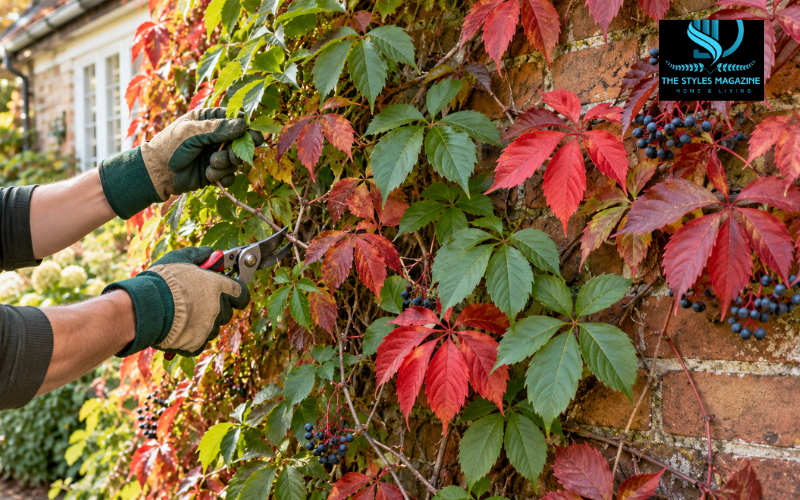
The vine climbs with branched tendrils tipped with small adhesive discs. These allow it to attach to suitable surfaces without needing to twist around a support. In summer, the green foliage creates thick coverage. Later in the year, the leaves can change to rich shades of red, burgundy, and purple, while clusters of dark berries provide food for birds.
Before planting Virginia creeper, it is worth understanding how large it can become, where it should be allowed to climb, and how much pruning may be needed. Choosing the right location from the beginning can make the difference between an attractive landscape plant and a vine that becomes difficult to control.
Quick Guide Table
| Feature | Virginia Creeper |
| Botanical name | Parthenocissus quinquefolia |
| Plant type | Woody, deciduous climbing vine |
| Typical leaves | Usually five toothed leaflets |
| Light | Full sun to shade |
| Fall colour | Red, crimson, burgundy, or purple |
| Flowers | Small, greenish flowers |
| Berries | Blue-black berries; not for human consumption |
| Wildlife value | Provides fruit and cover for birds |
| Growth habit | Climbs with adhesive-tipped tendrils |
| Main concern | Vigorous spreading and unwanted growth |
| Maintenance | Regular pruning and monitoring |
Simple Virginia Creeper Care Guide
- Plant it where there is enough room for vigorous growth.
- Choose a sturdy trellis, fence, or suitable support.
- Water regularly while a new plant becomes established.
- Allow more sunlight if strong autumn colour is a priority.
- Check growth during the season and prune unwanted shoots.
- Keep vines away from gutters, wiring, roofs, windows, and delicate surfaces.
- Wear gloves when pruning or removing large amounts of growth.
How to Identify Virginia Creeper
The easiest way to recognize Virginia creeper is by looking closely at its leaves. A mature leaf normally consists of five separate leaflets arranged from one central point. The individual leaflets are pointed and have noticeable toothed or saw-like edges. Occasionally, plants can have three or seven leaflets, especially on unusual or young growth, so leaf count should not be the only feature used for identification. University of Maryland Extension confirms that five leaflets are typical, although three or seven can sometimes occur.
The vine produces tendrils that end in small adhesive discs. These discs help it grip surfaces such as tree bark, fences, stone, and masonry. USDA notes that mature plants may climb to around 60 feet when suitable support is available.
Its flowers are much less noticeable than its leaves. Small greenish or greenish-white flower clusters appear in late spring or early summer and can easily be hidden by the foliage. These flowers later develop into small blue-black to dark purple fruits.
Season also helps with identification. New foliage may have reddish or purplish tones, turns green during the growing season, and then changes to red, crimson, burgundy, or purple in autumn.
Virginia Creeper vs Poison Ivy
Virginia creeper is often confused with poison ivy, especially when the vines grow together in wooded areas.
The most useful difference is leaf arrangement. Virginia creeper normally has five leaflets, while poison ivy usually has three. Clemson Cooperative Extension specifically highlights this distinction when explaining how to tell the two plants apart.
Their climbing methods are also different. Virginia creeper uses tendrils ending in adhesive discs. Mature poison ivy commonly attaches with many small aerial rootlets, which can make its older climbing stems look hairy.
Fruit provides another clue. Virginia creeper produces blue-black berries, while poison ivy develops pale, whitish fruit. Even so, inexperienced gardeners should avoid identifying an unknown vine from a single feature.
Young Virginia creeper can occasionally produce only three leaflets, so the simple “three versus five” rule is helpful but not perfect. Look at the vine, tendrils, fruit, and overall leaf arrangement as well. If poison ivy is a possibility, avoid touching the plant until you are confident about its identity.
Virginia Creeper Native Range and Natural Habitat
The Virginia creeper native range covers a large part of North America. USDA sources place it throughout much of the southern, midwestern, and eastern United States, with its natural distribution also reaching southeastern Canada and northern Mexico.
In the wild, it grows in forests, woodland margins, streambanks, clearings, fencerows, and other places where it can climb toward light or spread across open ground. These habitats help explain why the vine adapts so easily to home landscapes.
People searching for “West Virginia creeper” are generally looking for the same species, Parthenocissus quinquefolia, growing in or associated with West Virginia. It is not a separate plant called West Virginia creeper.
Its natural habitat also gives gardeners useful clues about care. Virginia creeper can handle a mixture of sun and shade and is able to grow in several soil conditions. That adaptability is one reason the vine can establish itself quickly once planted.
Virginia Creeper in the Fall
Virginia creeper in the fall is often at its most attractive. Leaves that were green through summer can turn bright red, crimson, burgundy, or purple as temperatures fall and the growing season ends.
Light exposure can influence the display. NC State Extension notes that Virginia creeper tolerates shade, but stronger red fall colour generally develops in sunnier sites.
The colour makes the vine useful for covering a large trellis, fence, sturdy wall, or other feature where seasonal interest is wanted. As leaves begin to fall, clusters of dark berries can also become easier to see.
Gardeners should remember that a beautiful autumn display does not mean the plant is low-maintenance. A vine that covers a large area by fall may need regular cutting back during the growing season to keep it away from roofs, gutters, windows, and neighbouring plants.
Virginia Creeper Berries, Flowers, and Wildlife Value
Virginia creeper flowers are small and not especially showy. They appear in clusters, usually from late spring into summer. Their appearance is modest compared with the vine’s foliage, but they still have ecological value. NC State reports that the flowers provide nectar for bees and other pollinators.
After flowering, the plant produces small dark fruits. Virginia creeper berries are typically blue-black, sometimes appearing deep purple, and often become particularly noticeable later in the season.
These berries are an important food source for wildlife. USDA notes that birds eat the fruits and help disperse the seeds. The thick foliage can also provide cover, perching areas, and nesting opportunities.
That wildlife value is one of the reasons Virginia creeper can be useful in a native or wildlife-friendly garden. However, the berries should be considered wildlife food rather than fruit for human consumption.
Is Virginia Creeper Poisonous?
Yes, Virginia creeper should be treated as a plant that is unsafe to eat. The berries and leaves contain oxalate crystals that can irritate the mouth and digestive system if chewed or swallowed.
Poison Control states that exposure can cause pain or irritation in the mouth and, in some cases, nausea, vomiting, diarrhoea, or difficulty swallowing.
This is especially important in gardens used by young children, who may mistake the dark berries for edible fruit. Children should be taught not to eat berries or leaves from unidentified garden plants.
Virginia creeper does not contain the same urushiol oil responsible for poison ivy reactions. However, Poison Control advises covering the skin while handling Virginia creeper to reduce exposure to oxalate crystals. Gloves and long sleeves are sensible when pruning, pulling, or cutting large amounts of the vine.
If someone eats Virginia creeper and develops concerning symptoms, seek advice from an appropriate poison-control or medical service rather than relying on home remedies.
Where Virginia Creeper Works Best in the Landscape
Virginia creeper works best where it has enough room to grow and where its vigorous habit can be managed.
A strong fence or sturdy trellis can provide an effective vertical growing area. The vine can also spread over banks and slopes as a groundcover. USDA specifically notes its use for erosion control, particularly in shaded areas and on slopes.
It can also suit native, woodland, pollinator, and wildlife gardens because of its native range and value to birds and insects.
Placement near a building needs more thought. NC State advises against allowing the vine to grow unchecked on wooden or shingle walls because its adhesive holdfasts are difficult to remove and may damage painted surfaces. Gutters, shutters, wiring, and other building features can also be affected if growth is not controlled.
Give the plant enough room from the start and provide a surface that can safely support mature growth.
Virginia Creeper Care and Growing Conditions
Virginia creeper care is fairly straightforward because the plant is naturally adaptable.
It grows in full sun, partial shade, and considerable shade. A position with more sunlight may produce more vivid autumn colour, while plants in shade generally remain capable of healthy growth.
Virginia creeper performs well in average, reasonably well-drained soil but tolerates several soil textures and moisture conditions. USDA notes that it prefers moist, well-drained ground but can also tolerate drier conditions.
Newly planted vines benefit from regular watering while roots become established. After establishment, watering needs will depend on rainfall, soil, heat, and the planting site.
The biggest part of long-term care is usually not feeding or watering but controlling growth. NC State describes the vine as rapid growing and recommends regular trimming to keep it within its intended space.
If you want it to climb in a particular direction, guide young growth toward a suitable trellis or surface and remove shoots that head toward unwanted areas.
Pruning and Keeping Virginia Creeper Under Control
Regular pruning is one of the most important parts of growing Virginia creeper successfully.
Check the vine throughout the growing season rather than waiting until it has reached the roof or spread through neighbouring shrubs. Cut back stems heading toward gutters, windows, wiring, roof spaces, shutters, and other areas where thick growth could create problems.
Ground-running stems should also be watched. University of Maryland Extension explains that stems can root where they touch the soil, helping the plant spread beyond its original position.
Where Virginia creeper grows near shrubs or small trees, remove competing shoots before they form a heavy cover. The goal is not necessarily to keep the plant small but to define clear boundaries.
Routine inspection makes the job far easier than trying to deal with several years of uncontrolled growth at once.
Virginia Creeper Problems to Watch For
Most Virginia creeper problems come from its vigorous growth rather than difficult care requirements.
A vine planted in too small a space may quickly move into nearby beds, shrubs, fences, trees, or structures. Stems running across the soil can root, while berries eaten by birds can help spread seeds elsewhere.
Another common concern is attachment to buildings. The adhesive discs can leave marks or residue when vines are removed. NC State warns that holdfasts can be troublesome on painted wood or shingles and that unchecked vines may interfere with gutters, shutters, and wiring.
The situation is more nuanced on sound masonry. University of Maryland Extension notes that Virginia creeper uses adhesive discs rather than penetrating rootlets and says these attachments do not structurally damage sound brick or block. Even so, old mortar, painted surfaces, cracked masonry, and other vulnerable finishes deserve caution.
The vine can therefore be an attractive garden plant in one location and an unwanted weed in another. Site selection and pruning largely determine which experience you have.
How to Remove Unwanted Virginia Creeper Safely
Small Virginia creeper seedlings and young vines can often be removed by hand. Moist soil makes it easier to lift roots without leaving large pieces behind. Gloves are recommended during the work.
For established plants, trace the vines toward their main stems and cut them near ground level. Avoid aggressively ripping mature climbing stems from delicate surfaces. Once a vine has been cut and has died back, attachments may become easier to deal with.
Removing only the visible upper growth may not solve the problem. University of Maryland Extension notes that Virginia creeper can regrow from roots that remain in the ground, so the site should be checked for new shoots.
Where physical removal is not practical, a herbicide labelled for the plant and location may sometimes be used. A cut-stem application can provide more targeted treatment around desirable vegetation than broadly spraying foliage. Always follow the specific product label, local regulations, protective-equipment instructions, and directions for avoiding damage to nearby plants.
Repeated monitoring is often necessary because new plants can emerge from remaining roots or bird-dispersed seeds.
Buying Virginia Creeper for Your Garden
If you are searching for Virginia creeper for sale, start by checking the plant’s botanical name. Genuine Virginia creeper should be labelled Parthenocissus quinquefolia. This helps avoid confusing it with other climbing plants that may have different growth habits.
Choose a nursery plant with healthy stems and leaves and no obvious signs of severe damage or stress. More importantly, decide where it will grow before buying it.
A young vine can look modest in a nursery pot, but a mature plant may eventually extend 30 to 50 feet or more under favourable conditions. NC State describes it as a vigorous vine capable of quickly reaching this size.
Think about the support, surrounding vegetation, nearby structures, and how easily you will be able to prune the plant in future. Buying the plant is simple; managing its mature size is the greater commitment.
Conclusion
Virginia creeper can be an impressive landscape vine when it is planted with a clear purpose. Its five-part leaves make it recognizable, its autumn foliage provides dramatic seasonal colour, and its flowers and berries offer value to pollinators, birds, and other wildlife.
It is also a vigorous plant that needs space and regular attention. Allowing it to spread without control can lead to unwanted growth across shrubs, trees, fences, ground areas, and parts of buildings.
Good results begin with correct identification and thoughtful placement. Keep Virginia creeper berries away from people, especially young children, wear sensible protection while handling large amounts of the vine, and prune it before growth reaches places where it may cause trouble.
For a gardener with enough space and a suitable location, Virginia creeper can be a useful native vine rather than a problem. The key is to enjoy its natural strength while keeping that growth within boundaries that work for your garden.
FAQs
Is Virginia Creeper Poisonous?
Virginia creeper berries and leaves contain oxalate crystals and should not be eaten. Ingestion can irritate the mouth and digestive system, so berries should be kept away from young children.
How Can You Tell Virginia Creeper From Poison Ivy?
Virginia creeper usually has five leaflets, while poison ivy normally has three. Virginia creeper also climbs using tendrils with adhesive discs, whereas poison ivy commonly attaches using aerial rootlets.
Does Virginia Creeper Damage Walls?
Virginia creeper generally does not penetrate sound masonry, but its adhesive discs can leave marks. It should be kept away from damaged mortar, painted surfaces, shingles, gutters, wiring, and other vulnerable areas.
How Fast Does Virginia Creeper Grow?
Virginia creeper is a vigorous vine and can spread quickly when conditions are suitable. Its exact growth rate varies with sunlight, soil, water, climate, and available climbing support.
Is Virginia Creeper Good For Wildlife?
Yes. Its flowers can support pollinators, while its dark berries provide food for birds. Dense foliage can also offer useful shelter and cover for wildlife.
Enjoyed it? Find more exclusive content on The Styles Magazine.
Disclaimer: This article is provided for general informational and educational purposes only. It explains Virginia creeper identification, care, safety, landscape use, and control based on reliable gardening information. It is not paid promotion, advertising, or sponsored content. Always follow local guidance and product-label instructions when using herbicides or managing plants around buildings, children, or pets.