Salvia is a name that can point to very different plants, which is why the term sometimes causes confusion. In botany, Salvia is a large genus in the mint family, Lamiaceae. Kew’s Plants of the World Online recognizes more than 1,000 species in the genus, spread across many parts of the world. They include flowering garden plants, culinary herbs, perennial plants, annuals, and shrubs.
If someone searches for “salvia plant in English,” sage is the common name most closely associated with the genus. However, not every plant called Salvia is used in the same way. Common sage is a familiar cooking herb, many other species are grown mainly for their flowers, and rosemary is now botanically included within Salvia.
There is also Salvia divinorum, a psychoactive species native to Oaxaca, Mexico. It is only one member of this very large genus and should not be confused with ordinary culinary sage or ornamental garden salvias.
Understanding these differences makes the subject much simpler: Salvia can describe beautiful garden flowers, useful herbs, native plants, and, in one specific case, a powerful psychoactive plant.
Quick Guide to Common Salvia Types
| Salvia Type | Common Name | Main Use | Key Feature |
| Salvia officinalis | Common sage | Culinary herb | Aromatic grey-green leaves |
| Salvia nemorosa | Woodland sage | Ornamental | Colorful upright flower spikes |
| Salvia splendens | Scarlet sage | Ornamental | Bright, showy flowers |
| Salvia rosmarinus | Rosemary | Culinary and ornamental | Fragrant, needle-like leaves |
| Salvia apiana | White sage | Native/ornamental and traditional uses | Silvery-grey aromatic foliage |
| Salvia divinorum | Diviner’s sage | Psychoactive species | Contains salvinorin A |
Quick Tips for Choosing the Right Salvia
- For cooking: Choose Salvia officinalis or rosemary (Salvia rosmarinus) from a source that sells plants for culinary use.
- For colorful gardens: Look at ornamental species such as Salvia nemorosa and Salvia splendens.
- For dry landscapes: Consider drought-adapted species suited to your local climate and soil.
- For pollinator gardens: Choose flowering salvias appropriate for native bees, butterflies, birds, or other local pollinators.
- Check the botanical name: Do not rely only on labels such as “sage” or “salvia,” because different species have very different characteristics.
- Do not confuse species: Ordinary culinary and ornamental salvias are different from the psychoactive Salvia divinorum.
Understanding the Salvia Plant Genus
Botanically, Salvia belongs to the Lamiaceae, or mint family. This same plant family includes many familiar aromatic herbs. Salvia itself is especially diverse, with species occurring across temperate, subtropical, and tropical regions. Kew describes the genus as cosmopolitan, meaning its members occur naturally across a very broad geographic range.
Some salvias complete their life cycle quickly and are grown as annuals, while others return year after year as herbaceous perennials. There are also woody and semi-woody shrubs. This diversity explains why advice that suits one Salvia may not suit another.
The words sage and salvia often overlap because many members of the genus have “sage” as their common English name. Woodland sage, scarlet sage, white sage, and culinary sage are all examples, but they are different species.
Rosemary adds another interesting layer. The plant long known scientifically as Rosmarinus officinalis is accepted by Kew under the name Salvia rosmarinus. The old scientific name is still widely recognized, but modern botanical classification places rosemary within Salvia.
What Salvia Plants Look Like
There is no single appearance that describes every Salvia species, but many share recognizable family features. Garden salvias commonly have upright or branching stems, paired leaves, and flowers with an upper and lower “lip.” Their flowers may be packed closely into upright spikes or arranged more loosely along slender stems.
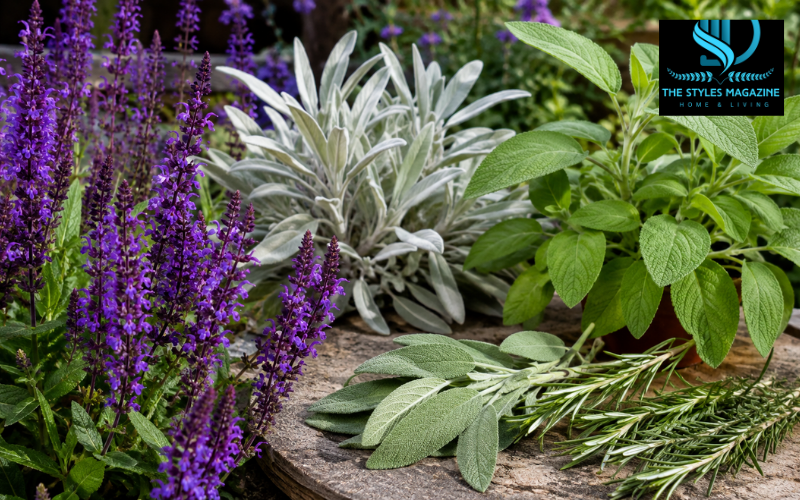
Flower color is one reason these plants are so popular in gardens. Depending on the species and cultivar, flowers can be blue, violet, purple, pink, red, white, yellow, or combinations of colors. Foliage varies just as much. Some plants have bright green leaves, while others have grey, silver, or softly hairy foliage.
Many species also have aromatic leaves, particularly when the foliage is rubbed or crushed. Culinary sage, for example, has soft grey-green leaves, while rosemary has narrow, needle-like evergreen leaves.
A useful identification clue is therefore the combination of leaf arrangement, aromatic foliage, and two-lipped flowers. Still, identification should never depend on appearance alone. Because the genus is so large, checking the botanical species name is the safer way to know exactly which plant you have.
Popular Types of Salvia and How They Differ
Salvia officinalis, commonly called garden sage or common sage, is the species most strongly associated with cooking. It is a woody-stemmed perennial with aromatic grey-green foliage and flowers that are often blue to purple.
Salvia nemorosa, or woodland sage, is mainly valued as an ornamental perennial. It forms clumps and produces upright flowering stems, making it useful in borders and perennial planting schemes.
Salvia splendens, commonly known as scarlet sage, is a flowering garden species native to Brazil. Although naturally a tender perennial, it is often treated as a seasonal bedding plant where cold weather prevents it from surviving outdoors year-round.
Salvia rosmarinus is rosemary, the familiar fragrant evergreen herb used in cooking and gardens.
Salvia apiana is white sage, a drought-adapted shrub native mainly to California and nearby areas.
Finally, Salvia divinorum is the psychoactive species associated with drug-related searches. Unlike these common culinary and ornamental plants, it contains salvinorin A and produces powerful changes in perception.
Salvia White and White Sage: Clearing Up the Name
A search for salvia white can lead to more than one type of plant. Sometimes the searcher wants a garden Salvia with white flowers. In other cases, the intended plant is Salvia apiana, whose established common name is white sage.
White sage is an aromatic shrub native to California and extending only slightly beyond the state’s borders. Its pale, grey-white to silvery foliage gives the plant a noticeably lighter appearance than many green-leaved sages. It is adapted to relatively dry conditions and performs well in sunny locations with low water needs once established.
This is different from ornamental cultivars that happen to produce white flowers. Those plants may belong to other Salvia species and can have completely different climate, soil, and watering needs.
White sage also should not be confused with Salvia divinorum. They are separate species with different natural ranges, characteristics, and uses. S. apiana is generally discussed as an aromatic native shrub and garden plant, whereas S. divinorum is known for its psychoactive chemistry.
When buying any plant described simply as “white salvia,” checking the botanical name prevents this confusion.
Growing Salvia Successfully in the Garden
Many popular garden salvias prefer a bright, sunny position and soil that drains well. Heavy, waterlogged ground can cause problems for numerous species, particularly culinary and evergreen types. However, Salvia is a diverse genus, and some species naturally prefer more moisture than others.
Water new plants regularly enough to help their roots establish, then adjust watering according to the species, weather, and soil. Many established garden salvias tolerate periods of dry weather well, but drought tolerance should not be assumed for every type.
Good airflow also matters. Give plants enough room to reach their expected mature size rather than crowding them together. Salvias can grow successfully in containers as long as the pot provides adequate drainage and enough space for the roots.
Pruning depends on the type. Removing faded flower stems can encourage further flowering in many ornamental salvias, while herbaceous, shrubby, and evergreen species may require different seasonal pruning methods.
Winter care also varies. Hardy perennials may remain outdoors, whereas tender types can require shelter from frost or protection from excessive winter moisture. Always base care on the particular species rather than treating every Salvia the same.
Why Gardeners Grow Salvia
Gardeners are drawn to Salvia mainly because the genus offers a remarkable range of flower shapes, colors, sizes, and growth habits. Compact varieties can work in pots or along the front of a border, while taller types create strong vertical accents among other flowering plants.
Many ornamental salvias also bloom over an extended period, especially when faded flowers are removed at suitable times. Their tubular, two-lipped flowers bring vivid color without requiring an overly formal garden style.
Another important benefit is their value to wildlife. The Royal Horticultural Society identifies Salvia as a useful group of plants for pollinators and notes that sage flowers are particularly attractive to bees. Depending on the species and location, other salvias can also provide food for butterflies, birds, and additional pollinating animals.
Many types are also well suited to water-conscious gardens because they tolerate dry conditions after establishment. Common sage and white sage are good examples of drought-adapted members of the genus.
The key is matching the species to the site. A plant adapted to dry Mediterranean-style conditions will not necessarily want the same treatment as one originating in a humid subtropical habitat.
Salvia as an Herb: Culinary and Traditional Uses
When people search for a salvia herb, they are often looking for common sage. Salvia officinalis has long been grown for its strongly scented leaves, which are used as a culinary herb. The flavor is distinctive and works particularly well in savory dishes, sauces, stuffings, and foods where a robust herbal note is wanted.
Rosemary is another culinary member of the genus under its accepted botanical name, Salvia rosmarinus. Its narrow, fragrant leaves are used fresh or dried to flavor many types of food. Kew recognizes rosemary for culinary as well as ornamental uses.
Various Salvia species also have histories of traditional herbal use in different cultures. Such traditions can be important from historical and cultural perspectives, but traditional use should not automatically be treated as evidence that a plant can prevent or cure a medical condition.
This distinction matters because the term “salvia herb” can otherwise become misleading. Culinary sage and rosemary are ordinary food herbs when used appropriately, while Salvia divinorum is a different species with strong psychoactive effects. Similar botanical names do not mean that the plants are interchangeable.
Salvia Divinorum: The Species Behind the Drug-Related Meaning
Salvia divinorum is a perennial member of the mint family whose native range is in Oaxaca, Mexico. Kew identifies it as a plant of subtropical habitat, and the species has a long association with the region.
Its importance in discussions about psychoactive substances comes from salvinorin A, the principal compound responsible for its powerful effects on perception and awareness. Scientific research identifies salvinorin A as a potent hallucinogenic compound that acts primarily at kappa-opioid receptors in the nervous system.
This is why a search for salvia drug usually concerns Salvia divinorum, not the entire genus.
That distinction is essential. A flowering Salvia bought for a garden border, common sage used in cooking, rosemary added to food, and white sage are not automatically psychoactive because they share the same genus name.
Using the full species name whenever discussing Salvia divinorum helps prevent inaccurate claims about other sages and makes information about the plant much easier to understand.
Why Salvia Is Described as a Psychedelic
The phrase salvia psychedelic generally refers to the mind-altering effects of Salvia divinorum and salvinorin A. People exposed to the psychoactive compound may experience major changes in visual perception, awareness of their surroundings, sense of identity, body perception, and understanding of time or space.
Researchers have described its effects as unusually intense and strongly disorienting. Controlled human research has also shown that the strongest subjective effects can arise rapidly and may fade much faster than the effects associated with many better-known hallucinogens.
Although it is often grouped with psychedelics in everyday language, its pharmacology is unusual. Classic psychedelics such as LSD and psilocybin are mainly associated with serotonin 5-HT2A receptor activity. Salvinorin A instead has strong activity at kappa-opioid receptors.
That difference helps explain why the experience is frequently described as distinct from classic psychedelic drugs. Calling it “natural” does not mean it is mild or predictable. A naturally occurring compound can still produce extremely powerful effects.
Salvia Smoking and the Risks Readers Should Understand
When people refer to salvia smoking, they usually mean inhaling smoke containing material from Salvia divinorum. The DEA also lists smoking among the ways the psychoactive plant has been misused.
The main safety concern is not simply hallucination. Strong changes in awareness can leave a person temporarily unable to understand where they are or what is happening around them. Research has described the effects of salvinorin A as brief but potentially intensely disorienting.
During such impairment, falls, collisions, panic, poor judgment, or other accidental injuries can become possible. People may also react unpredictably to frightening or confusing perceptions.
Having another person nearby or being in a familiar environment does not remove these risks. Individual reactions vary, and research on the full range of short- and long-term health effects remains more limited than for many widely studied substances.
If someone who has taken a psychoactive substance becomes unresponsive, has difficulty breathing, suffers a serious injury, or cannot be kept safe, contact local emergency medical services promptly. Medical professionals should be told what substance is believed to have been involved whenever that information is known.
Salvia Legality, Safety, and Common Misunderstandings
The legal position of Salvia divinorum is not the same everywhere. Laws differ between countries and may also vary between states, provinces, or other local jurisdictions. European and U.S. drug authorities document differing forms of control and restriction, which means a legal statement found online may not apply where a particular reader lives.
Because laws can change, anyone needing legal information should check the latest government rules for their own location rather than relying on an old article, forum post, or social media claim.
Another common misunderstanding is that all Salvia plants are drugs. They are not. The genus contains more than 1,000 species, including familiar culinary and ornamental plants. Salvia divinorum is the species primarily associated with psychoactive use.
White sage is also sometimes confused with it because both plants contain “sage” in their common names. Salvia apiana and Salvia divinorum are separate species.
Similarly, claims that every Salvia has the same medicinal, culinary, or intoxicating properties are inaccurate. Botanical relationships tell us that plants are related; they do not make their chemistry or uses identical.
Finding Salvia Near You and Choosing the Right Plant
Someone searching for salvia near me may simply be looking for an attractive garden plant or culinary sage. Local nurseries and garden centers are useful places to start because plants offered locally are often selected with regional growing conditions in mind. Specialist nurseries can also be helpful when a particular species or cultivar is required.
The most important detail on the label is the botanical name. A tag that says only “sage” or “salvia” may not tell you enough. Look for names such as Salvia nemorosa, Salvia officinalis, or another clearly identified species and cultivar.
Before buying, consider your available sunlight, soil drainage, typical winter temperatures, summer heat, available space, and whether you plan to grow the plant in the ground or a container. Flower color and mature size matter too, especially in borders where the plant needs to fit with surrounding vegetation.
Purpose is equally important. Culinary sage should be purchased as an edible herb from a suitable source, while an ornamental variety may be intended only for garden display.
Choosing by botanical name rather than appearance alone is the simplest way to avoid bringing home the wrong Salvia.
Conclusion
Salvia is much broader than a single flower, herb, or psychoactive plant. It is a huge and varied genus in the mint family containing more than 1,000 species with different appearances, habitats, growing requirements, and uses.
For gardeners, the name may bring to mind colorful woodland sage, scarlet sage, or other long-flowering ornamental plants. In the kitchen, it includes familiar herbs such as common sage and rosemary. White sage, Salvia apiana, is another distinct species with its own natural range and characteristics.
Salvia divinorum belongs to the same botanical genus but represents a very different subject because it contains the powerful psychoactive compound salvinorin A. It should not be treated as interchangeable with ordinary garden or culinary sages.
The easiest way to understand any Salvia is to look beyond the common name. Check the full botanical species name, learn what that particular plant is used for, and match your gardening, culinary, or safety decisions to the characteristics of that species. That simple habit removes much of the confusion surrounding one of the plant world’s most diverse genera.
Frequently Asked Questions
Is Salvia The Same As Sage?
Salvia is the botanical genus that contains many plants commonly called sages. Common sage, woodland sage, and white sage are different Salvia species, so “sage” does not always identify one specific plant.
Is Every Salvia Plant Psychoactive?
No. Most Salvia species are ordinary ornamental plants or herbs. The drug-related meaning of salvia generally refers specifically to Salvia divinorum, which contains the powerful psychoactive compound salvinorin A.
Is Rosemary Really A Type Of Salvia?
Yes. Rosemary is now botanically accepted as Salvia rosmarinus. It was formerly widely classified as Rosmarinus officinalis, which is why the older scientific name still appears in books, labels, and online resources.
Does Salvia Come Back Every Year?
It depends on the species and climate. Some salvias are hardy perennials, others are shrubs or tender perennials, and certain types are commonly grown as annuals in colder regions.
What Should I Check When Buying Salvia Near Me?
Check the plant’s full botanical name, mature size, sunlight and watering needs, climate suitability, and intended use. Botanical identification helps prevent confusion between culinary, ornamental, white sage, and other Salvia species.
Enjoyed it? Find more exclusive content on The Styles Magazine.
Disclaimer: This article is provided for general educational and gardening information. Salvia species differ greatly in their uses, chemistry, growing requirements, and safety. Do not eat or use an unidentified plant based only on its appearance or common name. Information about Salvia divinorum is educational and is not intended to encourage psychoactive drug use. Its legal status varies between countries and local jurisdictions, so always check current laws where you live. Health concerns or serious reactions involving any psychoactive substance should be discussed with a qualified healthcare professional or local emergency service when urgent care is needed.