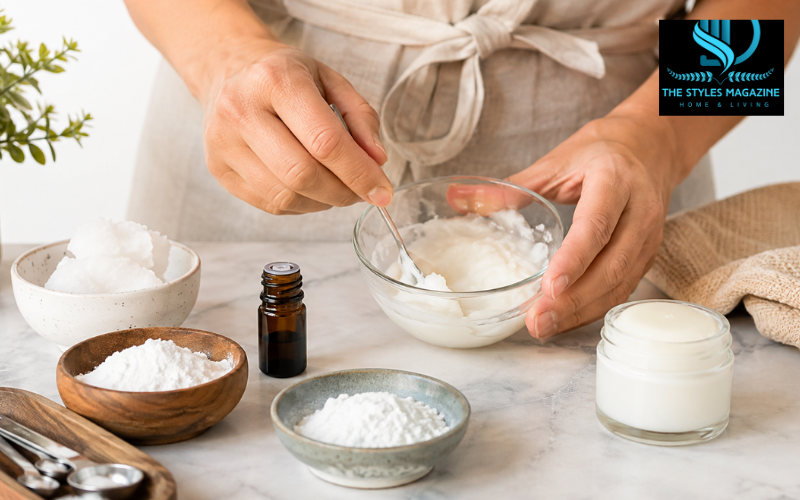
Learning how to make natural deodorant is surprisingly simple. A basic homemade deodorant can be made with just three ingredients: coconut oil, baking soda, and arrowroot powder or cornstarch. You can then adjust the recipe depending on your skin, preferred texture, climate, and whether you want fragrance.
Homemade deodorant is mainly designed to help manage underarm odor. Sweat itself is not always what creates the familiar body odor. Odor develops when sweat interacts with bacteria on the skin. Ingredients commonly used in deodorants can help absorb moisture, change the conditions in which odor develops, or add fragrance.
It is also important to understand the difference between a deodorant and an antiperspirant. Deodorants are intended mainly to control odor. Antiperspirants contain active ingredients that temporarily reduce the amount of sweat reaching the skin. Therefore, a homemade natural deodorant should not be expected to stop sweating in the same way as an antiperspirant.
The good news is that one homemade recipe can be adapted in several ways. Below, you will learn how to make the standard three-ingredient version, a gentler formula for sensitive skin, a deodorant without baking soda, scented versions with essential oils, a simple option for men, and a spray variation.
Quick Guide: Homemade Natural Deodorant Options
| Type | Main Ingredients | Best For | Key Note |
| 3-Ingredient Deodorant | Coconut oil, baking soda, arrowroot | Simple everyday use | Easy starting recipe |
| Sensitive-Skin Formula | Coconut oil, arrowroot, less baking soda | Easily irritated skin | Use less baking soda |
| Baking-Soda-Free | Coconut oil, arrowroot/cornstarch | Baking soda sensitivity | Gentler alternative |
| Essential-Oil Deodorant | Basic recipe + suitable essential oil | People who prefer fragrance | Use essential oils sparingly |
| Unscented Deodorant | Coconut oil, arrowroot, optional baking soda | Fragrance-sensitive users | Keeps the formula simple |
Quick Steps: How to Make Natural Deodorant
- Measure coconut oil, baking soda, and arrowroot powder or cornstarch.
- Gently soften or melt the coconut oil.
- Mix the dry ingredients together until evenly combined.
- Stir them into the coconut oil until smooth.
- Add a small amount of suitable essential oil if desired.
- Transfer the mixture to a clean jar or deodorant container.
- Let it cool and firm before applying a thin layer to clean, dry underarms.
What You Need to Make Natural Deodorant
The simplest homemade deodorant does not require a long ingredient list. Coconut oil is commonly used as the base because it creates a spreadable mixture that can be applied easily to the underarms.
Baking soda is included in many recipes to help with odor. However, it can be irritating for some people, so more is not necessarily better.
Arrowroot powder or cornstarch gives the deodorant a drier feel and helps absorb some surface moisture. These ingredients do not prevent your body from sweating, but they can make an oil-based formula feel less greasy.
Essential oils are optional. They can add fragrance, but you do not need them for the basic recipe. If you have sensitive skin or react to fragranced products, an unscented deodorant may be the better choice.
For equipment, you will need measuring spoons or cups, a small bowl, a spoon or whisk, and a clean container. A small glass jar is the easiest option, although a clean reusable deodorant tube can work if the finished mixture is firm enough.
Homemade Deodorant 3-Ingredient Recipe
For a straightforward homemade deodorant 3 ingredients are enough.
For a small batch, use:
- 1/2 cup coconut oil
- 1/4 cup baking soda
- 1/4 cup arrowroot powder or cornstarch
This creates a soft paste when the room is moderately cool. Because coconut oil changes consistency with temperature, the deodorant may become firmer in cold weather and softer during hot weather.
You do not have to treat these quantities as an unchangeable formula. If the deodorant feels too oily, a little more arrowroot powder can make it drier. If baking soda bothers your skin, reduce it substantially or use the baking-soda-free recipe later in this guide.
When making the recipe for the first time, consider preparing half the amount. A smaller batch lets you see how your skin responds before you use more ingredients.
How to Make Natural Deodorant Step by Step
The actual process of learning how to make natural deodorant at home takes only a few steps.
Start by softening the coconut oil. If it is very hard, gently warm it until it becomes soft or just melted. You do not need to make it extremely hot.
In a separate bowl, combine the baking soda with the arrowroot powder or cornstarch. Mixing the powders first helps distribute them more evenly.
Gradually stir the dry mixture into the coconut oil. Continue mixing until you have a smooth paste without obvious lumps. If you want a scented deodorant, add a small amount of your chosen skin-safe essential oil at this stage.
Spoon the mixture into a clean, dry jar or deodorant container. Let it cool and firm before using it. Refrigerating it briefly can speed up this process.
Check the texture once it has set. A jar deodorant should be soft enough to scoop in a small amount without being runny. If you are using a stick container, you will usually need a firmer consistency.
How to Make Natural Deodorant With Baking Soda
If you are researching how to make natural deodorant with baking soda, the basic three-ingredient recipe is an easy starting point.
Baking soda, or sodium bicarbonate, is popular in homemade deodorants because it can help control odor. However, underarm skin can be sensitive, and a high concentration is not necessary for everyone.
The standard recipe uses equal amounts of baking soda and arrowroot powder, but you can start with less baking soda. For example, use 2 tablespoons of baking soda and 6 tablespoons of arrowroot powder with 1/2 cup of coconut oil.
Pay attention to your skin rather than assuming discomfort is part of adjusting to natural deodorant. Burning, itching, redness, tenderness, or a persistent rash can indicate irritation or contact dermatitis.
If reducing the baking soda does not solve the problem, stop using that formula and try a baking-soda-free version.
Natural Deodorant Recipe Without Baking Soda
A natural deodorant recipe without baking soda can be a useful alternative for people whose underarms become uncomfortable with traditional DIY formulas.
For a very simple version, combine about 1/2 cup of coconut oil with 1/2 cup of arrowroot powder. Mix until you have a smooth, spreadable paste.
Arrowroot helps absorb moisture and reduces the greasy feeling of coconut oil. Cornstarch can also be used if that is what you have available.
Keep in mind that removing baking soda changes how the deodorant performs. You may need to experiment with the proportions or reapply as needed.
A baking-soda-free formula can be particularly worth trying if previous homemade deodorants have caused burning, redness, or itching. It is also easy to leave this version completely unscented.
How to Make Natural Deodorant for Sensitive Skin
When learning how to make natural deodorant for sensitive skin, simpler is usually better.
Begin with either the baking-soda-free formula or a recipe containing only a small amount of baking soda. Avoid adding several new ingredients at once because this makes it difficult to identify the cause if your skin reacts.
Fragrance can also cause problems for some people. Essential oils may be natural, but “natural” does not automatically mean non-irritating or suitable for every person’s skin. If you have sensitive skin, consider making your first batch without fragrance.
Before regularly applying a new formula, test a small amount on a limited area and watch for a reaction. Do not apply homemade deodorant to skin that is already irritated, cut, or damaged.
Stop using the product if you experience persistent redness, itching, burning, swelling, tenderness, or a rash. If a reaction is severe, does not improve after stopping the product, or keeps returning, seek advice from a qualified healthcare professional or dermatologist.
How to Make Natural Deodorant With Essential Oils
Essential oils are an optional way to customize the scent of homemade deodorant. They are not required for the basic recipe to work.
Lavender can provide a floral scent, while sweet orange offers a brighter citrus aroma. Other people prefer herbal, fresh, or earthy scents. Rather than using a large amount of essential oil, begin conservatively.
You can also combine scents. For example, a small amount of lavender with sweet orange creates a floral-citrus profile. The exact amount suitable for skin depends on the particular essential oil and its recommended dermal dilution, so follow reputable safety instructions for the oil you choose rather than assuming every essential oil can be used at the same concentration.
Fragrance ingredients can cause contact dermatitis in some people. If you notice itching, burning, swelling, or a rash, stop using the scented formula.
There is also nothing wrong with skipping essential oils completely. An unscented homemade deodorant is often the simplest choice, especially for fragrance-sensitive skin.
How to Make Natural Deodorant for Men
There is no need to completely redesign the recipe when considering how to make natural deodorant for men. The same coconut oil, arrowroot, and optional baking soda base can be used by anyone.
The main difference can simply be personal scent preference. Someone who wants a traditionally masculine fragrance might prefer woody, herbal, fresh, or citrus notes. An unscented formula works just as well for someone who does not want their deodorant competing with cologne or another fragrance.
Do not add extra baking soda simply because the deodorant is intended for a man. Skin tolerance and odor-control needs vary from person to person rather than being determined by gender alone.
A jar is convenient for home use, while a firmer stick can be easier for travel or quick application. Choose the format based on convenience rather than expected effectiveness.
How to Make Natural Deodorant Spray
A natural deodorant spray is different from the coconut-oil recipe because it needs to remain liquid enough to pass through a spray nozzle.
This is also an area where DIY recipes require extra care. Many internet recipes combine water, essential oils, and other ingredients in a spray bottle. However, adding water creates an environment in which microorganisms may grow unless the product has a suitable preservation system.
For that reason, it is difficult to give a reliable shelf life for an untested, homemade water-based deodorant spray.
If you experiment with a simple liquid formula based on a commercially prepared witch-hazel product, use a clean, dry spray bottle and make only a very small amount. Do not assume that adding essential oils will preserve the mixture. Essential oils and water also do not simply stay mixed without an appropriate solubilizer.
Shake a formula if its manufacturer-approved ingredients are expected to separate, and spray only onto clean, intact underarm skin. Stop using it if irritation occurs.
For regular long-term use, a properly formulated and preserved commercial spray is the safer choice than storing a homemade water-based mixture for extended periods.
How to Adjust Your Homemade Deodorant
One advantage of making deodorant yourself is that you can make small adjustments after seeing how the basic recipe behaves.
If your deodorant is too soft, add a small amount of arrowroot powder. Warm weather may also be the reason it has become runny, particularly because coconut oil softens as temperatures rise.
If the mixture is too hard, allow it to warm slightly before application or mix in a little more of the base oil when preparing your next batch.
A gritty texture can happen when powders have not been mixed thoroughly. Sifting or whisking the dry ingredients before adding them to the oil can produce a smoother result.
If the fragrance is too strong, make the next batch with less essential oil rather than trying to cover the scent with another fragrance.
Most importantly, if baking soda causes discomfort, reduce it or remove it altogether. Change one part of the recipe at a time. That makes it much easier to determine which adjustment actually improved the deodorant.
How to Use and Store Natural Deodorant
Apply a small amount of homemade deodorant to clean, dry underarms. If you are using a jar, scoop out a small amount with clean, dry fingers and gently spread a thin layer over the skin. With a stick, apply a light layer rather than repeatedly coating the area.
Avoid using deodorant immediately on broken or visibly irritated skin. Shaving can also temporarily make underarm skin more sensitive, so wait if application causes stinging.
Keep the container clean and dry. Washing your hands before dipping into a jar can help reduce contamination.
Coconut-oil deodorants can soften considerably in warm rooms. If yours becomes too soft, keep it in a cooler place or refrigerate it. Remember that storage conditions can affect both texture and product quality.
Homemade cosmetics do not automatically have a predictable shelf life. Discard your deodorant if you notice mold, an unusual smell, discoloration, unexpected separation, or another significant change. Making small batches is sensible when you do not have preservation and stability testing.
Common Homemade Deodorant Mistakes to Avoid
One of the most common mistakes is expecting homemade deodorant to stop sweat. Deodorant and antiperspirant perform different jobs, so sweating while wearing natural deodorant does not necessarily mean the recipe has failed.
Another mistake is assuming more baking soda means better odor control. Increasing it may simply increase the chance of irritation.
The same principle applies to essential oils. A stronger fragrance does not automatically make a better deodorant, and concentrated fragrance ingredients can irritate some people’s skin.
Do not ignore itching, burning, redness, or a recurring rash. Your skin does not need to “get used to” ongoing irritation for natural deodorant to work.
It is also unnecessary to assume everyone needs an “armpit detox” before switching deodorants. Your body does not need a special underarm detox treatment simply because you stop using a conventional product.
Finally, avoid making huge batches or storing homemade mixtures carelessly. Clean equipment, clean containers, dry handling, sensible storage, and small batches are especially important when making personal-care products at home.
Conclusion
Once you understand how to make natural deodorant, the process is easy to customize. A basic combination of coconut oil, baking soda, and arrowroot powder or cornstarch provides a simple starting point, and you can adjust it according to texture, climate, scent preference, and skin tolerance.
Start with a small, uncomplicated batch rather than adding many ingredients. If baking soda irritates your skin, reduce it or make a baking-soda-free version. If fragrance causes problems, choose an unscented recipe instead.
Most importantly, keep your expectations realistic. Homemade deodorant is intended to help manage odor; it is not necessarily an antiperspirant and should not be expected to prevent normal sweating.
The best homemade deodorant recipe is ultimately the one that is comfortable on your skin, easy to prepare, clean to use, and practical enough to fit into your daily routine.
FAQs
What Is The Easiest Homemade Natural Deodorant Recipe?
One of the simplest recipes combines coconut oil, baking soda, and arrowroot powder or cornstarch. Mix the ingredients into a smooth paste, place it in a clean container, and allow it to firm.
Can I Make Natural Deodorant Without Baking Soda?
Yes. A baking-soda-free deodorant can be made with coconut oil and arrowroot powder or cornstarch. This version may be more comfortable for people whose underarms become irritated by baking soda.
Does Homemade Natural Deodorant Stop Sweating?
Usually not. Homemade deodorant mainly helps manage body odor and may absorb some surface moisture. Antiperspirants are specifically formulated to reduce sweating, so the two products perform different functions.
Which Essential Oils Can I Add To Natural Deodorant?
Lavender, sweet orange, and some other skin-suitable essential oils are commonly used for fragrance. Essential oils should be properly diluted because concentrated fragrance ingredients can irritate sensitive underarm skin.
How Should Homemade Natural Deodorant Be Stored?
Store it in a clean, dry container in a cool place. Coconut-oil formulas may soften in warm conditions, so refrigeration can help. Discard the product if its smell, color, or appearance changes unexpectedly.
Enjoyed it? Find more exclusive content on The Styles Magazine.
Disclaimer: This homemade natural deodorant information is provided for general educational purposes and is not medical or dermatological advice. Skin sensitivity varies from person to person, and ingredients such as baking soda, fragrances, and essential oils may cause irritation or allergic reactions in some individuals. Patch-test a new formula before regular use and avoid applying it to broken, freshly irritated, or damaged skin. Stop using the deodorant if you develop persistent redness, burning, itching, swelling, or a rash. Seek advice from a qualified healthcare professional or dermatologist if symptoms are severe, continue after stopping the product, or repeatedly return.