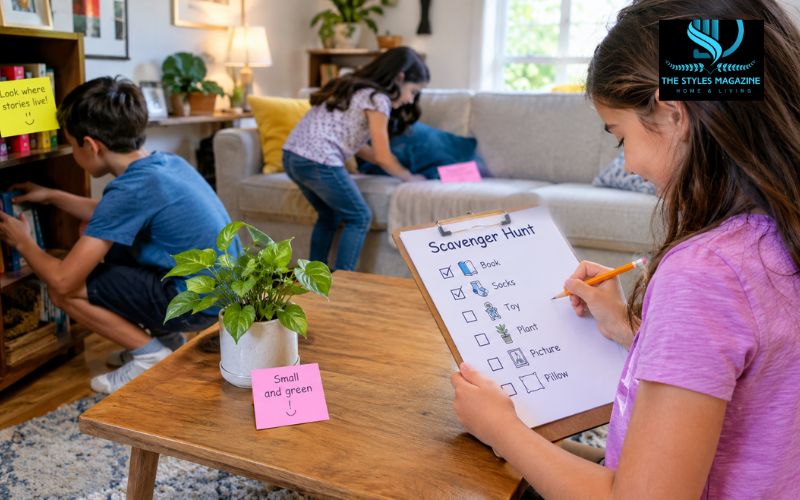
An indoor scavenger hunt is one of those activities that requires surprisingly little to create a lot of excitement.
A familiar living room can become the starting point of an adventure. The hallway becomes a trail to follow, the bookshelf hides a secret message, and an ordinary kitchen cupboard might contain the clue everyone has been searching for.
Whether you are planning a rainy afternoon, a birthday party, a family gathering or simply looking for something different to do at home, a scavenger hunt can keep children entertained while encouraging them to move, think and work together.
Better still, it can be adapted to almost any home and any age group.
Decide What Type of Scavenger Hunt You Want
There is more than one way to organise a scavenger hunt.
The simplest version gives children a list of objects they need to find around the house.
For example:
- something red;
- something round;
- something soft;
- an object beginning with the letter S;
- something smaller than your hand;
- three things made from wood.
This format is quick to prepare and works particularly well with younger children.
A clue-based scavenger hunt is more immersive.
Instead of receiving the whole list at once, the children receive one clue. Solving it tells them where the next clue is hidden.
For example:
I am cold inside and help keep your food fresh.
The answer is the refrigerator, where the next clue is waiting.
A third option is to combine the scavenger hunt with a treasure hunt. Children complete a series of searches and puzzles before eventually reaching one final reward.
This format works especially well for birthdays and themed family activities.
Choose a Theme
A theme can turn a simple household game into a much bigger adventure.
You do not need elaborate decorations. A short story at the beginning is often enough.
Popular themes include:
Pirates
The children must recover a missing treasure map and follow the captain’s clues to find the hidden chest.
Detectives
A mysterious object has disappeared, and the children have to collect evidence and identify what happened.
Secret Agents
Each clue is part of a classified mission, with codes and challenges that must be completed before the final objective is revealed.
Space Explorers
The children are astronauts travelling between imaginary planets around the house.
Wizards
A magical object has gone missing, and only a series of enchanted clues can reveal its location.
Jungle Explorers
The house becomes an unexplored jungle filled with hidden symbols, mysterious animals and forgotten treasure.
The theme does not need to affect every single clue. Its main purpose is to connect the different tasks and make the hunt feel like one complete story.
Use the Home as Part of the Game
One of the best things about an indoor scavenger hunt is that the setting is already there.
Almost every room contains potential hiding places.
You could hide clues:
- beneath a cushion;
- under a chair;
- beside the shoes;
- behind a curtain;
- inside a book;
- underneath the dining table;
- near the washing machine;
- beside a favourite toy;
- near the toothbrushes;
- inside a wardrobe.
Choose places children can access safely and independently.
Avoid high shelves, electrical equipment, cleaning products, medicine cupboards or anything that might encourage children to climb on furniture.
The goal is exploration, not difficulty reaching the clue.
Write Clues That Fit the Children’s Age
The quality of a scavenger hunt depends heavily on the clues.
If every clue is immediately obvious, the game may finish too quickly.
If the clues are too difficult, the children will lose interest.
The best level is one that requires a little thought but still allows the group to keep progressing.
For Ages 4 to 6
Use simple pictures, colours and familiar objects.
A clue might show a drawing of a bed or a shoe.
You could also say:
Find something you sit on.
or:
Look where you brush your teeth.
At this age, an adult can read the clues aloud.
For Ages 6 to 9
Children can begin solving riddles, simple codes and word clues.
For example:
I have four legs, but I cannot walk. You use me when you eat.
Answer: a table.
You can also introduce:
- simple number puzzles;
- missing letters;
- picture codes;
- mazes;
- matching games.
For Ages 9 and Up
Older children usually enjoy more challenging tasks.
Try:
- secret alphabets;
- logic puzzles;
- multi-step clues;
- hidden messages;
- riddles with wordplay;
- detective-style evidence.
At this age, an indoor scavenger hunt can begin to resemble a small escape-room experience.
Mix Searching With Puzzles
A scavenger hunt becomes more interesting when children do more than simply move from one hiding place to another.
Try adding different types of challenges between clues.
For example:
A Puzzle
Cut a picture into several pieces. Once assembled, it reveals the next location.
A Code
Replace letters with symbols or numbers and give children a key to decode the message.
A Memory Challenge
Show children six objects for thirty seconds, cover them, remove one and ask which object is missing.
A Physical Challenge
Before receiving the next clue, the children must complete a task such as:
- hop ten times;
- balance on one foot;
- throw a soft ball into a basket;
- crawl beneath a table;
- walk backwards across the room.
An Observation Task
Hide several symbols in a picture and ask children to find them all.
Variety keeps the game moving and gives different children opportunities to contribute.
Turn the Hunt Into a Story
A scavenger hunt becomes much more memorable when every clue feels like part of a larger mission.
Instead of simply writing:
Look under the sofa.
you could write:
The thief left another message somewhere people sit to relax. Search carefully before the trail goes cold.
The location is exactly the same, but the second version gives it meaning.
A simple introduction might be:
A mysterious box was delivered this morning. Inside was a message explaining that a hidden treasure has been left somewhere in the house. To find it, you must solve every clue before time runs out.
That is enough to give the game direction.
Make the Children Work Together
For birthday parties or groups of siblings, a cooperative scavenger hunt is often easier to manage than a race.
Instead of competing, everyone works towards the same goal.
One child may be good at spotting hidden details.
Another may understand a riddle quickly.
Someone else may remember something from an earlier clue.
Working together also prevents one particularly fast child from finding every clue before the others have had a chance to participate.
If the group is large, divide the children into smaller teams but give them different tasks that eventually contribute to one shared final solution.
Add a Countdown Carefully
A timer can make a scavenger hunt feel more exciting, especially for older children.
For example:
You have 45 minutes to recover the missing treasure.
However, a countdown should add excitement rather than pressure.
Younger children usually do not need a strict time limit.
For older children, the timer can work well if the clues are appropriately difficult and there is enough time to complete the adventure comfortably.
Prepare Hints Before You Start
Even a clue that seems obvious to an adult may completely confuse a group of children.
Prepare one or two hints for the more difficult stages.
If the clue is:
I have a door but no rooms, and I keep your food cold.
a first hint could be:
Look in the kitchen.
If they still cannot solve it:
You open me when you want milk.
This keeps the game moving without giving away the answer immediately.
Hints are especially useful when running the activity at a birthday party, where a long delay can quickly affect the whole group.
Use Printable Scavenger Hunts When You Want a Bigger Adventure
Creating a simple scavenger hunt from scratch can take only a few minutes.
A longer story-based game requires more preparation.
You may need to create:
- the story;
- the clues;
- the puzzles;
- the solutions;
- different difficulty levels;
- the final mission.
For parents who want the experience of a full adventure without designing everything themselves, printable games can be a practical option.
Riddlelicious offers printable treasure hunts and mystery adventures that combine stories, riddles, puzzles and challenges designed for children.
The structure of the adventure is already prepared, while parents can still decide where to place the clues and how to adapt the game to their home or party venue.
That makes printable games particularly useful when the scavenger hunt is intended to be the main activity rather than a quick ten-minute game.
Choose the Right Number of Clues
Longer is not always better.
Young children may be perfectly happy with five or six stages.
For children between six and nine, around eight stages can create a satisfying adventure.
Older children may enjoy ten or more, particularly when the hunt includes different types of puzzles.
Pay attention to how long each clue takes.
Ten quick clues can move faster than five difficult logic puzzles.
The ideal hunt should make children eager to discover the next challenge.
Create a Good Final Treasure
The final reward does not need to be expensive.
The excitement usually comes from reaching it.
Ideas include:
- chocolate coins;
- small sweets;
- stickers;
- party bags;
- small toys;
- certificates;
- craft supplies.
For a birthday party, prepare individual rewards so there is no argument over how the treasure should be divided.
The treasure can also lead into the next part of the day.
For example, the final clue might reveal the location of the birthday cake or a movie-night box.
Try a Rainy-Day Scavenger Hunt
Indoor scavenger hunts are particularly useful when plans suddenly change because of bad weather.
Instead of spending the afternoon deciding what to watch, prepare a quick list such as:
Find:
- something yellow;
- a book with an animal on the cover;
- something beginning with M;
- an object with four legs;
- something that makes a sound;
- an item smaller than a spoon;
- something everyone in the family uses.
The first child or team to complete the list wins.
For younger children, use drawings instead of written descriptions.
Create a Birthday Scavenger Hunt
For a birthday, make the hunt feel more special by connecting it to the party theme.
A dinosaur party could involve finding missing dinosaur eggs.
A superhero party could send children on missions to recover stolen equipment.
A detective party could revolve around solving a mystery.
A wizard party might ask children to recover ingredients needed for a magical spell.
Brands such as Riddlelicious use this type of story-led structure to turn the sequence of puzzles into one connected adventure rather than a collection of unrelated activities.
That narrative element is often what children remember most.
Let Children Create Their Own Hunt
Once children understand how scavenger hunts work, turn the activity around.
Ask them to create one for the adults.
Give them paper and let them write or draw clues.
They will need to:
- choose hiding places;
- decide what each clue means;
- think about the order;
- make sure one clue leads to the next.
Creating the hunt can be just as entertaining as completing one.
It also requires children to think about how another person will interpret their instructions.
Keep Safety in Mind
Before starting, check every hiding place.
Avoid areas containing:
- sharp objects;
- medicines;
- cleaning products;
- fragile decorations;
- hot appliances;
- electrical equipment.
Make sure children do not need to climb or move heavy furniture.
If certain rooms are off limits, explain this clearly before the game begins.
A simple rule such as “all clues are below shoulder height” can prevent unnecessary climbing.
A Simple Way to Make Home Feel Completely Different
The real appeal of an indoor scavenger hunt is not complicated puzzles or expensive decorations.
It is transformation.
For half an hour, an ordinary home becomes somewhere worth exploring.
Children begin looking at familiar rooms differently because any object could contain a clue and every solved puzzle brings them closer to the final discovery.
Whether you create a quick hunt using household objects or prepare a complete story-led adventure, the principle remains the same:
Give children something to search for, something to solve and a reason to discover what comes next.
Sometimes that is all it takes to turn an ordinary afternoon at home into an adventure.
Enjoyed it? Find more exclusive content on The Styles Magazine.