Learning how to make natural toothpaste can be appealing if you want a short ingredient list, a different flavour, or more control over the texture of what you brush with. Most homemade recipes are simple mixtures of a base such as coconut oil, a mild cleaning ingredient such as baking soda, and optional flavouring.
This guide covers four practical versions: a baking-soda toothpaste, a baking-soda-free paste, a herbal variation, and an Ayurvedic-inspired option. The recipes are designed to be simple rather than packed with unnecessary ingredients.
There is one important limit to understand before you start. Homemade toothpaste can help a toothbrush remove food debris and plaque from tooth surfaces, but a DIY mixture is not automatically an anticavity toothpaste. In the UK, current preventive guidance recommends brushing at least twice a day with fluoride toothpaste; standard adult toothpaste usually contains 1,350 to 1,500 ppm fluoride. Fluoride is the part of toothpaste with the strongest established role in preventing tooth decay.
Quick Guide Table
| Homemade Toothpaste Type | Main Ingredients | Best For | Important Note |
| Baking soda | Baking soda + coconut oil | Simple everyday DIY cleaning | Baking soda is relatively low-abrasive, but it does not provide fluoride protection by itself. |
| Baking-soda-free | Coconut oil + optional xylitol/glycerin | People who dislike baking soda | Mainly provides a brushing medium rather than proven cavity protection |
| Herbal | Basic paste + mild mint flavour | People who prefer a fresh herbal taste | Avoid excessive essential oils |
| Ayurvedic-inspired | Coconut oil + baking soda + mild culinary spice | Traditional-style flavour | Traditional ingredients should not be presented as proven dental treatments |
| Commercial fluoride toothpaste | Professionally formulated ingredients + fluoride | Routine cavity prevention | UK guidance recommends fluoride toothpaste for regular brushing. |
Simple Step-by-Step Guide
For a basic homemade natural toothpaste:
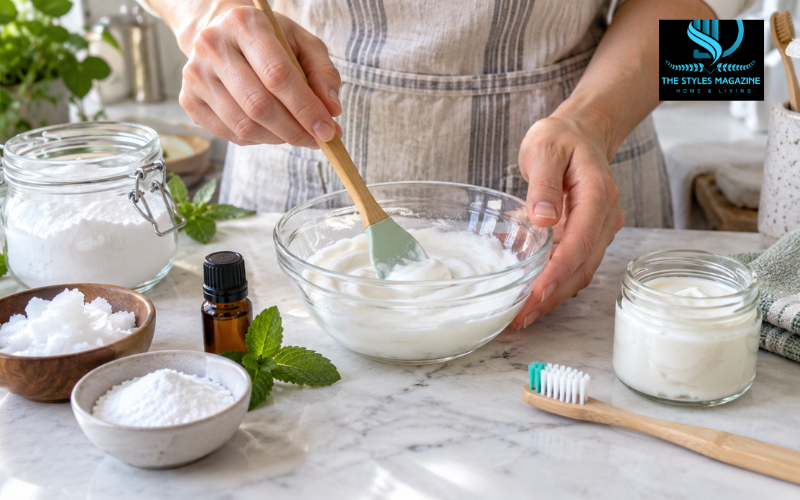
- Add 2 tablespoons of baking soda to a clean bowl.
- Mix in 2 tablespoons of softened coconut oil.
- Add 1 teaspoon finely powdered xylitol if you want a less salty taste.
- Add a tiny amount of suitable food-grade mint flavouring if desired.
- Stir until the mixture becomes smooth and even.
- Transfer it to a clean, dry container with a lid.
- Use a small amount and brush gently rather than scrubbing hard.
Baking soda has relatively low intrinsic abrasivity, but it does not have proven anticavity activity on its own.
What Natural Toothpaste Can—and Cannot—Do
Toothpaste does several jobs at once. It helps the toothbrush loosen plaque and food debris, makes brushing feel more comfortable, freshens the mouth, and can deliver active ingredients when the product has been properly formulated and tested.
Those jobs are not the same. Cleaning the tooth surface means physically removing deposits. Whitening toothpaste mainly helps with some surface stains. Cavity prevention involves protecting enamel against repeated acid attacks. Remineralisation means replacing minerals lost from early enamel damage. A homemade paste may help with cleaning, but that does not prove it prevents cavities or repairs enamel.
Fluoride remains the best-established toothpaste ingredient for reducing tooth decay, which is why UK and American dental guidance recommends fluoride toothpaste for routine brushing.
Hydroxyapatite toothpaste is also being studied as a fluoride-free option. A 2025 systematic review found promising results for manufactured hydroxyapatite toothpastes, although only four studies met that review’s eligibility criteria. The available research concerns properly formulated products, not adding loose hydroxyapatite powder to a kitchen-made paste. Homemade mixtures should therefore be described as DIY cleaning pastes rather than proven remineralising treatments.
Ingredients for a Simple Homemade Toothpaste Recipe
A simple homemade toothpaste recipe does not need a long shopping list. The most useful ingredients fall into four groups: a base, a mild abrasive, an optional sweetener, and an optional flavouring.
Coconut oil is commonly used as a base because it makes a spreadable paste, although it softens in warm rooms. It mainly provides texture and should not be treated as a replacement for fluoride. Food-grade vegetable glycerin is another optional base for a smoother texture.
Baking soda, or sodium bicarbonate, is a mild abrasive and can help lift surface deposits and stains. Research on baking-soda toothpastes describes sodium bicarbonate itself as relatively low in abrasivity. However, a homemade mixture has not been tested as a complete formulation, so gentle brushing still matters.
Finely powdered xylitol can be added for a less salty taste. It is optional, and the paste works without it. Water can thin a mixture, but it also makes storage more complicated because homemade products lack professional preservation systems.
For flavour, a small amount of mild mint flavouring may be used. Concentrated essential oils can irritate the mouth if too much is added, so they should be used sparingly and only when the product is specifically suitable for oral or food use. They are completely optional.
How to Make Natural Toothpaste With Baking Soda
If you are wondering how to make natural toothpaste with baking soda, start with a small batch rather than filling a large jar. This keeps preparation simple and reduces the amount you need to store.
For a basic recipe, use:
- 2 tablespoons baking soda
- 2 tablespoons softened coconut oil
- 1 teaspoon finely powdered xylitol, optional
- 1 drop of peppermint flavour or essential oil specifically labelled suitable for oral or food use, optional
Stir the baking soda and coconut oil together in a clean glass bowl until the texture is even. Mix in the xylitol and flavouring if you are using them. Transfer the paste to a clean, dry container with a lid.
If the mixture is too firm, add a little more softened coconut oil rather than pouring in water. If it is too loose, add a small amount of baking soda and mix again. Coconut oil naturally becomes softer in warm conditions, so the texture may change with room temperature.
Use only a small amount on a toothbrush and brush gently. Baking soda can help with cleaning and surface-stain removal, but adding extra does not make the paste automatically better. Research describes baking soda as a relatively low-abrasive toothpaste ingredient, while tooth wear can also be affected by brushing pressure, other abrasive ingredients, and acid exposure.
How to Make Natural Toothpaste Without Baking Soda
Some people dislike the salty taste of baking soda or simply want a smoother paste. A baking-soda-free recipe can work as a basic brushing medium, although it should not be presented as an anticavity substitute for fluoride toothpaste.
For a simple natural toothpaste without baking soda, combine:
- 2 tablespoons softened coconut oil
- 1 teaspoon very finely powdered xylitol, optional
- 1 teaspoon food-grade vegetable glycerin, optional
- A tiny amount of suitable mint flavouring, optional
Mix everything until smooth. If you leave out the glycerin, the result will be firmer and may soften quickly in a warm bathroom. This version contains no dedicated abrasive, so its main purpose is to provide a pleasant medium for brushing rather than to polish stains.
People with frequent cavities, dry mouth, braces, exposed roots, or a known high risk of decay should be especially cautious about replacing a formulated toothpaste. Fluoride toothpaste is generally the more evidence-based everyday choice.
Choosing Ingredients for Sensitive Teeth and Gums
Sensitive teeth and sore gums are good reasons to keep a DIY recipe very simple. Strong flavours, coarse powders, and vigorous brushing can make an already uncomfortable mouth feel worse.
Choose a soft-bristled toothbrush, use light pressure, and avoid adding gritty ingredients simply because they are described online as “natural whiteners.” A smooth paste is usually more comfortable than one containing rough charcoal, salt crystals, or coarse herbal powders.
If mint stings or causes discomfort, leave it out instead of adding another strong flavour to cover it. Homemade toothpaste does not need essential oils to function as a brushing paste.
Persistent sensitivity can have several causes, including gum recession, tooth wear, decay, or cracks. Repeated bleeding, swelling, pain, or sensitivity deserves dental advice rather than another change of homemade toothpaste.
How to Make Natural Toothpaste for Kids
Children need more caution than adults because younger children often swallow some toothpaste and are still learning how to brush properly. For that reason, a homemade fluoride-free recipe should not automatically replace the toothpaste recommended for a child.
The American Dental Association advises a rice-grain-sized smear of fluoride toothpaste for children under three and a pea-sized amount from ages three to six, with adult supervision. UK guidance is similar and recommends twice-daily brushing with age-appropriate fluoride toothpaste.
For a child, avoid concentrated essential oils, strong spices, rough powders, or recipes that encourage swallowing because they taste sweet. If a child dislikes mint, an age-appropriate commercial fluoride toothpaste in another flavour may be a more suitable choice than removing fluoride altogether.
Parents should also supervise brushing and help young children use the correct amount of toothpaste. A dentist can provide more specific advice for children who have repeated cavities, enamel problems, braces, or other special dental needs.
How to Make Herbal Toothpaste at Home
A homemade herbal toothpaste is usually a basic paste with a plant-based flavour. The simplest approach is generally better than mixing many strong herbs together.
Start with 2 tablespoons of softened coconut oil and 1 tablespoon of baking soda. If you want a herbal flavour, add only a very small amount of a suitable peppermint or spearmint flavouring. Mix until smooth and prepare only a small batch.
The herb or mint mainly changes taste and freshness. Traditional use does not automatically prove that an ingredient prevents cavities, treats gum disease, or kills harmful bacteria at a useful level inside a homemade paste.
Stronger is not always better. Concentrated essential oils may irritate sensitive oral tissues, and people with allergies or sensitive mouths may prefer to leave them out completely.
Avoid packing coarse dried herbs into toothpaste. They can create an unpleasant texture and make the mixture more difficult to keep clean.
Ayurvedic Toothpaste Recipe and Traditional Ingredient Choices
Ayurvedic oral-care traditions may use aromatic plants, spices, oils, or plant powders. Traditional use, however, is not the same as proven clinical benefit, so a home recipe should stay mild and avoid medical claims.
For a simple Ayurvedic-inspired brushing paste, mix 2 tablespoons of softened coconut oil with 1 tablespoon of baking soda. If desired, add a very small pinch of finely ground, food-grade cardamom or fennel for flavour. Mix until the ingredients are evenly combined.
The spice in this recipe is included for aroma and taste, not as a proven treatment for cavities or gum disease.
Avoid turning an Ayurvedic toothpaste recipe into a strong mixture containing concentrated clove oil, acidic fruit, coarse salt, charcoal, or several powdered herbs. Even familiar kitchen ingredients can irritate the mouth or become unpleasant when used in concentrated amounts.
If you are interested in neem, clove, or another traditional ingredient for a particular dental problem, discuss that use with a dental professional instead of assuming that a homemade concentration will be safe or effective.
What Is the Best Homemade Toothpaste for Your Needs?
There is no single best homemade toothpaste for everyone. The most practical option depends on taste, texture, sensitivity, and why you want to make your own paste.
| Type | Main ingredients | Texture and taste | Who may prefer it | Main precaution |
| Baking-soda paste | Baking soda and coconut oil | Smooth and slightly salty | Adults wanting a very simple DIY paste | Does not supply fluoride |
| Baking-soda-free paste | Coconut oil with optional xylitol or glycerin | Softer and milder | People who dislike baking soda | Limited polishing action and no fluoride |
| Herbal paste | Basic paste with mild mint flavour | Fresh-tasting | Adults who prefer herbal flavour | Avoid too much essential oil |
| Ayurvedic-inspired paste | Coconut oil, baking soda and mild culinary spice | Warm and aromatic | Adults interested in traditional-style flavour | Traditional use is not proof of dental benefit |
If cavity prevention is the main priority, professionally formulated fluoride toothpaste has the clearest evidence base. Hydroxyapatite research is encouraging but still developing, so people choosing fluoride-free products can ask a dentist which tested option suits their needs.
Is Homemade Toothpaste Suitable for Daily Use?
Whether homemade toothpaste for daily use is suitable depends less on whether the ingredients are labelled natural and more on what the mixture contains and what your mouth needs.
For regular use, consider abrasiveness, brushing pressure, fluoride exposure, sensitivity, dry mouth, diet, and cavity risk. A DIY paste may clean the surface yet still lack an active ingredient shown to reduce decay.
Current UK preventive guidance recommends brushing at least twice a day, including last thing at night, with fluoride toothpaste. For adults, standard toothpaste containing about 1,350 to 1,500 ppm fluoride is recommended. This means a fluoride-free homemade paste is not a like-for-like replacement for the toothpaste used in evidence-based cavity prevention.
If you enjoy natural toothpaste, consider it an occasional DIY option rather than automatically replacing both daily fluoride brushing sessions. People with frequent decay should seek individual dental advice before changing their routine.
How to Use and Store Homemade Toothpaste Safely
Homemade toothpaste does not contain the same preservatives, stabilisers, and quality controls used in manufactured products, so cleanliness matters.
Prepare the mixture with clean, dry utensils and make small amounts at a time. Store the paste in a clean container with a close-fitting lid. Instead of repeatedly dipping a used toothbrush into a shared jar, remove a small amount with a clean spoon or spatula and place it on the brush.
Water-free mixtures are simpler to manage than recipes containing added water. Once water is introduced, keeping a homemade product hygienic becomes more difficult, particularly when the container is repeatedly opened in a warm and humid bathroom.
There is no reliable universal shelf life that applies to every homemade toothpaste recipe. Ingredients, moisture, preparation, temperature, and handling can all differ. For that reason, avoid assuming that every DIY paste will remain suitable for a fixed number of weeks.
Discard the mixture if its smell, colour, texture, or appearance changes unexpectedly or if you believe it has become contaminated. Coconut-oil recipes may naturally soften or harden as the room temperature changes; this alone does not necessarily mean the mixture has spoiled.
Common Homemade Toothpaste Mistakes and Ingredients to Avoid
One of the biggest mistakes is adding acidic ingredients such as lemon juice or vinegar because they are promoted as natural whitening ingredients. Repeated acid exposure can contribute to enamel erosion, so strongly acidic ingredients do not belong in a routine homemade toothpaste.
Another common mistake is assuming that harsher scrubbing produces cleaner teeth. Avoid coarse salt, aggressive charcoal powders, and excessive brushing pressure. Baking soda itself is considered relatively low-abrasive compared with many dentifrice abrasives, but the whole brushing method still matters.
Essential oils should not be poured into a recipe freely. Adding more can make the mixture much stronger than expected and may make brushing uncomfortable. Keeping flavouring minimal—or leaving it out—is a simpler approach.
Clay, charcoal, coconut oil, herbs, and spices should also not be described as proven replacements for fluoride simply because they are natural. “Natural” describes the source or image of an ingredient; it does not guarantee that the ingredient is safer or more effective for teeth.
Most importantly, homemade toothpaste cannot cure a cavity, rebuild a broken tooth, or treat established gum disease. Tooth pain, visible holes, swelling, repeated bleeding, or ongoing sensitivity need proper dental assessment rather than another DIY ingredient.
Conclusion
Learning how to make natural toothpaste is straightforward: choose a simple base, keep any abrasive mild, add flavour only if you want it, and prepare small batches with clean tools. Baking-soda, baking-soda-free, herbal, and Ayurvedic-inspired versions can all be made without turning the recipe into a complicated mixture.
The safest approach is to keep expectations realistic. Homemade toothpaste may provide a pleasant way to brush and clean tooth surfaces, but “natural” does not automatically mean safer, and a DIY recipe does not automatically provide the cavity protection of a properly formulated toothpaste.
For everyday oral health, regular brushing, gentle technique, cleaning between the teeth, sensible sugar intake, and appropriate dental care matter more than adding many ingredients to a jar. If you choose to make natural toothpaste, use it thoughtfully and make sure your wider oral-care routine still meets your individual dental needs.
FAQs
Can I Use Homemade Natural Toothpaste Every Day?
You can use a mild homemade paste for cleaning, but it may not provide the same cavity protection as fluoride toothpaste. UK guidance recommends brushing at least twice daily with fluoride toothpaste.
Is Baking Soda Safe To Use In Homemade Toothpaste?
Baking soda is considered relatively low in abrasivity and is commonly used in formulated toothpastes. Still, brush gently and avoid adding unnecessarily coarse or highly abrasive ingredients to homemade recipes.
How Can I Make Natural Toothpaste Without Baking Soda?
Mix softened coconut oil with optional finely powdered xylitol and a little food-grade vegetable glycerin. Mild flavouring can be added, but the mixture should not be considered a proven anticavity toothpaste.
Can Children Use Homemade Natural Toothpaste?
A homemade fluoride-free paste should not automatically replace children’s fluoride toothpaste. The ADA recommends a rice-sized smear before age three and a pea-sized amount from ages three to six, with supervision.
Does Homemade Toothpaste Prevent Cavities?
Not necessarily. Cleaning ingredients can help remove surface debris, but cavity prevention requires more than cleaning alone. Fluoride toothpaste has established evidence for reducing tooth decay.
Enjoyed it? Find more exclusive content on The Styles Magazine.
Disclaimer: This article is provided for general informational and educational purposes only and is not a substitute for professional dental advice, diagnosis, or treatment. Homemade toothpaste recipes may not provide the fluoride, preservation, or tested cavity protection of professionally formulated toothpaste. Children, people with sensitive teeth, frequent cavities, gum problems, or other dental concerns should speak with a qualified dentist before changing their oral-care routine.