Choosing grout may seem like a small part of a shower project, but it affects how the finished surface looks, cleans, and handles daily moisture. Epoxy grout for shower installations is popular because it is dense, highly water-resistant, stain-resistant, and does not need routine sealing. Those qualities make it especially useful in areas exposed to water every day.
Unlike traditional cement grout, epoxy grout is made with resin and a hardener rather than cement as its main binding material. Once the components are mixed, they cure into a strong grout joint that absorbs very little moisture. This can reduce staining and make routine cleaning easier.
However, epoxy grout costs more and can be less forgiving during installation. It also does not replace the waterproofing system behind shower tile. Before choosing it, homeowners should understand its benefits, limitations, tile compatibility, installation needs, and repair options.
Quick Tips Before Using Epoxy Grout
- Check that the grout is approved for shower use.
- Confirm compatibility with your tile type.
- Mix components exactly as directed.
- Work in small sections because epoxy can set quickly.
- Clean residue before it cures.
- Do not rely on grout as a replacement for proper shower waterproofing.
What Epoxy Grout Is and How It Works in a Shower
Traditional epoxy grout usually contains an epoxy resin, a hardener, and a colored filler or aggregate. When the resin and hardener are combined, a chemical reaction begins. The mixture gradually becomes firm and forms a dense joint between the tiles.
That dense structure gives epoxy grout many of its advantages in a shower. It has very low water absorption and offers strong resistance to common stains and chemicals. Products such as MAPEI Kerapoxy CQ and ARDEX WA are two-component, 100%-solids epoxy products designed for demanding tile installations, including wet areas.
Cement grout works differently. It is generally mixed with water and hardens through a cement-based curing process. Modern high-performance cement grouts can work well in bathrooms, but true epoxy grout generally provides better stain resistance and lower water absorption. The tradeoff is that epoxy usually costs more and requires more careful handling during installation.
Main Benefits of Using Epoxy Grout in a Shower
The biggest benefit of epoxy grout for shower tile is its ability to handle a wet environment with less moisture absorption than conventional cement grout. MAPEI describes epoxy grout as its most water- and stain-resistant grout option for showers. Products such as Kerapoxy CQ and SPECTRALOCK PRO Premium also do not require a penetrating grout sealer.
Its stain resistance is valuable around shampoo, conditioner, soap, body oils, and colored personal-care products. A dense grout joint gives these materials less opportunity to soak deeply into the grout. Some epoxy products also contain technology intended to help inhibit stain-causing mold and mildew in the grout joints.
Maintenance is another advantage. Because sealing is generally unnecessary, homeowners avoid the recurring job of applying a penetrating grout sealer. Properly installed epoxy grout is also durable and usually provides consistent color.
That does not mean epoxy grout can never become dirty. Soap film, hard-water deposits, and surface grime can still collect on it. The difference is that these materials are less likely to penetrate deeply into a dense epoxy joint.
Epoxy Grout vs. Cement Grout for Showers
Both materials can be used successfully in a properly constructed shower, but their performance and installation needs are different.
| Feature | Epoxy Grout | Cement Grout |
| Water absorption | Very low | More absorbent |
| Stain resistance | High | Varies by formulation |
| Sealing | Usually not required | May be recommended depending on product |
| Color consistency | Generally very good | Can be affected by mixing and curing |
| Installation | Faster-paced and less forgiving | Usually easier for DIY users |
| Cost | Higher | Lower |
| Maintenance | Generally lower | May require more stain and sealer care |
Epoxy grout is often worth the added cost where low maintenance, moisture resistance, and stain resistance are priorities. Cement grout remains practical when budget and easier installation matter more.
However, grout type should not be confused with shower waterproofing. Even a premium epoxy grout cannot make an incorrectly constructed shower waterproof.
Best Epoxy Grout for Shower Projects: What to Look For
There is no single best epoxy grout for shower projects because the right choice depends on the tile, grout-joint width, installer experience, desired color, and manufacturer-approved applications.
LATICRETE SPECTRALOCK PRO Premium is a high-performance epoxy grout designed for ceramic, glass, and stone applications, including wet areas. Its manufacturer highlights stain resistance, color uniformity, durability, and a non-sag formula.
MAPEI Kerapoxy CQ is a two-component, 100%-solids epoxy grout containing color-coated quartz. Current product information lists it for grout joints from 1/16 inch to 3/8 inch and states that no sealer is required.
ARDEX WA is another two-component, 100%-solids epoxy grout and adhesive. ARDEX specifically lists showers, bathrooms, swimming pools, and hot tubs among its suitable applications.
When comparing products, look beyond the color chart. Check the approved tile types, joint-width range, working time, cleanup method, cure time, and installation instructions. A professional-grade epoxy can be worth the extra expense when long-term stain resistance and low maintenance are priorities.
Waterproof Epoxy Grout for Shower Areas
The phrase waterproof epoxy grout for shower projects needs some explanation. Certain epoxy products are marketed as waterproof or highly resistant to water, but grout is only one part of a complete tiled shower.
Tile industry waterproofing systems are designed to stop moisture before it reaches vulnerable parts of the building. Schluter, for example, states that tile and grout joints are not inherently waterproof and that showers require an appropriate waterproofing system behind the finished tile surface.
This is especially important around shower floors, niches, benches, curbs, corners, wall-to-floor connections, drains, and plumbing penetrations.
In practical terms, epoxy grout can greatly reduce moisture absorption through grout joints, but it should be considered a durable finishing material rather than the primary waterproofing layer. If water is reaching the wall or floor structure because the underlying waterproofing has failed, simply replacing cement grout with epoxy will not solve the main problem.
White Epoxy Grout for Shower Tile
White epoxy grout for shower tile is popular because it produces a bright, clean appearance. It works especially well with white ceramic tile, porcelain, marble-look tile, mosaics, and many patterned bathroom designs.
The strong stain resistance of epoxy can also be useful with light-colored grout because spills and bathroom products are less likely to penetrate the grout deeply.
However, white epoxy grout is not maintenance-free. Hard-water minerals, soap film, body oils, and cleaning-product residue can collect on the surface and make even stain-resistant white grout look dull over time.
Color should also be chosen with the overall tile design in mind. Bright white creates visible, defined grout lines. An off-white, warm gray, or tile-matching shade may produce a softer appearance and make minor surface buildup less noticeable.
Natural stone requires additional care. Before using white or any other epoxy grout with porous stone, confirm compatibility and test a small area first.
Pre-Mixed Epoxy Grout for Shower Projects
The term pre-mixed epoxy grout for shower use can be confusing. Traditional epoxy grout normally comes in separate components that must be combined immediately before application. Once the components are mixed, the curing reaction begins and the installer has a limited working period.
Ready-to-use grout is different. Some modern one-component products use advanced resin technology to provide performance similar to epoxy without requiring the installer to mix resin and hardener.
For example, LATICRETE SPECTRALOCK 1 is a pre-mixed, one-component grout designed to provide epoxy-level performance. LATICRETE lists it for demanding applications including showers and pools. It should not, however, be confused with a traditional multi-component epoxy such as SPECTRALOCK PRO Premium.
Ready-to-use grout can be convenient for smaller projects, repairs, or homeowners who want to avoid mixing separate components. Always read the actual technical data sheet instead of assuming every product described online as “pre-mixed epoxy” is a traditional epoxy grout.
Choosing Epoxy Grout for Different Shower Tile Types
Porcelain and ceramic tiles are generally strong candidates for epoxy grout. Their surfaces are usually less porous, which can make removal of grout residue easier when the manufacturer’s cleaning directions are followed.
Glass tile can also work with certain epoxy products. LATICRETE, for example, lists glass among the materials suitable for SPECTRALOCK PRO Premium. However, always confirm compatibility because tile finish, grout-joint width, transparency, and scratching concerns can differ between products.
Natural stone requires more caution. Marble, travertine, limestone, slate, and other stone products can vary greatly in porosity and sensitivity. MAPEI advises checking the suitability of natural stone because some materials can stain or react unexpectedly during installation.
Highly textured tile can create another challenge. Epoxy resin can remain in small surface recesses and become difficult to clean after curing.
A small test area is wise whenever the tile is porous, rough, textured, handmade, sensitive, or expensive.
How Epoxy Grout Is Installed in a Shower
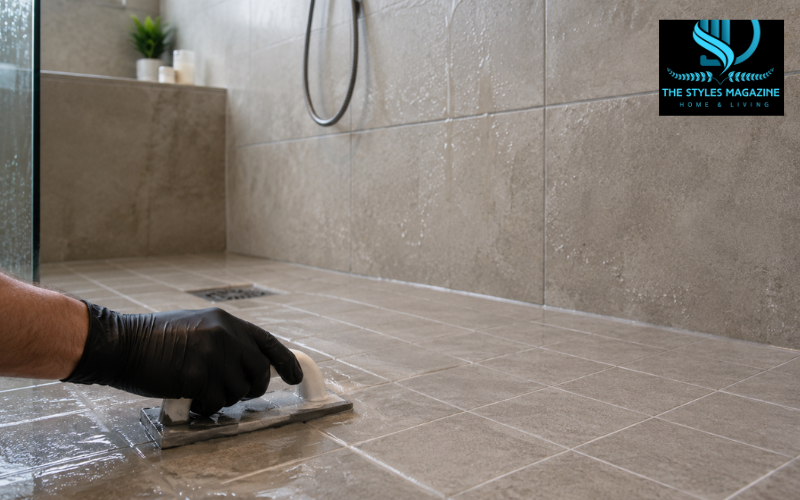
Good preparation matters with epoxy grout. Grout joints should be clean and prepared according to the product instructions. Before mixing begins, the installer should have the correct grout float, cleaning pads or sponges, buckets, and other required materials ready.
The resin and hardener must be combined according to the manufacturer’s specified proportions. Once the mixture is activated, the installer should work in manageable sections rather than covering a large area at once.
The grout is pressed firmly into the joints, excess material is removed, and the tile surfaces are cleaned according to the product’s required timing.
Cleanup is especially important. If epoxy residue is allowed to harden on the face of the tile, removing the resulting haze can become much more difficult.
Working time also differs between products and depends partly on temperature. For example, different SPECTRALOCK product information lists specific working times under specified temperature conditions, so homeowners should not assume that every epoxy grout has the same 30- or 45-minute working window.
Finally, keep the shower out of service until the grout has cured for the period specified by its manufacturer.
Epoxy Grout for Shower Repair and Regrouting
Epoxy grout for shower repair can be useful when existing grout is stained, deteriorated, or missing, but the reason for the damage should be identified first. Simply spreading new epoxy over failing grout is not a reliable long-term repair.
Loose or deteriorated old grout normally needs to be removed sufficiently to create a clean, sound joint for the replacement material. The remaining joints should then be prepared according to the new grout manufacturer’s instructions.
Recurring cracks need closer inspection. Cracks where two surfaces meet, such as wall-to-wall or wall-to-floor changes of plane, may require an appropriate flexible sealant rather than rigid grout.
Cracks that repeatedly appear through several joints or tiles can point to movement in the substrate or another installation problem. In that situation, replacing the grout without addressing the underlying cause may only provide a temporary improvement.
Complete regrouting is more sensible when deterioration is widespread, much of the original grout is loose or badly stained, or small repairs would leave an uneven finished appearance.
Where to Buy Epoxy Grout for Shower Projects
Epoxy grout is available through tile and flooring stores, building-material suppliers, home-improvement retailers, and online tile-installation suppliers.
Searching epoxy grout for shower near me can be useful when you need a particular color quickly or want advice from a local tile supplier. Specialty tile stores may also carry professional products that are not stocked by every general home-improvement retailer.
Homeowners also frequently search for Home Depot epoxy grout for shower options. Product availability can change by country, region, store, and time, so check the retailer’s current inventory instead of assuming a particular epoxy brand or color will always be available.
Wherever you purchase the grout, confirm that it is approved for the intended shower application. Check its tile compatibility, joint-width requirements, package coverage, color, cure time, and installation instructions.
Coverage is especially important. Buying too little can interrupt the installation, while buying far more than needed can be costly because epoxy grout is usually more expensive than standard cement grout.
Common Epoxy Grout Mistakes, Cleaning, and Maintenance
One common installation mistake is preparing more epoxy than can be placed and cleaned within its usable working time. A large batch may seem more efficient, but it can leave the installer rushing once the material starts to cure.
Another mistake is allowing resin haze to remain on the tile. Initial and final cleaning should happen at the times specified by the manufacturer. Waiting until the epoxy is fully hardened can make residue much more difficult to remove.
The manufacturer’s mixing ratios should also be followed exactly. Do not add extra water, change the amount of resin or hardener, or introduce unapproved additives in an attempt to make the grout easier to spread.
After curing, maintenance is relatively simple. Use a mild cleaner that is suitable for both the grout and the surrounding tile, remove soap film regularly, and rinse away cleaning residue.
Epoxy’s stain and moisture resistance does not mean a shower can never become dirty or develop surface mildew. Soap residue and organic material can still collect on the surface. Routine cleaning, good ventilation, and allowing the shower to dry between uses will help keep both grout and tile looking cleaner.
Conclusion
Epoxy grout for shower installations is a strong option for homeowners who want very low water absorption, high stain resistance, consistent color, and freedom from routine grout sealing. It can be especially valuable in frequently used showers where easier long-term maintenance is a priority.
Its main disadvantages are the higher material cost and more demanding installation process. Tile compatibility also deserves attention, especially with porous natural stone, textured surfaces, or specialty tiles.
Most importantly, epoxy grout should never be treated as a replacement for proper shower waterproofing. The membrane and underlying shower assembly are responsible for controlling water that reaches areas beneath the tile.
When the shower is correctly built and the grout is installed according to current manufacturer instructions, epoxy grout can provide a durable, attractive, and relatively low-maintenance finish for many years. Whether the extra cost is worthwhile ultimately depends on the tile being used, the project budget, maintenance expectations, and the installer’s skill level.
FAQs
Is Epoxy Grout Good For Showers?
Yes. Epoxy grout is well suited for showers because it has very low water absorption, strong stain resistance, and generally does not require routine sealing.
Is Epoxy Grout Completely Waterproof?
Epoxy grout is highly resistant to water, but grout alone does not waterproof a shower. A proper waterproof membrane or approved shower system is still required behind the tile.
Does Epoxy Grout Need To Be Sealed?
Most true epoxy grouts do not need a penetrating sealer. Always check the specific manufacturer’s instructions because product formulations and installation requirements can differ.
Can Epoxy Grout Be Used With Any Shower Tile?
It works well with many porcelain, ceramic, glass, and mosaic tiles. Porous natural stone or textured tile may need testing first because epoxy residue can stain or become difficult to remove.
Is Epoxy Grout Worth The Extra Cost?
It can be worth the higher price when you want better stain resistance, lower maintenance, consistent color, and durable grout joints in a frequently used shower.
Enjoyed it? Find more exclusive content on The Styles Magazine.
Disclaimer: This article provides general information about epoxy grout for shower projects. Always follow the grout and tile manufacturer’s instructions and consult a qualified tile professional for waterproofing, structural problems, or complex installations.