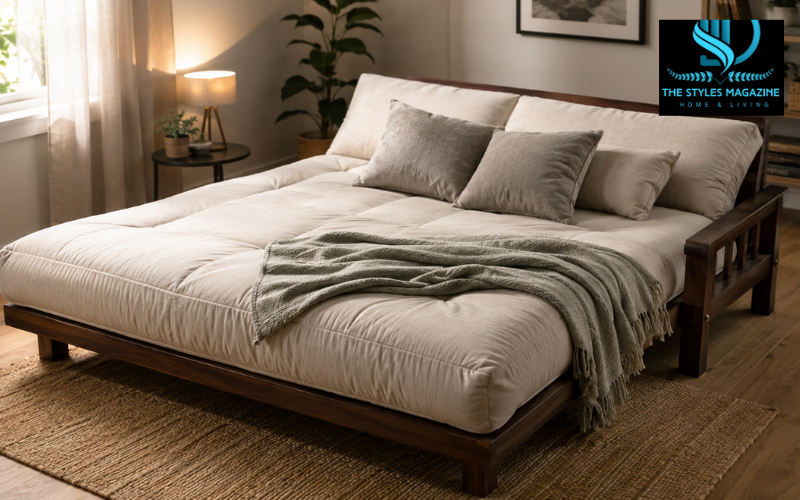
A comfortable futon should feel supportive when you sit on it and relaxing when you lie down. It should not make you feel the hard frame underneath, sink too deeply, or leave your back and shoulders uncomfortable after a short time.
Comfort depends on several things working together. The mattress thickness, the type of filling, the strength of the frame, the size of the sleeping area, and how often you plan to use the futon all matter. A thick mattress can feel soft, but it still needs enough support underneath to stay comfortable.
Sitting comfort and sleeping comfort are also slightly different. A futon used mainly as a sofa should hold its shape and provide firm support while sitting. A futon used for sleeping should offer a flatter surface with enough cushioning around the shoulders, hips, and back.
You should also decide whether you want a sofa-style futon, a Japanese floor futon, or another convertible design. Each type offers a different balance of comfort, space-saving ability, and everyday convenience.
Quick Guide Table
| Feature | What to Look For |
| Mattress | Supportive foam, memory foam, coils, or hybrid layers |
| Thickness | Around 6–8 inches for many sofa-style futons |
| Firmness | Medium to medium-firm for balanced support |
| Frame | Strong wood or metal with even support |
| Size | Full or queen for more adult sleeping space |
| Small Rooms | Loveseat, folding, or compact convertible futon |
| Regular Sleeping | Durable mattress with good pressure support |
Quick Tips for Choosing a Comfortable Futon
- Choose the futon according to sleeping, sitting, or dual-purpose use.
- Check both folded and fully opened dimensions.
- Look for supportive materials rather than thickness alone.
- Avoid very thin padding for regular adult sleeping.
- Choose breathable, durable fabric for frequent use.
- Make sure the frame feels stable and evenly supports the mattress.
The Features That Make a Futon Comfortable
The mattress is usually the biggest factor in how comfortable a futon feels. A mattress with enough depth can help prevent your body from pressing directly against the frame or floor. Western-style futon mattresses often feel better when they use supportive foam, memory foam, coils, or a combination of materials.
High-density foam can provide stable support without flattening too quickly. Memory foam is softer and adjusts to the shape of the body, which may help reduce pressure around the shoulders and hips. Coil-supported futons can feel more like a traditional bed because the springs provide extra support and help the mattress hold its shape.
Firmness also matters. A very soft futon may feel comfortable at first but can become uncomfortable if your body sinks too far. A very firm mattress may provide strong support but may not offer enough cushioning for some sleepers.
The frame or foundation must also be strong and even. Soft, breathable fabric adds comfort, especially if you spend long periods sitting or sleeping on the futon. Thickness alone does not guarantee comfort; the quality and support of the materials are equally important.
Main Types of Comfortable Futons
There are several types of futons, and each is designed for a slightly different purpose.
Western-style futon sofa beds are common in living rooms, guest rooms, and apartments. They usually have a wooden or metal frame with a separate or attached mattress. These futons can work well for both sitting and sleeping, especially when the mattress is thick and supportive.
Traditional Japanese futons are very different. They are usually thinner, foldable sleeping pads placed directly on the floor or over a tatami-style surface. They are designed to provide a firmer sleeping experience and can be folded away when not in use.
Modern folding sleepers, chair beds, and pull-out loveseats offer another option. These designs are often useful in small rooms because they can change from seating into a sleeping surface without taking up permanent bed space.
For regular sitting, a sofa-style futon is usually more practical. For minimalist sleeping and easy storage, a floor futon may make more sense. Compact convertible sleepers can be useful for guests or multipurpose rooms.
Most Comfortable Futon for Adults: What to Look For
The most comfortable futon for adults should provide enough support for an adult’s weight without sagging, flattening, or making the frame noticeable. This is especially important if the futon will be used every day.
A supportive mattress with a solid foam core, coils, or a layered construction often performs better for adults than a very thin mattress filled mainly with loose fiber. The mattress should also be thick enough to create a comfortable barrier between the body and the frame.
Frame strength matters just as much. Check whether the frame has sturdy slats, secure joints, and a stable folding mechanism. A weak frame may move, squeak, or create uneven pressure points.
Size is another important factor. Make sure the futon is long and wide enough for the person who will use it. A mattress may be comfortable in terms of softness but still feel restrictive if the sleeper cannot stretch out naturally.
For adults, very thin and lightly padded futons are generally better suited to short-term use than frequent sleeping.
Most Comfortable Futon for Sleeping
The most comfortable futon for sleeping should provide a stable surface that supports the body evenly throughout the night. You should not feel like you are sinking deeply into the middle or resting directly against a hard frame.
Balanced cushioning is important. The mattress should feel soft enough to reduce pressure around the shoulders and hips but supportive enough to keep the body from dipping too far.
The surface should also stay reasonably flat when the futon is opened into bed mode. Large gaps, uneven sections, or deep folds can become uncomfortable during longer periods of sleep.
How often you sleep on the futon should guide your choice. For occasional guests, a simple padded futon may be perfectly adequate. For frequent sleeping, it is worth choosing a stronger mattress with better support and more durable materials.
People who sleep on their side may prefer more cushioning around pressure points, while back and stomach sleepers often benefit from a slightly firmer surface that prevents excessive sinking.
Futon Bed for Adults: Daily Use vs. Guest Use
A futon bed for adults that will be used every night should be chosen more carefully than one intended only for visitors.
For daily sleeping, mattress support and durability should be the main priorities. Repeated sitting, sleeping, folding, and unfolding can place stress on both the mattress and the frame. A higher-quality construction is more likely to stay comfortable over time.
The conversion mechanism should also be easy to operate. If changing the futon from sofa to bed becomes difficult, it can quickly become frustrating during everyday use.
For occasional guests, you may not need the same level of durability. A simpler design can work well if it provides enough support for one or two nights at a time.
Think realistically about how often the futon will be used. Buying a heavy-duty model for occasional visitors may be unnecessary, while choosing a lightweight guest futon for nightly sleeping can lead to faster wear and reduced comfort.
Most Comfortable Futon Mattress for Sleeping
The most comfortable futon mattress for sleeping depends on your preferred firmness and the materials inside the mattress.
High-density foam is commonly used because it creates a stable surface while still providing some cushioning. Layered foam can also help distribute body weight more evenly.
Memory foam feels softer and adjusts to the body’s shape. This can be useful for people who want extra pressure relief. However, some sleepers may find very soft memory foam too warm or too deep.
Innerspring and pocket-coil futon mattresses provide a more traditional mattress feel. The coils help support the body and may improve the mattress’s ability to return to its original shape after use.
Hybrid futon mattresses combine foam with coils or other supportive materials. They can offer a good balance between softness and structure.
Basic fiber-filled mattresses can feel comfortable when new but may compress faster, especially under regular adult use. Instead of choosing a mattress simply because it is labeled soft, medium, or firm, consider how you personally prefer to sleep.
Mattress Thickness and Firmness Explained
Mattress thickness plays an important role in comfort, especially with Western-style futon sofa beds. A mattress around 6 to 8 inches thick, or sometimes more, can provide better cushioning for many adults because there is more material between the body and the supporting frame.
However, thickness should not be considered alone. A thick mattress made from weak filling can still flatten, while a slightly thinner mattress made with strong foam or supportive coils may feel better over time.
Soft futons offer more cushioning but may allow heavier sleepers to sink deeply. Medium-firm futons often provide a balance between comfort and support. Firmer mattresses may suit people who prefer a stable sleeping surface or who do not like feeling surrounded by soft foam.
Body weight and sleeping position also influence what feels comfortable. A side sleeper may appreciate extra cushioning, while a stomach sleeper may need more firmness.
Traditional Japanese futons should not be judged by the same thickness standards. Their thinner design is intentional and is meant to provide a firmer sleeping surface.
Full Futon Sofa Bed for Seating and Sleeping
A full futon sofa bed can be a practical choice for people who want a piece of furniture that works as both everyday seating and an occasional bed.
Full-size futons often fit well in guest rooms, home offices, apartments, and multipurpose rooms. They provide more sleeping room than smaller chair or loveseat designs without taking up as much floor space as many larger sleepers.
Comfort depends on both the mattress and the frame. Look for even support across the sleeping surface, a mattress that does not slide easily, and a frame that feels stable when sitting or lying down.
It is also important to measure the room before buying. A futon may appear compact while folded as a sofa but require much more floor space when fully opened.
Measure the width, depth, and clearance around the futon in both positions. This simple step can prevent you from choosing a model that becomes difficult to use once converted into a bed.
Most Comfortable Futon Queen for Extra Sleeping Space
The most comfortable futon queen can be a good option for couples, taller adults, or anyone who prefers more space while sleeping.
A queen-size sleeping surface allows more room to turn during the night and can feel less restrictive than smaller futon sizes. This extra space can be especially useful when two adults share the bed.
The downside is that queen futons require more room. You need enough open floor space for the futon to unfold completely, as well as enough room to move around it comfortably.
A larger mattress is also heavier, so the frame should be strong enough to support it. The folding system should operate smoothly even with the added mattress weight.
For a spacious guest room or multipurpose area, a queen futon can be a useful choice. In a very small apartment or office, however, a full-size or loveseat sleeper may provide a better balance between comfort and available space.
Comfortable Futons for Small Spaces
Finding comfortable futons for small spaces is mainly about using the available room wisely without sacrificing the sleeping surface.
Loveseat futons, chair-to-bed designs, and compact folding sleepers are useful for studios, small bedrooms, offices, and apartments. They provide seating during the day and can be opened when an extra bed is needed.
Before choosing one, check how it converts. Some futons require space behind the frame, while others unfold mainly toward the front. Knowing the direction of movement helps you plan where the futon can be placed.
Storage can also make a difference in a small room. A futon with nearby space for bedding, pillows, or a mattress topper can keep the room more organized.
Avoid choosing the smallest option simply to save space. A futon that is too narrow or short may not be comfortable for sleeping. The goal is to find the smallest design that still gives the intended user enough room to rest properly.
Frame, Fabric, and Build Quality Matter Too
A comfortable mattress cannot perform well if the frame underneath it is weak or uneven.
Wooden frames often provide a warm, traditional appearance and can be very sturdy when made with strong materials and properly spaced slats. Metal frames may be lighter and easier to move, but their quality can vary. In either case, the frame should feel stable and should not bend or shift during normal use.
Look at the slats carefully. Large gaps or sagging sections can cause the mattress to dip, which may reduce comfort.
Fabric also affects the experience. Breathable materials can feel more pleasant during warm weather, especially for people who sleep on the futon overnight. Durable and easy-to-clean upholstery is useful when the futon is used every day.
For sofa beds, test or check the folding mechanism whenever possible. A smooth mechanism makes the futon easier to use and reduces unnecessary strain on the frame.
How to Make an Existing Futon More Comfortable
You may not need to replace your futon immediately if it feels slightly too firm or lacks cushioning.
A supportive mattress topper can make a noticeable difference. A topper around 2 to 3 inches thick can add softness and pressure relief, especially when the original mattress is still in good condition.
If the mattress sags between the frame slats, improving the support underneath may help. Additional slats or another suitable firm support layer can create a flatter surface, although any changes should be compatible with the frame design.
A non-slip pad placed between the mattress and the frame can reduce movement when sitting or converting the futon.
If the manufacturer allows it, rotating or repositioning the mattress may help reduce uneven wear. Supportive pillows can also make sofa-style futons more comfortable for sitting.
However, a topper cannot fully repair a mattress that has become deeply compressed, lumpy, or damaged. In that case, replacing the mattress may provide better long-term comfort.
Conclusion
Choosing a comfortable futon is easier when you focus on how it will actually be used. A futon for everyday sleeping has different needs from one that will mainly serve as a sofa or occasional guest bed.
Look beyond appearance and pay attention to the mattress materials, firmness, thickness, frame support, sleeping dimensions, and available room space. A thicker mattress can improve comfort, but supportive materials and a strong foundation matter just as much.
Adults who plan to sleep on a futon regularly should generally prioritize durable foam, coils, or a supportive layered mattress. People with limited space may prefer a compact loveseat or folding sleeper, while those with more room may benefit from a full or queen futon.
There is no single futon that feels perfect for everyone. The best choice is the one that matches your body, comfort preference, room size, and how often you plan to use it. When those factors are considered together, a futon can become a practical and genuinely comfortable place to sit, relax, and sleep.
FAQs
What Makes A Futon Comfortable For Sleeping?
A comfortable sleeping futon combines supportive cushioning, suitable firmness, a flat sleeping surface, and a strong base. Foam, coils, or hybrid mattresses often provide better support than thin fiber-only padding.
What Is The Most Comfortable Futon For Adults?
The most comfortable futon for adults usually has a supportive mattress, sturdy frame, enough sleeping space, and balanced firmness that prevents excessive sinking while cushioning the shoulders, hips, and back.
Is An 8-inch Futon Mattress Comfortable?
An 8-inch futon mattress can be comfortable, especially for sofa-style futons, but thickness is not everything. The quality of the foam, coils, filling, and supporting frame also affects overall comfort.
Are Futons Comfortable Enough For Everyday Sleeping?
Some futons can work for everyday sleeping when they have durable support, suitable firmness, and a stable sleeping surface. Thin or lightly padded guest futons may be less suitable for nightly use.
How Can I Make My Futon More Comfortable?
You can add a supportive mattress topper, improve the foundation, use a non-slip pad, rotate the mattress when allowed, and add supportive pillows. Replace severely compressed or damaged mattresses.
Enjoyed it? Find more exclusive content on The Styles Magazine.
Disclaimer: Futon comfort varies by body type, sleeping position, mattress materials, and personal preference. Always check product dimensions, weight limits, materials, and manufacturer recommendations before purchasing.