Loam is a type of soil made from a useful balance of sand, silt, and clay particles. Gardeners often value loam because it can hold moisture while still allowing excess water to drain away. It is also usually easier to dig and plant in than very heavy clay or extremely sandy soil.
In simple terms, the loam meaning refers to soil that combines different particle sizes rather than being dominated by just one. This balance can create good conditions for roots, water, air, and nutrients.
That does not mean every loam soil is exactly the same. Some contain more sand, while others contain more clay or silt. The USDA soil-texture system therefore classifies soils according to ranges of sand, silt, and clay rather than requiring one exact 40% sand, 40% silt, and 20% clay formula.
This guide focuses on loam soil used in gardens and landscapes. It covers its composition, appearance, different types, drainage, fertility, identification, improvement, and suitable garden uses. Unrelated searches involving LOAM supplements, fibre products, or businesses are not the subject of this article.
Quick Answer:
Loam is a balanced soil texture made from sand, silt, and clay. It is popular in gardening because it usually offers good drainage, moisture retention, aeration, and workability.
Quick Guide Table
| Soil Type | Main Characteristic | Drainage | Water Retention | Best Approach |
| Loam | Balanced texture | Good | Good | Maintain with organic matter |
| Sandy Loam | Grittier and lighter | Fast | Moderate to low | Add compost to improve moisture holding |
| Silt Loam | Smooth and fine | Moderate | Good | Avoid compaction |
| Clay Loam | Heavier and stickier | Slower | High | Add organic matter and avoid working when wet |
| Sandy Soil | Very gritty and loose | Very fast | Low | Add organic matter regularly |
Simple Steps to Check Loam Soil
- Take a small handful of soil and remove stones or roots.
- Moisten it slightly with water.
- Rub it between your fingers.
- Loam usually feels partly smooth, slightly gritty, and crumbly.
- If it feels extremely gritty, it may contain more sand.
- If it feels very sticky and forms a firm ribbon, it may contain more clay.
- For greater accuracy, consider a professional soil-texture test.
What Loam Soil Is Made Of
Loam is mainly described by the proportions of three mineral particle groups: sand, silt, and clay.
Sand has the largest particles of the three. It tends to create larger spaces in soil, allowing water and air to move more easily. Silt particles are smaller and usually feel smoother. Clay particles are extremely fine and have a strong influence on the amount of water and nutrients a soil can hold.
The USDA recognises several texture classes based on the relative percentages of these particles, including loam, sandy loam, silt loam, and clay loam.
You may sometimes see loam described as 40% sand, 40% silt, and 20% clay. That can be a useful example of a loamy mixture, but it should not be treated as the only correct formula. A soil can fall within the loam texture class while having somewhat different proportions.
Organic matter is also important in healthy garden soil. However, it is different from sand, silt, and clay. Soil texture mainly describes the mineral particles, while organic matter helps improve soil structure, moisture management, biological activity, and nutrient availability.
Loam Meaning and Pronunciation
In gardening, loam means soil containing a mixture of sand, silt, and clay in proportions that avoid many of the problems found in soils dominated by only one particle type. The RHS describes loams as mixtures of clay, sand, and silt that avoid the extremes of clay and sandy soils.
The loam pronunciation is simple: it rhymes with “home.”
The terms loam, loamy, and loam soil are closely connected but are not always used in exactly the same way.
“Loam” can refer to the recognised soil texture class. “Loam soil” is a common gardening phrase for soil with loamy characteristics. “Loamy” is often used more generally to describe soil that feels balanced, workable, and neither extremely sandy nor extremely clay-heavy.
Because gardeners often describe soil by feel and behaviour, the word “loamy” may sometimes be used less precisely than it would be in a laboratory soil analysis.
What Loam Looks and Feels Like
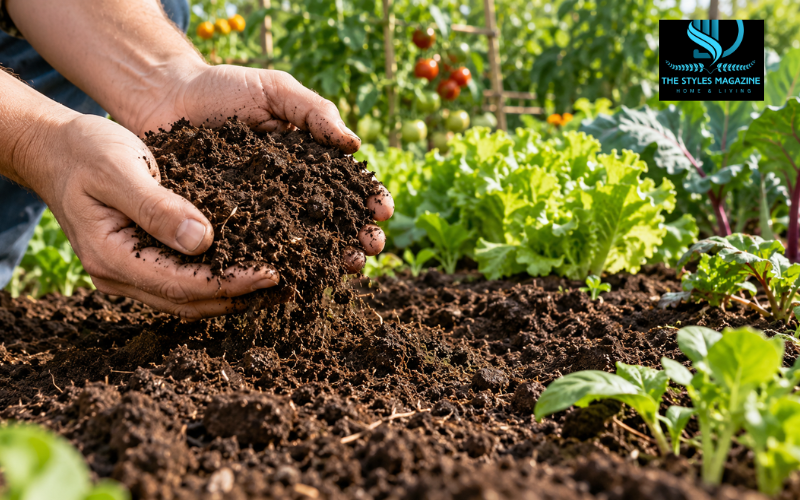
Healthy loam often has a loose, crumbly structure that is comfortable to handle and easy to work. When slightly moist, it normally holds together better than pure sand but does not feel as sticky or dense as heavy clay.
If you squeeze a handful of moist loam, it may form a loose shape in your hand but usually breaks apart fairly easily when disturbed.
There is no single official loam color. Loam can be light brown, medium brown, dark brown, reddish brown, or other shades depending on its mineral content, organic matter, moisture level, and local geology.
Dark colour alone does not prove that soil is loam. A dark soil may contain plenty of organic matter but still have a clay-heavy, sandy, or silty mineral texture.
Texture is usually more useful than colour when identifying soil. Sandy soil tends to feel gritty. Clay becomes sticky and smooth when wet, while silt feels finer and more slippery. RHS guidance recommends touching and rolling soil by hand as a practical first step in identifying its type.
Why Loam Is Well Suited to Gardens
Loam is popular because it can provide a useful balance between drainage and moisture retention.
Soil with too much sand may allow water to drain so quickly that plants dry out and nutrients are washed away. Heavy clay can hold plenty of water but may drain slowly, compact easily, and become difficult to work.
Loam generally sits between these extremes. Sand helps create drainage and air spaces, while silt and clay help the soil retain moisture. Fine clay particles can also hold plant nutrients more effectively than sand alone.
Good soil structure allows air to reach roots, which is important because roots need oxygen as well as water. A crumbly soil also gives roots space to spread.
The RHS describes loamy soils as fertile, well drained, and easily worked, although actual conditions can still vary from one garden to another.
These characteristics make loam useful for many flower beds, vegetable plots, lawns, shrubs, and general landscape planting.
Main Types of Loamy Soil
Not all loamy soils behave in exactly the same way. Their properties change depending on which mineral particle is present in greater amounts.
Standard loam has a relatively balanced mix of sand, silt, and clay. It usually offers a middle ground between drainage and moisture retention.
Sandy loam contains a stronger sandy influence. It commonly drains more quickly and may be easier to dig, but it can also dry faster than heavier loam.
Silt loam has more silt and generally holds moisture well. Because fine silt particles can compact, good soil structure remains important.
Clay loam contains more clay. It often holds water and nutrients well but can feel heavier and may drain more slowly.
The USDA texture system includes all of these as separate soil classes, showing why “loamy soil” should not be understood as a mixture with equal amounts of every particle.
Clay Loam vs Loam
The main difference between clay loam and loam is the amount and influence of clay.
Clay loam contains enough clay to feel noticeably heavier and stickier when wet. According to USDA soil classification guidance, clay loam generally contains 27% to less than 40% clay, with the remaining mineral portion made up of sand and silt within defined limits.
Regular loam usually feels more crumbly and easier to cultivate. It often drains faster than clay loam because the clay influence is lower.
Clay loam can be very useful for plants because it may hold water and nutrients well. However, it can also be more vulnerable to compaction, particularly when walked on or worked while wet.
Neither type is automatically better. The right soil depends on the plant, rainfall, drainage, garden design, and how the soil is managed.
Where clay loam becomes dense or difficult to work, adding suitable organic matter can improve its structure rather than trying to remove or replace the clay.
How to Tell If Your Garden Has Loam Soil
A simple hand test can give you a reasonable idea of your garden’s soil texture.
Take a small amount of soil and remove obvious stones and plant material. Add enough water to make it moist, but not soaking wet. Rub it between your fingers and try gently pressing or rolling it.
A strong gritty feeling suggests a high sand content. A silky or smooth feel may indicate more silt. Soil that becomes very sticky, can be shaped easily, and holds a long ribbon or sausage shape usually contains more clay. Loam often shows a mixture of these characteristics without one becoming extreme.
RHS guidance uses similar touch-and-roll methods for identifying garden soils.
A jar-settling test is another basic home method. Soil is mixed with water in a clear jar, shaken, and allowed to settle. Larger particles generally settle before finer ones. It can provide a rough visual indication of soil layers, although it should not be treated as a laboratory-quality measurement.
For important landscaping, farming, or soil-management decisions, professional soil testing can provide more dependable information.
Remember that soil may also change across a single garden, particularly where previous building work or landscaping has moved and mixed different materials.
Loam Soil, Drainage, and Water Retention
One of the most useful characteristics of loam soil is its ability to manage water without behaving like either extreme sand or heavy clay.
Sand particles help create larger spaces through which water can pass. Clay has much smaller particles and can hold considerably more water. Silt falls between the two in particle size and contributes to moisture retention and soil texture.
A balanced combination can therefore allow loam to stay moist without remaining saturated for long periods under suitable conditions.
However, saying that loam “always drains perfectly” would be misleading.
Drainage is affected by much more than texture. Compacted soil may drain badly even if its basic texture is loamy. Soil structure, organic matter, slope, the depth of the soil, underground layers, rainfall, and drainage systems can all influence how quickly water leaves an area.
That is why gardeners should look at the real conditions in their garden instead of assuming the word “loam” guarantees perfect drainage.
Nutrients, Organic Matter, and Soil Fertility
Soil texture and soil fertility are related, but they are not the same thing.
Texture describes the balance of sand, silt, and clay. Fertility refers to the soil’s ability to provide nutrients and suitable conditions for plant growth.
Loam is often productive because it can hold water and nutrients while still providing reasonable drainage and aeration. However, simply identifying soil as loam does not prove that it contains every nutrient a particular plant needs.
Organic matter plays an important role in maintaining healthy soil. Garden compost, well-rotted plant material, and other suitable organic soil improvers can help create stable crumbs, improve water management, and support soil organisms.
The USDA notes that organic matter contributes to the binding agents involved in soil aggregation, while compaction and working soil when it is too wet can damage that structure.
Even with good loam soil, testing pH can be helpful because different plants prefer different levels of acidity or alkalinity. Nutrient testing may also be useful where plants show persistent growth problems or when planning intensive food growing.
Improving Sandy or Clay Soil Toward Better Loamy Structure
If your garden is very sandy or clay-heavy, the goal should normally be to improve its structure and growing conditions rather than trying to create a precise laboratory mixture of loam.
Mixing large amounts of sand directly into clay is not a reliable shortcut. Small amounts of sand added to heavy clay may fail to improve drainage and can sometimes leave the soil difficult to manage. Purdue Extension recommends improving clay soil with organic matter instead of relying on sand.
For clay-heavy ground, adding well-rotted organic matter can encourage a more workable crumb structure. Avoid digging, walking over, or heavily cultivating clay when it is very wet because this can increase compaction.
Very sandy soil benefits from organic matter for a different reason. Organic material helps it retain more moisture and nutrients rather than allowing both to disappear quickly through the soil. RHS guidance recommends adding organic matter to both sandy and clay soils to improve their growing characteristics.
Mulching can also protect the surface, reduce moisture loss, and gradually add organic material as suitable mulches break down.
These improvements can make soil behave in a more balanced, loam-like way, but they do not instantly change the original proportions of mineral sand, silt, and clay.
Plants and Garden Uses That Suit Loamy Soil
Loamy soil can support a wide range of garden uses because of its generally balanced growing conditions.
It is commonly suitable for flower beds and mixed borders, where different perennials, annuals, bulbs, and shrubs may share the same space. Vegetable gardens can also benefit from soil that holds useful moisture without remaining constantly waterlogged.
Loamy topsoil is often used when creating new beds, lawns, and raised growing areas. RHS guidance notes that good-quality topsoil can be used for beds, borders, raised beds, and as a base for lawns when existing soil is unsuitable or missing.
Trees and shrubs can also grow well in loam when the drainage, available space, climate, and soil pH suit the species.
However, loam is not automatically perfect for every plant. Some plants prefer very free-draining sandy ground, while others grow naturally in moist soil. Acid-loving plants may struggle if a loamy soil has an alkaline pH.
For this reason, choose plants according to the complete site conditions rather than simply looking for a label saying they prefer loam.
Common Loam Soil Mistakes and Misunderstandings
One common mistake is assuming that any dark, rich-looking soil must be loam. Colour tells you very little about the actual percentages of sand, silt, and clay.
Another misunderstanding is that loam has one specific colour. It does not. Soil colour changes according to minerals, organic matter, drainage, moisture, and local conditions.
The often-repeated 40% sand, 40% silt, and 20% clay description should also be treated as an example rather than a strict definition. USDA classification is based on ranges shown within the soil-texture triangle.
It is also important not to confuse loam with topsoil or compost. Topsoil simply refers to the upper soil layer or to material sold for landscaping, and its texture can vary. Compost is decomposed organic material used to improve soil; it is not itself the same mineral texture class as loam.
Finally, avoid changing soil before you understand what it actually needs. Unnecessary amendments can waste money and may create new drainage or fertility problems.
Some searches for loam fibre, loam supplement, or Loam Dayton refer to unrelated products, organisations, locations, or businesses. Those meanings are separate from loam soil in gardening.
Conclusion
Loam is valued because it brings together the different characteristics of sand, silt, and clay without being dominated too heavily by one of them. This can give gardeners a useful balance of drainage, moisture retention, air movement, nutrient-holding capacity, and workability.
There is no single perfect formula for loam. Sandy loam, silt loam, clay loam, and other related textures behave differently, so it is better to understand the soil in your own garden than to chase one exact percentage mixture.
If you are unsure what you have, start by feeling the soil, observing how it drains, and checking its pH where necessary. More detailed testing can be useful when accurate texture or nutrient information is important.
Good loam also needs care. Avoid unnecessary compaction, do not work soil when it is excessively wet, and regularly add appropriate organic matter where needed. Maintaining healthy soil structure is usually more useful than trying to manufacture a supposedly “perfect” loam from a fixed recipe.
FAQs
Is Loam The Best Soil For Gardening?
Loam is suitable for many garden plants because it balances drainage, moisture retention, and air movement. However, the best soil still depends on each plant’s preferred pH, moisture, and drainage conditions.
What Is The Difference Between Loam And Clay Loam?
Loam has a more balanced mix of sand, silt, and clay. Clay loam contains more clay, so it usually feels heavier, holds more water, and may drain more slowly.
Is Loam Always 40% Sand, 40% Silt, And 20% Clay?
No. That ratio is often used as a simple example, but loam is actually classified within a range of sand, silt, and clay percentages rather than one fixed formula.
Can I Turn Clay Soil Into Loam?
You cannot instantly change its basic mineral texture, but adding organic matter over time can improve clay soil’s structure, drainage, aeration, and workability, making it behave more like good garden soil.
What Colour Is Loam Soil?
Loam has no single colour. It may be light brown, dark brown, reddish, or another shade depending on minerals, organic matter, moisture, drainage, and local soil conditions.
Enjoyed it? Find more exclusive content on The Styles Magazine.
Disclaimer: This article is provided for general gardening and educational purposes only. Soil conditions vary by location, climate, drainage, and land use. For major landscaping, agricultural, or soil-treatment decisions, consider professional soil testing or local expert advice. thestylesmagazine.co.uk shares this information only to help readers understand loam soil and does not provide paid promotion, advertising, or guest-post endorsement.