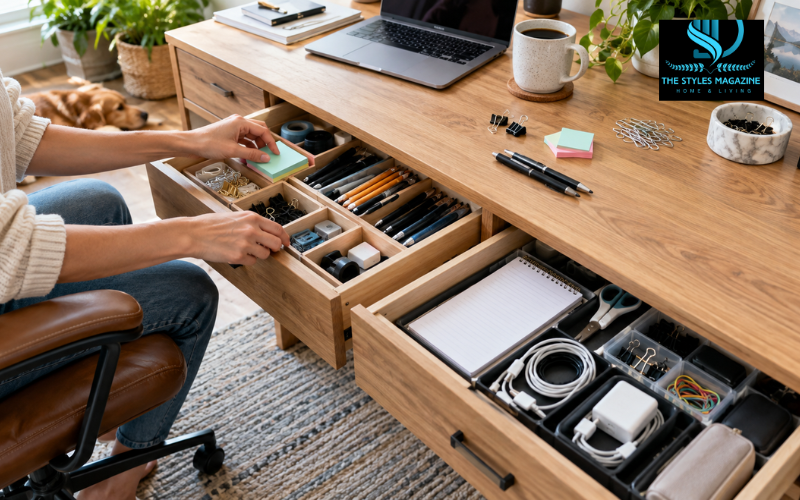
A desk drawer should make your work easier, not become another place where you have to search for things. When pens, chargers, paper clips, notebooks, old receipts, and other small items are mixed together, even a spacious desk can feel disorganized. Learning how to organize desk drawers is mainly about deciding what belongs there, giving each type of item a clear place, and making the things you use most often easy to reach.
You do not need a perfectly styled office or expensive storage products to make this work. A practical system follows a simple order: empty the drawers, remove what you do not need, group similar items, decide what deserves the easiest access, add boundaries, and put everything back in a logical place.
The same method can work for a home office, a student’s study desk, a compact writing desk, or a larger workspace with several drawers. The exact layout will be different for everyone because the best organization system is based on how you actually use your desk.
Quick Answer:
To organize desk drawers, empty everything first, remove unwanted items, group similar supplies, keep frequently used essentials within easy reach, and use trays, dividers, or small containers to give each item a clear place.
Quick Guide Table
| Step | What to Do | Why It Helps |
| Empty drawers | Remove every item and clean the inside | Gives you a fresh starting point |
| Declutter | Discard broken, dried-out, or unnecessary items | Prevents wasted space |
| Categorize | Group pens, paper, cables, and small supplies | Makes items easier to find |
| Prioritize | Keep daily-use items in the easiest-to-reach drawer | Saves time during work |
| Divide | Use trays, boxes, or drawer dividers | Stops supplies from mixing together |
| Maintain | Return items to their assigned places | Keeps drawers organized longer |
Simple Step-by-Step Guide
- Empty all desk drawers completely.
- Clean the inside of each drawer.
- Remove rubbish, broken items, and unnecessary duplicates.
- Group similar supplies together.
- Place frequently used items in the top or nearest drawer.
- Use trays, dividers, or small reusable boxes to create sections.
- Store occasional-use and backup supplies in lower or deeper drawers.
- Check the drawers regularly and return misplaced items to their proper sections.
Empty and Reset Every Desk Drawer
Start by taking everything out. Trying to organize a drawer while half of its contents are still inside makes it harder to see how much space you have and how many unnecessary things have accumulated.
Place everything on the desk, floor, or another clean surface where you can see it clearly. Once the drawers are empty, wipe the interiors with a soft damp cloth and remove dust, crumbs, pencil marks, eraser pieces, and loose paper. Allow the surfaces to dry before putting items back.
As you empty each drawer, begin making simple decisions. Keep items you still use, move unrelated objects to their proper rooms, recycle suitable paper or electronics, set aside usable unwanted supplies for donation where appropriate, and discard genuine rubbish.
This reset stage is important because professional organizing advice consistently recommends removing the contents and grouping them before deciding how to rebuild the drawer. It makes it much easier to see duplicates and items that do not belong in the workspace.
Do not worry about creating the final arrangement yet. At this stage, the goal is simply to give yourself a clean and accurate starting point.
Decide What Actually Belongs in Your Desk
A common reason desk drawers become cluttered is that they slowly turn into storage for anything that does not have another home. The simplest way to prevent this is to give the desk a clear purpose.
Items connected to work, studying, planning, writing, or regular desk activities normally deserve a place nearby. Pens, pencils, highlighters, notebooks, sticky notes, scissors, charging cables, clips, and other frequently needed supplies are reasonable examples.
On the other hand, a desk drawer may not be the best home for random household tools, old packaging, outdated receipts, unused cosmetics, mystery cables, or objects that belong in another room.
Test pens and markers before putting them back. Remove dried-out writing tools, damaged accessories, empty tape dispensers, broken cables, and anything you no longer use. If you discover several identical items, decide how many backups you realistically need.
Extra supplies are useful, but storing ten of something when you normally use one can take space away from items you reach for every day.
Group Supplies by Purpose and Frequency of Use
After removing unnecessary items, sort what remains into useful categories. This is where a pile of unrelated objects begins to turn into an organization system.
Keep writing tools together, paper products together, small stationery together, and technology accessories together. Depending on your work, you may also have categories for notebooks, craft supplies, mailing materials, drawing tools, calculators, memory cards, or personal work essentials.
Grouping similar items has two benefits. First, you can quickly see how much of each category you own. Second, you stop spreading the same type of item across several drawers.
Frequency matters just as much as category. A pen used several times each day should not be stored beside supplies you touch twice a year simply because both happen to fit in the same tray.
Separate your daily essentials from occasional-use supplies before you choose their final positions. This makes the next stage much easier.
Give the Most-Used Items the Best Drawer Space
The easiest part of your desk to reach is valuable space. Use it for the objects that support your normal routine.
For many people, that means keeping a small selection of pens, pencils, sticky notes, a notepad, scissors, a charger, or other everyday tools in the top or nearest drawer. Items used less often can move toward the back, into lower drawers, or into another storage area.
Professional organizing guidance similarly recommends placing frequently used supplies toward the front while moving lower-priority items farther back.
However, do not fill the top drawer simply because it is convenient. Too many objects will make it difficult to see what is there. The goal is not to fit the maximum number of items into the easiest drawer. It is to make common tasks easier.
Think about your actual workday. If you reach for a notebook ten times but rarely use a stapler, the notebook deserves the better position.
Measure the Drawers Before Choosing Organizers
Before buying trays or dividers, measure the inside of each drawer. Record its usable width, depth, and height rather than relying on the outside dimensions of the furniture.
Also look for anything that reduces usable space, such as rails, screw heads, handles, raised edges, or unusual corners. Recent organizing guidance from NEAT Method specifically recommends measuring drawer width, depth, and height while accounting for hardware or other obstructions.
These measurements help you avoid buying attractive organizers that do not actually fit.
You can choose fixed trays, adjustable dividers, individual containers, or modular inserts depending on what needs to be stored. Modular organizers are especially helpful when a drawer contains objects of several different sizes because individual sections can be arranged around them.
An IKEA desk drawer organizer or another modular store-bought system may be suitable if its dimensions match your drawer, but the brand matters much less than the fit. Measure first and choose the arrangement that makes the best use of your available space.
Build Clear Sections With Trays and Dividers
An organized drawer works better when every category has a visible boundary. Without boundaries, small objects gradually move around until separate groups become one mixed pile again.
Use narrow trays for pens and pencils, small containers for clips and pins, and larger sections for notebooks or technology accessories. The size of each section should reflect the amount you actually own.
Avoid using one oversized tray for several unrelated categories. A container alone does not create organization if everything inside it is still mixed together.
At the same time, do not divide the drawer into so many tiny compartments that putting things away becomes annoying. The system should feel easy enough to use every day.
Lightweight trays sometimes move when a drawer opens and closes. A small amount of removable museum gel or another suitable removable fixing material beneath the corners can help hold them in position. Better Homes & Gardens also notes this approach as a way of stopping drawer containers from shifting.
How to Organize Drawers Without Organizers
You can organize a desk effectively without buying dedicated drawer inserts.
Look around your home for clean, sturdy containers that fit the space. Small gift boxes, shallow product packaging, tins, phone boxes, and similar containers can create useful compartments for office supplies.
For example, one small box could hold paper clips while another contains charging adapters. A long narrow box may work for pens, while a shallow lid can contain sticky notes or erasers.
Professional organizers also suggest repurposing containers already available at home rather than assuming that every drawer needs new plastic storage products.
The important part is not what the container was originally designed for. What matters is whether it fits the drawer, safely holds the item, and creates a clear boundary.
If you are wondering how to organize drawers without organizers, think in terms of sections rather than products. Once every group has its own defined space, ordinary boxes can perform much the same basic job as commercial inserts.
DIY Desk Drawer Organization on a Budget
People searching for how to organize desk drawers DIY often need a solution that can be adjusted to an unusual drawer without spending much money.
Cardboard is one of the simplest materials for creating removable dividers. Measure the internal dimensions of the drawer, cut sturdy strips to the required size, and arrange them to create compartments around the items you need to store. Covering the cardboard neatly is optional; function matters more than decoration.
Small boxes can also be combined like building blocks. Try different arrangements before attaching or securing anything. This allows you to create a layout around awkward objects such as a large calculator, ruler, drawing tools, or charging equipment.
Whenever possible, keep DIY changes removable. Permanent glue, screws, or modifications may damage furniture and make the layout difficult to change later.
A good DIY setup should be sturdy enough for everyday use but flexible enough to adjust when your work habits change.
How to Organize Deep Desk Drawers
Deep drawers offer plenty of space, but that space can easily be wasted if everything is dropped into one large container.
When considering how to organize deep desk drawers, divide the space into zones. Bulky supplies can go into deeper containers while small objects still need shallow, defined compartments so they do not disappear underneath larger items.
Try to avoid creating several hidden layers of frequently used supplies. If you must remove three objects every time you need something at the bottom, the storage system will quickly become frustrating.
Deep drawers are often better suited to larger notebooks, spare supplies, equipment, folders, or less frequently used office items. Keep the things you use regularly visible and within easy reach.
Stacking can be useful when the drawer height allows it, but only when the upper layer can be moved easily and the contents below remain clear. Organization guidance for deep storage also emphasizes making sensible use of vertical space rather than allowing it to become an uncontrolled pile.
Keep Cables, Chargers, and Small Tech Accessories Under Control
Technology accessories can make an otherwise tidy desk drawer look chaotic because cables become tangled and small adapters are easy to lose.
Start by matching cables with devices you still own. If you cannot identify a cable, set it aside temporarily and determine what it belongs to before deciding whether it deserves drawer space. Broken or unwanted electronics should be handled through an appropriate local electronics recycling route rather than automatically placed in normal household waste.
Recent organizing advice also recommends checking old cords against devices currently in use and removing obsolete ones instead of keeping every cable “just in case.”
Coil the cables you are keeping loosely and place them in separate sections. Small reusable ties can help prevent tangling. If several cables look almost identical, a simple label can save time later.
Keep USB drives, adapters, earbuds, memory cards, and similar small accessories in their own containers instead of mixing them with pens and paper clips.
How to Organize a Desk Without Drawers
Not every desk has built-in storage. Fortunately, the same organization principles still apply when learning how to organize a desk without drawers.
The goal is to create useful storage near the workspace without covering the entire desktop. A monitor riser can provide space underneath for small supplies or notebooks. A compact desktop organizer can hold everyday stationery, while a nearby rolling unit can provide additional storage for larger collections.
Shelves and wall-mounted storage may help when floor and desk space are limited. Apartment Therapy also suggests options such as monitor stands, wall storage, desktop organizers, and under-desk solutions for desks without drawers.
A small filing cabinet or freestanding drawer unit beside the desk can also work when more storage is needed.
So, although people sometimes search for how to organize desk drawers without drawers, the practical solution is to recreate the same zones elsewhere. Keep frequently used supplies closest to you and move lower-priority items farther away.
Keep Desk Drawers Organized After the Reset
The real test of an organization system is whether it still works several weeks later.
Make returning an item to its assigned section easier than dropping it somewhere random. When every category has an obvious home, maintaining the drawer should require very little thought.
Take a quick look through the drawers regularly and remove rubbish, unnecessary duplicates, empty packaging, and objects that have wandered in from other areas. You do not need to completely reorganize the desk each time.
Restock supplies based on what you genuinely use rather than filling empty spaces automatically. An open section is not a problem; it gives the drawer room to function.
You should also be willing to change the layout. If you originally placed a tool in the bottom drawer but now use it every day, move it somewhere more convenient. Good organization should follow your habits rather than forcing your habits to follow a rigid arrangement.
Some of the same principles apply when people organize drawers in the bedroom or organize drawers for clothes. Dividers establish boundaries, similar items stay together, and visible storage makes items easier to find. For a desk, however, the priority should remain work and study supplies that support the activities carried out at that workspace.
Conclusion
Learning how to organize desk drawers does not require filling every inch with matching containers. A useful system begins by clearing everything out, deciding what genuinely belongs at the desk, grouping similar supplies, and giving the most frequently used items the easiest positions.
From there, trays, dividers, reused boxes, or simple DIY compartments can help create boundaries that stop items from mixing together. Measuring the drawer first prevents wasted space, while thoughtful storage for cables, deep drawers, and backup supplies makes the overall setup easier to use.
Most importantly, organize your desk around your real routine rather than trying to create a drawer that only looks perfect in a photograph. The arrangement that works best is the one you can understand at a glance and maintain without extra effort.
When every essential has an obvious and convenient home, keeping your desk drawers organized becomes part of your normal routine instead of another cleaning project.
FAQs
How Do I Organize A Messy Desk Drawer?
Start by emptying the entire drawer. Remove anything you no longer need, group similar supplies together, and create separate sections using trays, dividers, or small boxes.
What Should I Keep In My Top Desk Drawer?
Keep items you use several times a day, such as pens, pencils, sticky notes, a small notepad, scissors, or frequently used charging accessories.
How Can I Organize Desk Drawers Without Buying Organizers?
Use clean household containers such as small boxes, shallow packaging, tins, or sturdy cardboard dividers. The main goal is to create clear sections for different categories.
How Should I Organize Deep Desk Drawers?
Use deeper drawers for larger or less frequently used items. Divide the space into sections and avoid stacking everyday supplies where they become difficult to see or reach.
How Often Should I Reorganize My Desk Drawers?
There is no fixed schedule. Check them whenever clutter starts building up, supplies become difficult to find, or your work habits change enough that the existing layout no longer works.
Enjoyed it? Find more exclusive content on The Styles Magazine.
Disclaimer: This article is provided for general informational and organizational purposes only. Drawer sizes, desk designs, storage needs, and suitable organizing products can vary between homes and workspaces. Always measure your furniture before purchasing organizers and follow manufacturer instructions when using adhesives, fixtures, or storage accessories. thestylesmagazine.co.uk does not guarantee that every organization method or product mentioned will be suitable for every desk, material, or individual workspace.