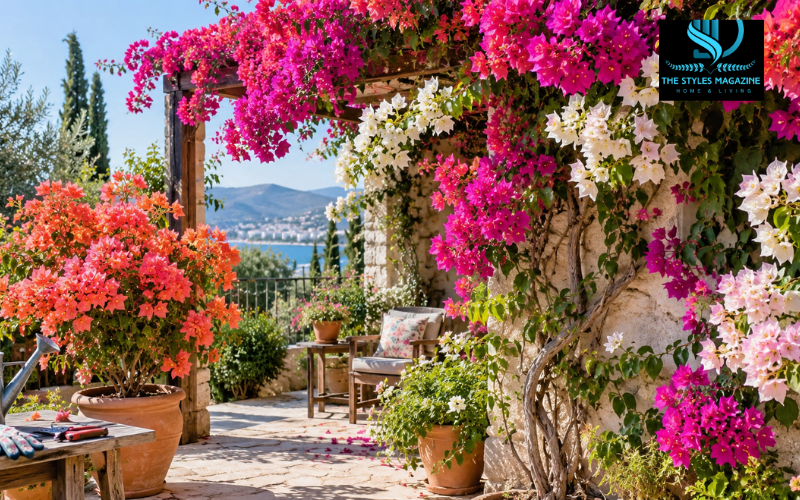
Bougainvillea is one of those plants that can transform a plain wall, sunny patio, fence, or garden corner into a striking display of colour. Native to South America, it is a woody plant commonly grown as a climber, sprawling shrub, or trained specimen. In warm climates it can become large and vigorous, while gardeners in cooler places often keep it in containers.
What most people call bougainvillea flowers are actually colourful modified leaves called bracts. The true flowers are much smaller and sit inside these papery bracts. Depending on the variety, the display can be pink, purple, magenta, red, orange, yellow, white, or shades in between.
Growing bougainvillea successfully is mainly about providing enough light, warmth, good drainage, suitable watering, and sensible pruning. This guide explains how to recognise the plant, understand its main types and growth forms, encourage colourful displays, and care for it through the seasons.
Quick Guide Table
| Feature | Bougainvillea Quick Guide |
| Plant type | Woody climber, shrub, or trained standard |
| Light | Full sun; ideally 6+ hours outdoors |
| Soil | Well-draining soil or potting mix |
| Watering | Water thoroughly, then allow some drying |
| Common colors | Pink, purple, magenta, red, orange, yellow, white |
| Flower display | Colorful bracts surrounding small true flowers |
| Best climate | Warm, frost-free conditions |
| UK care | Usually container-grown with frost-free winter protection |
| Pruning | Usually late winter or early spring |
| Main concern | Cold temperatures and persistently wet roots |
Simple Bougainvillea Care Steps
- Place bougainvillea in a bright, sunny position.
- Use soil or compost that drains freely.
- Water deeply when needed, but avoid keeping the roots constantly wet.
- Feed during active growth without overusing high-nitrogen fertilizer.
- Give climbing plants a trellis, wires, or another secure support.
- Prune carefully to control size and encourage manageable new growth.
- Wear gloves when handling mature plants because many varieties have thorns.
- Protect container plants from frost and cold winter temperatures.
What Is Bougainvillea?
Bougainvillea is a genus in the Nyctaginaceae family, sometimes called the four-o’clock family. Kew Science records the genus as native to South America, where different species grow naturally as woody climbers, shrubs, or lianas. Several have since become popular ornamental plants in warm parts of the world.
Its most recognisable feature is the cluster of thin, brightly coloured bracts surrounding small tubular flowers. These bracts perform much of the visual work that petals normally do, which explains why a bougainvillea can appear to be covered in large flowers even though its true flowers are quite small.
The stems become woody with age, and many bougainvilleas develop curved or sharp thorns. Their natural habit is often scrambling rather than neatly climbing by themselves. For this reason, plants grown against fences, walls, pergolas, or trellises usually need to be tied and trained while the shoots are young.
In suitable conditions, bougainvillea can grow quickly and become a substantial plant. Regular shaping is therefore useful in smaller gardens and especially important when it is grown in a container.
Bougainvillea Pronunciation and the Story Behind Its Name
Bougainvillea may look difficult to pronounce at first. A commonly used English pronunciation is “boo-gun-VEEL-ee-uh,” with the main stress falling around “VEEL.” Regional pronunciation can vary slightly, so small differences are normal. North Carolina State Extension uses the phonetic form “boo-gun-VEEL-ee-uh.”
The botanical and everyday name is Bougainvillea. It is also sometimes known as paper flower, a name that refers to the thin, papery texture of the colourful bracts.
The genus was named in honour of Louis Antoine de Bougainville, the eighteenth-century French explorer who led a voyage around the world. Today, the name is recognised far beyond its South American origins because the plant has become a familiar feature of Mediterranean-style and tropical landscapes.
Bougainvillea Vine, Shrub, or Tree: Understanding Its Growth Forms
People often search separately for a bougainvillea vine, bougainvillea shrub, or bougainvillea tree, but these descriptions usually refer to how a plant naturally grows or how it has been trained.
A bougainvillea vine develops long, flexible shoots that can be guided across a trellis, pergola, fence, or wall. It does not cling to a surface in the same way as ivy, so stems normally need support and tying.
A bougainvillea shrub is generally kept bushier through regular pruning and shaping. Compact cultivars are particularly useful for patios, pots, and smaller spaces.
A bougainvillea tree is usually a plant trained into a standard form, with one main stem and a rounded crown above it. It is not necessarily a separate tree species. RHS guidance confirms that bougainvillea can be trained as a standard as well as grown as a climber.
Whatever form you choose, remember the thorns. Avoid placing a large thorny specimen directly beside narrow paths, doorways, children’s play areas, or other places where people regularly brush against it.
Bougainvillea Glabra, Spectabilis, and Other Important Types
Two well-known species are Bougainvillea glabra and Bougainvillea spectabilis. Kew currently accepts both as separate species and records both as native to parts of Brazil. B. glabra is described as a climbing shrub or liana, while B. spectabilis is also naturally a liana.
To the average gardener, the two can look very similar. Bougainvillea glabra, often called lesser bougainvillea, has five-angled floral tubes and relatively shorter bracts. Bougainvillea spectabilis, sometimes called great bougainvillea, has rounder floral tubes and longer bracts.
Garden plants may also be hybrids. One important example is Bougainvillea × buttiana, associated with B. glabra and B. peruviana. RHS notes that both B. glabra and B. × buttiana can be suitable for container cultivation because they can flower while relatively young.
For most home gardeners, however, the named cultivar may be more useful than identifying the exact species. Cultivar information can tell you more about mature size, bract colour, growth habit, and whether the plant suits a container or needs considerably more room.
Bougainvillea Colors and What Creates the Display
One reason bougainvillea remains so popular is the range of colours available. Depending on the plant, bougainvillea colors include pink, deep magenta, purple, red, orange, yellow, and white. Some varieties also have variegated foliage, giving them decorative value even when the bracts are less prominent.
The colourful parts are bracts rather than true flower petals. Inside them are much smaller tubular flowers, commonly pale or white. Because the bracts are modified leaves, they can create a strong visual display around these otherwise inconspicuous flowers.
Colour depends mainly on the cultivar, so a plant sold with purple bracts will not suddenly become a true orange variety because of fertilizer or pruning. Growing conditions can, however, influence the quality and amount of the display. Strong light, appropriate watering, healthy new growth, and suitable temperatures all play a part.
The Best Growing Conditions for Healthy Bougainvillea
Light is one of the most important requirements. Outdoors, bougainvillea performs best in full sun, and six or more hours of direct sunlight is a useful target. Plants grown in insufficient light may produce plenty of foliage but give a disappointing colour display.
Warmth is equally important. Bougainvillea is a tropical to subtropical plant and is sensitive to frost. A sunny, sheltered position that receives plenty of warmth suits it far better than a cold, exposed corner.
UK gardeners need to treat bougainvillea differently from gardeners in reliably frost-free climates. RHS recommends bright conditions and frost-free winter protection. Plants are commonly grown in large pots in conservatories or heated greenhouses and can be moved outdoors during suitable summer weather. RHS suggests maintaining around 10°C as a minimum night temperature for actively maintained plants, although plants kept just above freezing may survive in a drier dormant state and lose their leaves.
Behind greenhouse or conservatory glass, very intense midsummer sunlight can scorch foliage, so some protection may occasionally be needed even though the plant normally loves sunshine.
Planting Bougainvillea in the Ground or in Containers
Planting directly in the ground works best where winters remain reliably frost-free and the plant can stay outside permanently. Choose a sunny site with excellent drainage and enough room for the plant’s mature growth.
Containers are usually a safer option in cooler regions because they allow the plant to be moved under protection before cold weather arrives. Choose a sturdy pot with drainage holes. A well-drained, loam-based potting compost is suitable for container plants; RHS recommends a peat-free loam-based medium for bougainvillea grown in pots.
Place the container where the plant receives plenty of light. Avoid leaving a decorative outer pot or saucer permanently full of water, as poor drainage can damage the roots.
Repot when the plant genuinely needs more root space rather than automatically moving it into a much larger container every year. In the UK and similar climates, container plants can spend warm summer periods outdoors before returning to a frost-free greenhouse, conservatory, or other bright protected position for winter.
Soil and Watering: Getting the Balance Right
Bougainvillea needs good drainage. It can cope with relatively dry conditions once established, but persistently wet soil around the roots is a much greater concern than short dry periods. University of Florida guidance notes that bougainvillea performs well when the soil is kept somewhat dry, while North Carolina State Extension recommends deep watering followed by a period in which the soil is allowed to dry.
New plants and containers require closer attention because their roots cannot search a large area for moisture. During active growth, water thoroughly when needed, allowing excess water to drain away. Established plants growing outdoors in suitable climates are generally more drought tolerant.
Avoid following a rigid timetable such as watering every two or three days regardless of conditions. Temperature, sunlight, container size, wind, soil type, and season all change how quickly moisture disappears.
Too much water may contribute to yellowing leaves, leaf loss, weak growth, and root problems. Too little water can cause wilting and stress. During cooler winter conditions, water needs normally fall considerably, especially if the plant has slowed its growth.
Feeding Bougainvillea and Encouraging More Color
Feeding can support healthy growth, particularly for plants confined to containers, but fertilizer should not be treated as a guaranteed way to make bougainvillea flower.
RHS recommends feeding plants during active growth. Its detailed guidance suggests supporting leafy growth first and then changing to a higher-potassium feed once the colourful bracts begin to appear. Feeding is reduced and eventually stopped as the plant moves into its autumn and winter rest period.
More fertilizer is not necessarily better. Excessive nitrogen can promote vigorous green foliage at the expense of the colourful display. University of Florida guidance specifically warns that too much nitrogen may encourage leaves rather than flowering.
If a mature plant looks healthy but is producing few bracts, first consider the amount of sunlight it receives. Also review watering, feeding, temperature, and pruning. Frequent pruning can repeatedly remove young growth that would otherwise contribute to the next display.
Pruning and Training Bougainvillea Without Harming the Plant
Pruning keeps a vigorous bougainvillea manageable and helps direct growth where you want it. RHS recommends pruning in late winter or early spring before active new growth begins and notes that bougainvillea flowers on the current season’s growth.
Start by removing damaged, dead, crossing, or badly positioned stems. Long shoots can then be shortened to improve shape. Young flexible growth may be tied gently to a trellis, wire, fence, or other support. This is particularly useful when covering a wall or pergola.
For shrub forms, regular light shaping is usually easier than allowing the plant to become very large and then repeatedly cutting it back hard. Standard or tree-form bougainvilleas also need occasional trimming to maintain the crown.
Do not prune constantly simply because the plant is growing quickly. University of Florida warns that frequent pruning may reduce flowering by removing productive new growth.
Wear strong gardening gloves and long sleeves while pruning. Many cultivars have sharp thorns that can make handling mature stems uncomfortable.
Seasonal Care, Winter Protection, and Common Problems
In spring, increase watering gradually as warmth and light encourage new growth. This is also a suitable time to repot a container plant if necessary and begin feeding once growth becomes active.
During summer, give the plant abundant light, adequate water, and good ventilation. Container plants dry faster than those in the ground, so check them regularly rather than assuming drought tolerance means they never need watering.
As autumn arrives in cooler regions, reduce feeding and watering as growth slows. Before frost becomes a risk, move container-grown bougainvillea into a suitable protected location. Winter leaf loss does not always mean the plant is dead. RHS notes that bougainvillea may drop leaves when temperatures fall, especially when maintained cooler during dormancy.
Poor flowering is commonly associated with insufficient sun, excessive water or nitrogen, or inappropriate pruning. Yellow leaves can have several causes, including root stress from wet conditions, while alkaline soil can contribute to chlorosis in B. glabra.
Bougainvillea is generally not known for serious disease problems, but pests can appear, particularly under glass. RHS lists aphids, mealybugs, whitefly, and red spider mites among the pests that may affect the plant. Inspecting foliage regularly makes it easier to notice a problem before it becomes severe.
Finding and Choosing a Bougainvillea Near Me
If you are searching online for “bougainvillea near me,” start with established garden centres, specialist nurseries, and reputable local plant sellers. Availability often depends on climate and season, so areas with warm conditions usually offer a wider range than places where bougainvillea must be overwintered indoors.
Before buying, think about where the plant will eventually live. A compact cultivar makes more sense for a patio container than an extremely vigorous climber intended to cover a large wall. Likewise, a shrub-trained plant and a bougainvillea tree or standard require different maintenance from a long climbing specimen.
Look for healthy foliage, sturdy stems, and signs of active growth. Check under leaves and around new shoots for pests. The compost should not smell sour or remain heavily waterlogged, and the plant should ideally have a clear cultivar label.
Colour is worth considering, but it should not be the only reason for choosing a plant. Check mature size, growth habit, local winter temperatures, and whether you can provide indoor protection if required. Buying a bougainvillea suited to your actual space and climate will make long-term care much easier.
Conclusion
Bougainvillea can provide months of impressive colour when its basic needs are understood. Its famous display comes mainly from papery bracts surrounding much smaller true flowers, while its naturally woody, thorny growth can be trained as a vine, shrub, or standard tree form.
Success starts with choosing a suitable type and giving it enough room. Strong light, warmth, free-draining soil, sensible watering, appropriate feeding, and well-timed pruning are more valuable than complicated gardening tricks.
Care should also reflect the climate. A bougainvillea growing permanently outdoors in a frost-free region needs a different winter routine from one kept in a container in the UK. Pay attention to the plant and its growing conditions rather than following a rigid schedule. With the right position and regular but measured care, bougainvillea can remain a colourful and distinctive part of the garden for many years.
FAQs
Is Bougainvillea A Vine Or A Bush?
Bougainvillea can grow as a climbing vine or be regularly pruned into a shrub. It can also be trained into a tree-like standard, depending on the cultivar and how it is maintained.
Does Bougainvillea Need Full Sun?
Yes. Bougainvillea generally flowers best in strong sunlight. An outdoor position receiving around six or more hours of direct sun usually supports better growth and a stronger display of colorful bracts.
How Often Should Bougainvillea Be Watered?
There is no fixed watering schedule. Water thoroughly when needed and allow the growing medium to dry somewhat between waterings. Container plants usually need checking more frequently than established plants growing in the ground.
Can Bougainvillea Survive Winter In The Uk?
Bougainvillea is not reliably frost hardy in the UK. It is normally grown in a container and moved to a bright, frost-free greenhouse, conservatory, or suitable protected space during colder months.
Why Is My Bougainvillea Growing Leaves But Not Flowering?
Insufficient sunlight, excessive nitrogen, frequent pruning, unsuitable temperatures, or overly wet conditions can reduce flowering. Start by checking light levels and overall growing conditions rather than simply adding more fertilizer.
Enjoyed it? Find more exclusive content on The Styles Magazine.
Disclaimer: This article provides general gardening and plant-care information about bougainvillea for educational purposes. Growing results can vary depending on cultivar, climate, temperature, soil, sunlight, container size, and local conditions. Always consider the specific needs of your plant and follow product instructions when using fertilizers or pest treatments. In colder climates, check local weather conditions before leaving bougainvillea outdoors during winter.