A shady garden does not have to be dull or difficult to plant. Many garden plants for shade are valued for rich foliage, delicate flowers, long-lasting structure, or the ability to grow where sun-loving plants struggle. The key is to match the plant to the conditions rather than choosing anything simply labelled “shade tolerant.”
Start by looking at how much light the area receives, whether the soil stays moist or dries quickly, how much room the plant will have at maturity, and how cold or hot your local climate becomes. A plant that thrives beneath a lightly shaded tree may not cope with a dark corner beside a building, and a moisture-loving fern may struggle in dry soil under mature tree roots.
A well-planned shade garden can include bold hostas, colorful heucheras, flowering perennials, seasonal annuals, compact edging plants, taller background plants, evergreens, and container displays. Once you understand the site, choosing suitable plants becomes much easier.
Quick Steps for Choosing Garden Plants for Shade
- Check how many hours of direct sunlight the area receives.
- Decide whether the soil is usually dry, moist, or poorly drained.
- Check the plant’s mature height and spread before planting.
- Choose foliage plants for very dark areas where flowering may be limited.
- Use a mix of perennials, annuals, and evergreens for longer seasonal interest.
- Match every plant to your local climate and winter temperatures.
Understand the Type of Shade in Your Garden
Shade is not one single condition. Light shade receives plenty of indirect light with little direct sun. Partial shade usually means several hours of direct sun each day. Dappled shade is the shifting, broken light found beneath open tree canopies. Moderate shade is darker for longer periods, while deep or full shade receives very little direct sunlight. The RHS describes deep or heavy shade as generally receiving less than about two hours of direct sun a day.
The timing of sunlight also matters. Morning sun is usually gentler, while strong afternoon sun can heat leaves and dry soil quickly. Shade from a wall is different from shade beneath a tree because tree roots also compete for water and nutrients. Deciduous trees create another pattern: the ground may be bright in early spring and much darker after the leaves open.
Before buying plants, observe the area for a few clear days. Check it in the morning, around midday, and later in the afternoon. Note both direct sun and bright filtered light. The darker the site becomes, the more useful foliage plants tend to be, because many flowering plants produce fewer blooms when light is very limited.
Best Garden Plants for Shade at a Glance
The best garden plants for shade are those suited to both the light level and the soil. The table below offers a practical starting point. Heights are approximate because climate, soil, moisture, and cultivar all affect mature size. RHS plant guidance also notes that final height and spread can change with location and growing conditions.
| Plant | Type | Best shade level | Soil moisture | Approx. height | Main interest | Key feature | Pots? |
| Hosta | Perennial | Partial to full shade | Moist, well-drained | 30–90 cm | Spring–autumn | Bold leaves | Yes |
| Heuchera | Perennial | Light to partial shade | Moist, well-drained | 20–50 cm | Most of year | Colored foliage | Yes |
| Japanese painted fern | Fern | Partial to deep shade | Moist | Around 30–45 cm | Spring–autumn | Silver-purple fronds | Yes |
| Astilbe | Perennial | Partial shade | Moist | 40–100 cm | Summer | Feathery flowers | Yes |
| Bleeding heart | Perennial | Partial shade | Moist, well-drained | 60–90 cm | Spring | Heart-shaped flowers | Yes |
| Hellebore | Perennial | Partial shade | Moist, well-drained | 30–50 cm | Winter–spring | Early flowers | Yes |
| Pulmonaria | Perennial | Partial shade | Moist | 20–40 cm | Spring | Flowers and spotted leaves | Yes |
| Brunnera | Perennial | Partial shade | Moist | 30–45 cm | Spring–autumn | Heart-shaped foliage | Yes |
| Ajuga | Groundcover | Partial to full shade | Average to moist | 10–20 cm | Spring onward | Low spreading cover | Yes |
| Impatiens | Annual | Partial shade | Moist | 20–45 cm | Summer | Bright flowers | Yes |
| Begonia | Annual/tender perennial | Partial shade | Moist, well-drained | 20–45 cm | Summer | Flowers and foliage | Yes |
| Coleus | Tender perennial/annual | Light to partial shade | Moist | 30–90 cm | Warm season | Colorful leaves | Yes |
| Caladium | Tender perennial | Light to partial shade | Moist, well-drained | 30–60 cm | Warm season | Large patterned leaves | Yes |
Foliage Plants That Bring Color and Texture to Shade
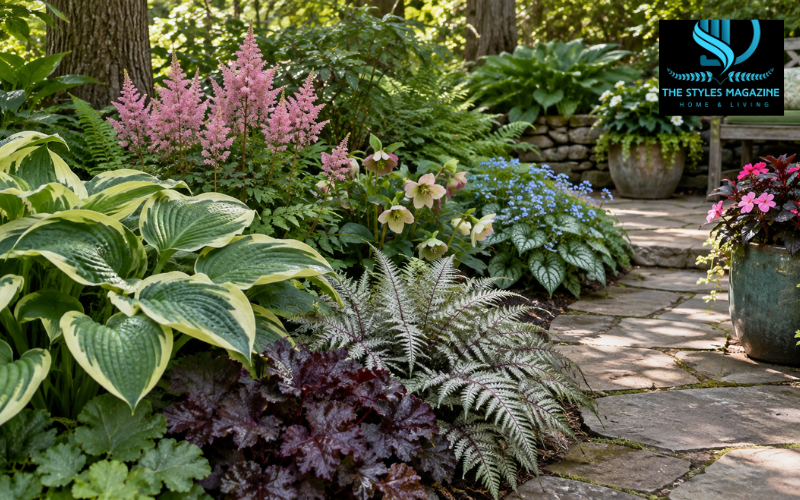
Foliage often does the most important visual work in a shady border. Hosta ‘Patriot’ is a strong example, with broad green leaves edged in white. Hostas are widely valued as shade foliage plants and also grow well in containers, though slugs and snails can damage softer leaves.
Heuchera ‘Obsidian’ creates a very different effect. Its glossy leaves mature to near-black, making a useful contrast beside silver, lime, or variegated foliage. RHS lists it as a compact perennial for full sun or partial shade in moist but well-drained soil.
Japanese painted fern, Athyrium niponicum var. pictum, has silvery-green fronds and purple-red stems and is especially attractive in damp shade. Brunnera adds broad, heart-shaped leaves, and silver-leaved cultivars can brighten darker beds. Coleus and caladium bring warmer-season color, especially in containers or frost-free climates.
For a natural-looking design, mix leaf shapes as well as colors. Large hosta leaves look stronger beside fine fern fronds, while dark heucheras stand out near pale or silver foliage. This creates interest even when few plants are flowering.
Flowering Perennial Plants That Grow Well in Shade
Many plants that grow in shade are perennials, returning for several years when conditions suit them. Astilbe ‘Fanal’ is useful where shade is paired with moisture-retentive soil. It produces deep crimson flower spikes above divided foliage in early summer and reaches roughly 50 cm in height according to RHS guidance.
Bleeding heart, now commonly listed botanically as Lamprocapnos spectabilis, is loved for arching spring stems carrying pink-and-white heart-shaped flowers. It is particularly effective in woodland-style borders. Helleborus ‘Pink Frost’ provides interest much earlier: it is an evergreen, clump-forming perennial with flowers from mid-winter into spring and prefers partial shade and moist but well-drained soil.
Pulmonaria combines early flowers with patterned leaves. Astrantia can flower in summer where soil stays reasonably moist, while Japanese anemones bring taller flowers later in the season in lighter shade.
Gardeners often search for perennials for shade that bloom all summer, but continuous bloom from one plant is not always realistic, especially in deeper shade. A better approach is to combine species with different flowering times so spring, summer, and early autumn interest overlap. Flowering also tends to decrease as shade becomes heavier.
Shade-Loving Annuals for Fast and Seasonal Color
Annuals are useful when you want fast color, need to fill gaps between young perennials, or want a different display each year. Unlike established perennials, most annuals complete their life cycle in one growing season.
Impatiens walleriana remains a classic choice for colorful shaded beds and containers. Wax begonias combine flowers with glossy foliage, while coleus is grown mainly for its leaves. Torenia, often called wishbone flower, is another useful option for shaded summer displays. Lobelia and browallia can also work where conditions are suitable.
Missouri Botanical Garden lists wax begonias, impatiens, coleus, torenia, lobelia, and browallia among annuals that tolerate shade. Rather than planting large blocks of one annual, they can be used between hostas, ferns, or other permanent plants to add temporary color without changing the basic structure of the border.
Low-Maintenance Garden Plants for Shade
Low maintenance garden plants for shade are easiest to manage when the site suits them from the beginning. Hellebores, hardy ferns, heucheras, epimediums, and Geranium macrorrhizum are useful choices in many gardens. Hostas can also be easy once established, although slug and snail damage may require attention. Ajuga works as a low groundcover where its spreading habit is welcome.
Epimedium is particularly useful because several types cope with dry shade and form attractive groundcover. RHS also identifies Geranium macrorrhizum as one of the relatively few plants that can tolerate dry shade.
“Low maintenance” does not mean “no maintenance.” New plants still need regular watering while roots establish. Mulch helps reduce moisture loss and weeds, and some perennials benefit from occasional division. Old or damaged foliage may need trimming, and local pests should be monitored. Choosing the right plant for the soil usually saves far more work than trying to correct a poor planting choice later.
Small Garden Plants for Shade and Tight Spaces
Small garden plants for shade can make narrow borders, courtyard beds, and shaded edges feel full without overwhelming the space. Heuchera, tiarella, pulmonaria, ajuga, compact ferns, violas, and smaller hosta cultivars are all worth considering.
Do not judge a plant by height alone. A short plant may still spread widely, so check its mature width before placing it beside a path or in a small bed. In tight spaces, use simple layers: low ajuga or viola near the front, heuchera or pulmonaria behind it, and a compact fern or small hosta as the main foliage feature.
Leaving enough space between young plants may look slightly open at first, but it reduces crowding and improves airflow as they mature.
Tall Garden Plants for Shade That Add Height and Structure
Tall garden plants for shade help a border feel layered instead of flat. Actaea racemosa can provide strong vertical growth and white flower spikes in lighter or dappled shade. RHS lists it at roughly 1.2–2.2 m, making it useful behind shorter plants.
Foxgloves add upright flower stems, while taller astilbes provide softer summer plumes where soil stays moist. Japanese anemones can bring height and late-season flowers. Rodgersia suits roomy, moisture-retentive shade and has bold leaves as well as flowers.
Royal fern, Osmunda regalis, is a dramatic choice for very moist shaded areas. In favorable conditions it can become a large plant, so it needs plenty of room.
Place tall plants behind hostas, heucheras, and groundcovers, but remember that published heights are guides rather than guarantees. Soil quality, rainfall, temperature, and light can all change the final size.
Outdoor Shade Plants for Pots and Containers
Outdoor shade plants for pots are useful on balconies, patios, entranceways, and small courtyards where garden soil is limited. Hostas, heucheras, many ferns, begonias, impatiens, and coleus all work well in containers when their individual needs are met. Fuchsias can also perform well in bright shade in suitable climates.
Good drainage is essential. Use a pot with drainage holes and a container mix appropriate for the plant. Large plants need enough root space, while small pots dry more quickly and may need more frequent watering. Shade slows moisture loss, but it does not stop it; walls, roof overhangs, wind, and dense roots nearby can make a shaded container surprisingly dry.
Container plants also depend on the nutrients available in the potting mix, so long-season plants may need feeding according to the product and plant instructions. Tender plants such as coleus, many begonias, and caladium may need winter protection or seasonal replacement in cold climates.
RHS specifically recommends shade-friendly seasonal bedding such as impatiens and begonias for containers.
Year-Round Plants for Shaded Areas
Year round plants for shaded areas are most useful when they provide structure after summer flowers fade. Hellebores can keep foliage through much of the year and add winter or early spring flowers. Evergreen ferns, where suited to the climate, are excellent for texture.
For larger spaces, Fatsia japonica provides bold evergreen leaves and handles shady, sheltered locations well. Skimmia japonica is another evergreen shrub that suits partial to full shade, and female plants can carry red fruits if pollinated. Aucuba japonica is valued for tough evergreen foliage, while bergenia and evergreen or semi-evergreen heucheras can add lower-level structure.
“Year-round” should not be taken to mean flowers every month. A better shade garden uses different forms of interest: evergreen leaves in winter, bulbs and hellebores in early spring, foliage and perennials through summer, and berries or changing leaves later in the year.
Choosing Plants for Dry Shade and Moist Shade
Shade and soil moisture need to be considered together. Dry shade is common beneath established trees, near walls, and under roof overhangs. Tree roots take up water, while buildings can create a rain shadow that keeps soil much drier than nearby open ground. RHS notes that dry shade combines low light with limited moisture, making it one of the harder garden conditions.
Epimedium, Geranium macrorrhizum, and some Dryopteris and Polypodium ferns are good plants to investigate for dry shade. Moist shade offers a wider choice. Astilbes, Japanese painted fern, Rodgersia, pulmonaria, and many hostas generally appreciate soil that does not dry out severely.
Even moisture-loving shade plants should not automatically be placed in waterlogged soil. “Moist” usually means the root zone holds useful moisture while excess water can still drain unless the plant is specifically adapted to boggy conditions.
Adding suitable organic matter can improve many soils, and a surface mulch helps reduce evaporation. Matching moisture needs is one of the simplest ways to prevent repeated wilting, poor growth, or root problems.
Planting and Caring for Garden Plants in Shade
Successful planting starts with the basics: shade level, soil type, moisture, mature plant size, and local climate or hardiness zone. Check these before buying. If the soil is poor, work in suitable organic matter without damaging major tree roots. After planting, water thoroughly and keep new plants consistently watered while they establish.
A layer of mulch can help conserve moisture and reduce weeds, but keep heavy mulch away from crowns and stems. Under trees, watch the soil carefully because established roots may remove water quickly. Beside buildings, remember that areas close to walls can stay unusually dry; RHS notes that conditions very close to walls may be dry because of shelter and eaves.
Give plants room to reach their mature spread. Overcrowding can reduce airflow and make pest or disease problems worse. Divide clump-forming perennials when they become congested and when the species is suited to division.
Common problems in shade include slugs and snails, weak flowering, waterlogged soil, and plants stretching toward light. If a plant is struggling, do not immediately add fertilizer. First check whether it is receiving the right amount of light and moisture. Correcting the growing conditions is often more useful than feeding a plant that is simply in the wrong place.
Conclusion
The most successful garden plants for shade are not chosen from a single “best plants” list. They are matched to the type of shade, soil moisture, climate, and available space.
Start with dependable foliage for structure, then add flowering perennials, seasonal annuals, compact plants, taller accents, and evergreens where they suit the site. Use containers to add color in small spaces, and treat dry shade differently from moist shade.
With the right plant in the right position, a shady corner can become one of the most varied and attractive parts of the garden.
FAQs
What Are The Best Garden Plants For Shade?
Some reliable choices include hostas, heucheras, ferns, hellebores, astilbes, pulmonaria, begonias, and impatiens. The best option depends on your shade level, soil moisture, climate, and available space.
What Plants Grow Well In Full Shade?
Ferns, some hostas, hellebores, ajuga, epimedium, and certain groundcovers can tolerate full shade. Very deep shade usually supports fewer flowers, so attractive foliage becomes especially important.
Which Shade Plants Are Low Maintenance?
Hellebores, hardy ferns, heucheras, epimedium, ajuga, and some hostas can be relatively low maintenance once established, provided they are planted in suitable soil and receive enough moisture.
What Are Good Outdoor Shade Plants For Pots?
Hostas, heucheras, begonias, impatiens, coleus, ferns, and some fuchsias grow well in shaded containers. Use pots with drainage holes and check moisture regularly, as containers can still dry out.
Can Shade Gardens Have Flowers All Season?
Yes, but it is usually better to combine plants with different flowering periods. Hellebores can flower early, astilbes in summer, and Japanese anemones later in the season.\
Enjoyed it? Find more exclusive content on The Styles Magazine.
Disclaimer: The plant suggestions in this article are provided as general gardening guidance. Growth, flowering, mature size, and winter survival can vary depending on climate, soil type, moisture, sunlight, and local growing conditions. Always check the specific care requirements and hardiness of a plant before adding it to your garden.