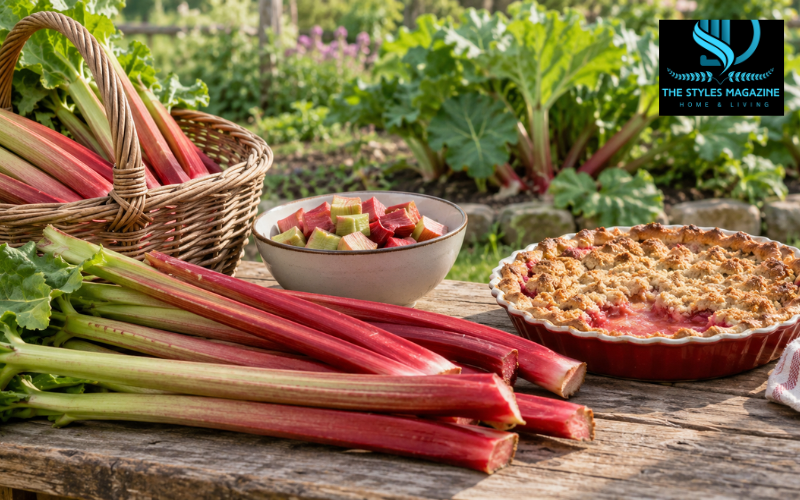
Rhubarb is a hardy perennial plant grown for its thick, edible leaf stalks. Those stalks may be red, pink, or green, and they have a sharp, tart taste that makes rhubarb stand out from most other garden vegetables. Because the plant returns year after year and is usually harvested in spring and early summer, rhubarb has become closely linked with seasonal pies, crumbles, jams, and sauces.
The most important fact to know is simple: the stalks are edible, while the leaves should never be eaten. Rhubarb leaves contain substances that can be harmful if swallowed, so they should always be removed and discarded before the stalks are prepared.
Beyond that safety point, rhubarb is easy to use once you understand its flavor. Fresh stalks can be bought, refrigerated, frozen, cooked into desserts, or used in savory dishes. Gardeners can also grow rhubarb for many years in a suitable spot. This guide explains what rhubarb is, how to choose and prepare it, when it is in season, how to use it in cooking, and how to grow and harvest it safely.
Rhubarb Quick Guide
| Feature | Quick Information |
| Plant type | Hardy perennial vegetable |
| Edible part | Stalks |
| Unsafe part | Leaves should never be eaten |
| Flavor | Sharp, sour, and tart |
| Typical season | Spring to early summer |
| Common colors | Red, pink, red-green, or green |
| Popular uses | Pies, crumbles, jams, compotes, sauces |
| Storage | Refrigerate fresh stalks or freeze for longer storage |
| Common pairings | Strawberry, apple, orange, ginger, vanilla |
| Growing habit | Returns each year once established |
How to Prepare Rhubarb Safely
- Remove all leaves and discard them completely because rhubarb leaves should not be eaten.
- Wash the stalks thoroughly under cool running water.
- Trim both ends and remove any damaged or unusually tough parts.
- Cut the stalks into pieces suitable for your recipe.
- Cook as needed, adding sweetness gradually to balance rhubarb’s natural tartness.
- Refrigerate leftovers or freeze prepared rhubarb if you want to keep it longer.
What Rhubarb Is and What It Tastes Like
Rhubarb forms a large clump of broad green leaves held above thick, fleshy stalks. Its botanical name is Rheum × hybridum, and it is a hardy perennial, meaning an established plant can survive winter and return with new growth in spring. Its leaves may make the plant look ornamental, but the stalks are the useful kitchen crop.
Fresh rhubarb has a strong sour, tangy taste. A raw piece can be mouth-puckering, especially when compared with sweet fruits. Cooking softens the stalks and mellows the flavor, while sugar, fruit, or other sweet ingredients help balance the acidity. This is why rhubarb works so well in desserts, although it can also add brightness to savory sauces and chutneys.
For readers wondering about rhubarb pronunciation, the usual English pronunciation is roughly “ROO-barb,” with the stress on the first syllable. British and American pronunciation differ slightly in the final sound. If you are searching for rhubarb in Russian, the common word is ревень, often written in Latin letters as reven’.
Is Rhubarb a Fruit or a Vegetable?
The common rhubarb fruit question can be confusing because the way rhubarb is cooked does not match the way it is grown. Rhubarb is generally treated as a vegetable in horticulture because the edible portion is the plant’s leaf stalk rather than a fruit produced from a flower. The Royal Horticultural Society also classifies rhubarb as a vegetable.
Cooks, however, often use rhubarb much more like a fruit. It is regularly combined with sugar and sweeter fruits, especially strawberries, and used in pies, crumbles, jams, cakes, and compotes. That culinary habit is why many people casually think of rhubarb as a fruit.
In practical terms, there is no contradiction. Rhubarb is grown and classified as a vegetable, but its sharp flavor makes it useful in many recipes where fruit would normally be used. If a recipe calls for rhubarb, it means the stalks. You also do not need to wait for harvested rhubarb to “ripen” in the way you might wait for a peach, pear, or other fruit.
Is Rhubarb Poisonous? The Parts You Can and Cannot Eat
Is rhubarb poisonous? The answer depends entirely on which part of the plant you mean. The stalks are commonly eaten as food, but rhubarb leaves should not be eaten.
The leaves contain oxalic acid and other compounds that can cause poisoning. Health guidance specifically identifies the leaf blade as the dangerous part while noting that the stalk can be eaten. The safest habit is to remove every leaf completely before washing, storing, or cooking rhubarb.
There is no need to be alarmed by normal use of properly prepared stalks. The important distinction is simply between the edible stalk and the unsafe leaf.
If someone accidentally eats rhubarb leaves, especially more than a tiny taste, contact a local poison control service or healthcare professional for advice. Do not make the person vomit unless a medical professional specifically tells you to do so. Possible poisoning symptoms can include nausea, vomiting, stomach pain, mouth or throat irritation, weakness, and more serious problems in severe cases.
Pets should also be kept away from the plant’s leaves and roots. The ASPCA lists rhubarb as toxic to dogs, cats, and horses because of soluble calcium oxalates. If a pet eats a potentially dangerous part of the plant, contact a veterinarian or animal poison service promptly.
Rhubarb Nutrition and Health Considerations
Plain rhubarb is naturally low in calories. One cup of diced raw rhubarb provides about 26 calories and 2.2 grams of dietary fiber. It also contains potassium, vitamin K, vitamin C, calcium, and smaller amounts of several other nutrients.
Those figures describe raw rhubarb without added sugar. The nutritional picture can change considerably when the stalks are turned into pie filling, jam, syrup, or a heavily sweetened compote. Rhubarb itself contains relatively little sugar, but recipes often add more because its natural flavor is extremely tart.
If you prefer a less sweet dish, you can often balance the flavor with naturally sweeter fruit, warming spices, vanilla, or orange rather than hiding the tartness under a large amount of sugar.
Rhubarb is also considered a high-oxalate food. That does not mean everyone needs to avoid it. However, people who form calcium oxalate kidney stones or who have specifically been advised by a doctor or dietitian to limit high-oxalate foods may need to watch how much they eat. Dietary needs vary, so broad restrictions are not necessary for everyone.
Rhubarb should be enjoyed as a food rather than promoted as a treatment or cure for any medical condition.
Rhubarb Season and the Best Time to Buy It
Rhubarb is strongly associated with spring and early summer. In many temperate regions, established plants begin producing harvestable stalks during spring, with many varieties ready from April or May. Exact timing varies with climate, weather, and variety.
Gardeners commonly reduce or stop heavy harvesting by early or midsummer so the plant can keep enough leaves to rebuild its energy for the following year. This does not mean the stalks suddenly become poisonous later in summer. They may become tougher, and repeatedly removing stalks can weaken the plant, but summer does not turn an otherwise normal stalk toxic.
You may also see forced rhubarb before the main outdoor crop arrives. Forcing involves covering an established crown so new stalks grow without light. The result is earlier, tender, pale pink growth that is often sweeter and less sharp than ordinary outdoor rhubarb.
Availability can therefore vary considerably. Farmers’ markets generally follow the local harvest, while supermarkets may have a wider supply window depending on where their produce comes from.
How to Choose Fresh, Good-Quality Rhubarb
Good rhubarb should feel firm and crisp rather than soft, floppy, badly shriveled, or damaged. Look for fresh-looking stalks with no obvious decay or large bruised areas. If leaves are still attached, remove them before storing or preparing the stalks.
Do not judge quality by color alone. Rhubarb varieties naturally range from deep crimson and bright pink to red-green and mostly green. The RHS notes that different varieties produce stalks with naturally different sizes and colors.
A green stalk is therefore not automatically unripe, just as a red stalk is not automatically sweeter or better. Variety and growing conditions have a major effect on appearance.
Thickness can vary as well. Thin stalks are often tender, but a healthy thick stalk can be just as useful when it is crisp and fresh. At a supermarket or farmers’ market, choose mainly according to firmness and condition. If a recipe depends on a bright pink appearance, then color may matter for presentation, but it should not be your only measure of quality.
Where to Find Rhubarb Near You
If you are searching for “rhubarb near me,” supermarkets and produce markets are good places to start, especially during spring. Depending on where you live, you may also find fresh stalks at farmers’ markets, farm shops, seasonal produce stands, community markets, and directly from local growers.
Availability is usually easiest during the local growing season. Because the harvest period can be fairly short, it is useful to check before making a special trip. Look at a supermarket’s online stock information when available, call its produce department, or check current vendor lists for nearby farmers’ markets.
Local farms may also publish harvest updates through their websites or social pages. These can be useful when you want locally grown stalks rather than supermarket produce.
Fresh rhubarb can be harder to find outside its main season, but frozen rhubarb may be available for longer. Frozen pieces work particularly well in cooked recipes such as pies, sauces, compotes, and crumbles, where a crisp raw texture is not required.
How to Prepare, Store, and Freeze Rhubarb
Start by removing every leaf and any damaged portions. Wash the stalks under cool running water, trim the ends, and cut them into the size your recipe requires.
Rhubarb usually does not need to be peeled. If an older stalk has unusually tough strings, you can pull away the thickest fibers while trimming it, but removing the whole outer layer is normally unnecessary.
Fresh rhubarb keeps best in the refrigerator and should be protected from drying out. The RHS notes that fresh stalks can be refrigerated and that rhubarb also freezes well. For the best eating quality, use refrigerated stalks while they remain firm and crisp.
Freezing is useful when you buy or harvest more than you need. Wash and trim the stalks, cut them into convenient pieces, and put them in suitable freezer packaging. According to the National Center for Home Food Preservation, rhubarb can be frozen raw or briefly heated first. Blanching it in boiling water for one minute and then cooling it quickly can help preserve its color and flavor. It can also be dry-packed without added sugar.
Frozen rhubarb is especially useful in dishes where the stalks will eventually cook until soft.
Rhubarb Color, Ripeness, and Common Misconceptions
One of the most common rhubarb myths is that every good stalk should be bright red. In reality, color depends heavily on the variety. Some plants produce rich ruby stalks, while others remain pink, green, or green with a reddish blush even when ready to harvest.
For that reason, waiting for a naturally green variety to turn red is not a useful way to judge it. Firmness, freshness, stalk development, and knowledge of the variety are more useful guides. Flavor can also differ between varieties and with the age of the stalk.
Another misconception is that rhubarb stalks become poisonous as summer progresses. University of Minnesota Extension specifically describes this as a myth. Later-season stalks do not automatically become toxic, although they may be tougher than the tender stalks harvested earlier in the year.
The main reason gardeners stop regular harvesting is to protect the plant. Leaving plenty of healthy leaves allows the crown to restore the energy it needs for future growth.
The Best Ways to Cook and Use Rhubarb
Rhubarb is famous for desserts because heat softens its firm stalks and sweet ingredients balance its sharp flavor. Simmered with some sugar, it quickly turns into a soft compote that can be served with yogurt, porridge, pancakes, or desserts.
It also works naturally in crumbles, tarts, jams, preserves, chutneys, cakes, and sauces. The RHS notes that although rhubarb is traditionally associated with desserts, it can also be used in tangy chutneys and savory sauces.
There is no rule that rhubarb has to become extremely sweet. A useful approach is to add sweetness gradually. Cook it, taste it, and adjust if needed. Naturally sweet fruit can soften the sharp taste, while orange zest, vanilla, ginger, cinnamon, and cardamom can add flavor without completely covering rhubarb’s character.
Rhubarb can also work in savory meals. A chutney can combine its acidity with onion and spices, while a rhubarb sauce or reduction can provide contrast alongside rich foods such as pork or duck.
The goal is balance. Rhubarb is most interesting when enough sweetness or richness is added to make it pleasant while some of its fresh tartness remains.
Rhubarb Pie, Classic Desserts, and Flavor Pairings
Rhubarb pie is one of the plant’s best-known uses. As the chopped stalks bake, they soften and release juice, creating a tart filling that contrasts with the rich pastry around it. Because rhubarb gives off plenty of liquid while cooking, pie recipes commonly use starch or another thickening ingredient to help the filling hold together.
Strawberry-rhubarb pie is especially popular. Ripe strawberries bring natural sweetness and fragrance, while rhubarb supplies the acidity that keeps the filling from tasting flat or overly sugary. The two flavors balance each other well.
Apples can work in a similar way, providing sweetness and body. Other useful partners include orange, ginger, vanilla, cinnamon, cardamom, and other warm spices.
Pie is only one option. Rhubarb is equally at home in crumbles, galettes, cakes, muffins, jam, and compote. The best pairing depends on the result you want. Strawberries and apples soften its sourness, orange makes it taste brighter, ginger adds warmth, while vanilla and gentle spices can make its sharp flavor feel smoother and more rounded.
Growing and Harvesting Rhubarb at Home
Rhubarb grows well in a sunny, open position with fertile soil that drains properly. Because a mature plant develops into a large leafy clump, it needs enough space rather than being squeezed into a crowded bed. Once established, rhubarb is hardy and can continue producing for many years.
Gardeners commonly start rhubarb from crowns or divisions. New plants need time to build strong roots and energy reserves, so newly planted rhubarb should not normally be harvested during its first year. Only a small harvest should be taken in the second year, with normal harvesting beginning once the plant is well established.
When harvesting, hold a mature stalk close to the base and pull it with a gentle twist rather than simply cutting every stalk away. Remove the leaf immediately and leave plenty of stalks and leaves on the plant so it can continue growing.
If a flowering stem appears, remove it near the base so the plant does not spend unnecessary energy producing flowers and seed. Older clumps that have become crowded or weak can be divided while dormant, commonly about every five years.
Healthy, established crowns can also be forced for an earlier crop by excluding light. Because forcing uses the plant’s stored energy, the crown should be allowed time to recover rather than being repeatedly forced without rest.
Conclusion
Rhubarb is unusual in the best way: it is a vegetable that behaves like a fruit in many recipes, has a bold sour flavor, and signals the arrival of spring in many gardens and markets. Its stalks can become pies, crumbles, jams, sauces, compotes, chutneys, and savory dishes, while extra rhubarb can be refrigerated or frozen for later use.
Color is not a reliable sign of ripeness or quality on its own. Depending on the variety, perfectly good rhubarb may be deep red, pink, red-green, or mostly green. Freshness, firmness, and proper handling matter more.
Above all, remember the basic safety rule: use the stalks and never eat the leaves. Once the leaves are removed, rhubarb is simple to prepare and surprisingly versatile.
Whether you buy a few stalks at a spring market, harvest them from an established garden plant, or use frozen rhubarb later in the year, a little care with selection, storage, preparation, and flavor balance is all you need to enjoy its distinctive tart character.
Frequently Asked Questions
Is Rhubarb A Fruit Or A Vegetable?
Rhubarb is botanically and horticulturally treated as a vegetable because its edible portion is the leaf stalk. However, cooks often use it like fruit in sweet dishes such as pies and crumbles.
Is Rhubarb Poisonous?
Rhubarb stalks are edible, but the leaves should never be eaten. The leaves contain oxalic acid and soluble oxalates that can cause poisoning when consumed in harmful amounts.
Can You Eat Green Rhubarb?
Yes. Green rhubarb can be perfectly mature and edible. Some varieties naturally produce green or partly green stalks, so bright red color is not required for good-quality rhubarb.
When Is Rhubarb In Season?
Fresh rhubarb is most strongly associated with spring and early summer, although exact harvest dates vary by climate, variety, and growing region. Forced rhubarb may become available earlier.
Can You Freeze Fresh Rhubarb?
Yes. Wash the stalks, remove the leaves, trim the ends, and cut the rhubarb into pieces before freezing. Frozen rhubarb works especially well in pies, sauces, crumbles, and compotes.
Enjoyed it? Find more exclusive content on The Styles Magazine.
Disclaimer: This article is provided for general informational and educational purposes and should not replace professional medical, nutritional, veterinary, or gardening advice. Only rhubarb stalks should be eaten; the leaves should be completely removed and discarded. If a person or pet consumes rhubarb leaves or develops concerning symptoms, contact an appropriate healthcare professional, poison-control service, veterinarian, or animal poison service promptly. Individual dietary needs may also vary, particularly for people who have been advised to limit high-oxalate foods.