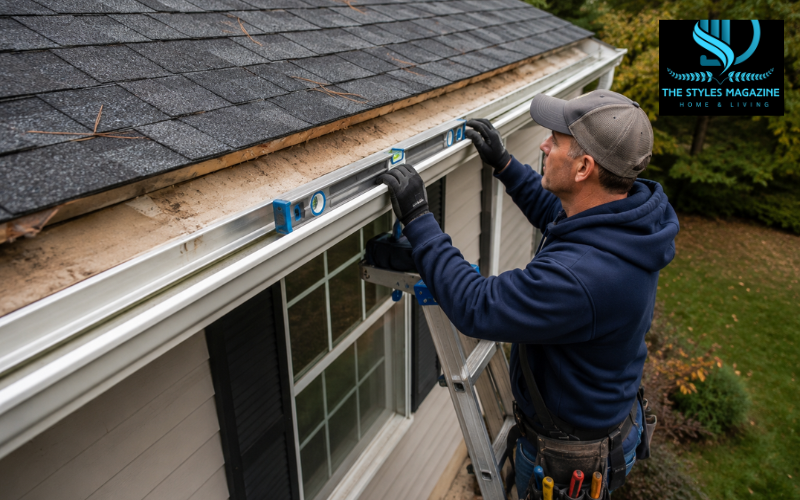
Gutters get treated as the least consequential exterior decision, which is why the questions that determine whether they work get skipped in favour of settling on a colour. The regrets that follow are consistent enough to be predictable, and every one of them is a five-minute conversation that didn’t happen.
None of these are expensive to address beforehand, and several are expensive to correct afterward. Homeowners across the Chicago suburbs run into the same handful of regrets, often discovering them only after the first heavy rain reveals exactly what was skipped during that first conversation.
Here’s what people wish they’d asked about.
Skipping a Proper Runoff Plan Before Installation
This is the most common regret and the most consequential. Gutters collect water efficiently and then discharge it somewhere, and if that somewhere is beside the foundation, the system has relocated a problem rather than solved it. Department of Energy building science guidance notes that just a few inches of rain on a roof can produce several thousand gallons of runoff and specifies terminating downspouts at least five feet from the foundation, or ten feet where they discharge into an underground catchment system.
Those distances are the useful part, because they turn a vague instruction into something you can check with a tape measure. Downspout extensions, buried drainage, or discharge onto a graded area all achieve it, and the decision belongs in the installation conversation rather than afterward. A homeowner who discovers water pooling at the foundation during the first heavy rain is solving a problem that was designed in.
Not Inspecting the Fascia Before Installing New Gutters
This is the regret homeowners describe most often after new gutters start sagging within a season or two. Rain channels mount directly to fascia board, which means the condition of that board matters just as much as the gutters themselves. Old rain channels frequently hide rot underneath, since moisture trapped behind a failing system quietly deteriorates the wood it’s attached to, invisible until the old gutters actually come off.
Installing new rain channels onto compromised fascia produces a system that sags or detaches within a couple of seasons, regardless of how well the new gutters themselves were installed. A contractor who inspects and reports on fascia condition before quoting is doing the job properly; one who quotes a straight replacement without mentioning it may be planning to raise it as a change order midway through. Either way, it’s better known in advance.
Not Choosing the Right Gutter Size Before Installation
This is the regret that shows up the first time heavy rain overwhelms a brand-new system. Standard five-inch gutters suit standard roofs, and roofs with large surface area, steep pitch, or valleys concentrating flow frequently need six-inch and larger downspouts. Undersized rain channels overflow during heavy rain regardless of how cleanly they’re installed, since the problem is capacity rather than installation quality.
Sizing is a calculation based on roof area and expected rainfall intensity rather than a preference. A contractor who arrives at a size by measuring rather than by defaulting is worth the extra fifteen minutes, particularly on homes with complex roof geometry where flow concentrates unevenly.
Choosing a Drainage System Without Comparing the Seams
This is the regret that surfaces years later, when a joint finally gives out during a storm nobody expected trouble from. Sectional gutters join at intervals, and joints are where leaks develop as materials expand and contract across seasons. Seamless systems are formed on site to the length of each run, eliminating those failure points entirely and removing one of the most common sources of long-term drainage failure.
Before comparing prices, homeowners should ask any seamless gutter contractor Chicago suburbs whether the quote covers sectional or seamless installation, since the difference isn’t always stated plainly. Contractors who handle rain channels alongside roofing, such as Lakeland Exteriors & Roofing, are well positioned to catch issues where the two systems interact at the roof edge, since problems in one frequently originate in the other.
Assuming Every Guard Handles Debris the Same Way
The drainage system guards are the decision people most often regret in both directions, having either fitted the wrong type or skipped them next to a mature maple tree.
- Large leaves: typically handled well by wider screen guards, but not by fine mesh
- Pine needles: small and sharp enough to pass through larger screens, requiring fine mesh instead
- Seed pods: behave differently again, often clogging systems not designed to catch their shape
- Fine mesh guards: handle needles well but can clog with pollen over time
- Larger screen guards: handle leaves effectively but let needles pass through
Getting this matched to your specific trees is the difference between a system that reduces maintenance and one that adds a new kind.
Not Asking How the Gutter Slope Will Be Set
Gutters need consistent fall toward downspouts, and insufficient slope leaves standing water while excessive slope looks wrong from the ground. It’s a small tolerance, and it’s set during installation. A rain channel that looks perfectly level to the eye can still be off by just enough to cause problems, since the margin for error here is genuinely narrow.
Standing water is the visible symptom: it breeds mosquitoes, adds weight, and accelerates corrosion at low points. Asking how slope is established, and whether the installer checks it with a level rather than by eye across a long run, is a reasonable question about workmanship that most homeowners never think to raise.
Final Thoughts
The regrets on this list share a pattern: they’re all questions that cost nothing to ask before installation and money to fix afterward. Establish where water discharges and whether that’s far enough from the foundation. Ask about fascia condition before the old gutters come off. Confirm sizing was calculated rather than assumed. Clarify whether you’re being quoted seamless or sectional. Match any guard system to the trees you actually have. And ask how the slope gets set. Ten minutes of questions during the estimate, and you avoid the specific frustration of watching a new system fail at the first proper storm.
Enjoyed it? Find more exclusive content on The Styles Magazine.