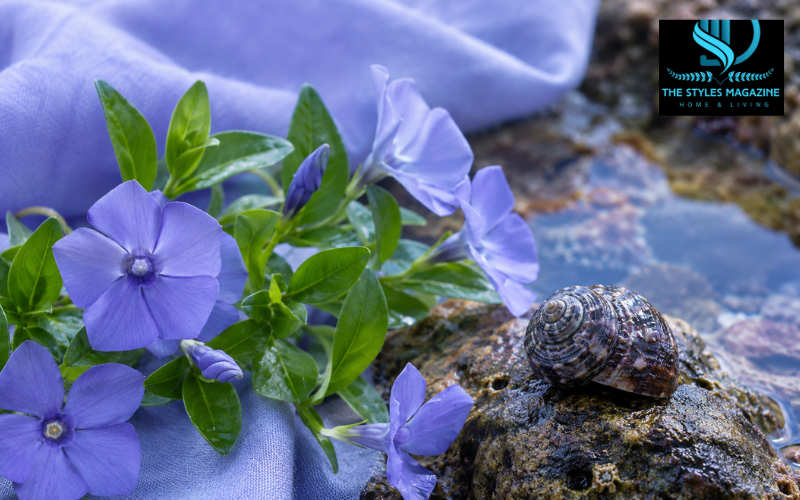
Periwinkle is one of those words that can mean very different things depending on the context. In design, periwinkle is a soft purple-blue colour. In gardening, it refers to several flowering plants, especially species of Vinca and the Madagascar periwinkle. Along the coast, a periwinkle can also be a small sea snail that lives on rocks and is eaten as seafood in some regions.
These meanings are connected mainly by name rather than by biology. The familiar periwinkle colour took its name from the blue-lavender flowers associated with lesser periwinkle, while the marine animal belongs to an entirely different part of the natural world. This can make online searches confusing, especially when someone searches for “periwinkle blue,” “periwinkle leaves,” “periwinkle fish,” or “periwinkle seafood.”
This guide separates the three main meanings clearly, so you can understand what periwinkle means in colour, gardening, medicine, marine life, and food without mixing them up.
Quick Guide to Periwinkle
| Meaning | What It Refers To | Key Detail |
| Periwinkle colour | Pale blue-purple shade | Common HEX code: #CCCCFF |
| Vinca minor | Lesser periwinkle plant | Low-growing evergreen groundcover |
| Vinca major | Greater periwinkle plant | Larger, vigorous trailing groundcover |
| Catharanthus roseus | Madagascar periwinkle | Warm-season flowering ornamental |
| Periwinkle snail | Small marine gastropod | Lives mainly around rocky coastal areas |
| Periwinkle seafood | Edible sea snail | Often called a winkle |
Quick Periwinkle Identification Guide
- Soft blue-purple shade: Usually refers to periwinkle colour.
- Low creeping plant with blue-lavender flowers: Often Vinca minor.
- Larger trailing Vinca plant: Usually Vinca major.
- Pink, white, or red summer flowers: Often Madagascar periwinkle.
- Small spiral shell on coastal rocks: A periwinkle sea snail.
- “Periwinkle fish”: Periwinkles are sea snails, not fish.
Periwinkle Colour: The Soft Shade Between Blue and Lavender
Periwinkle colour is usually described as a pale blue with a noticeable purple or violet influence. It sits visually between light blue and lavender, giving it a cool, gentle appearance. One commonly used digital version of periwinkle has the HEX code #CCCCFF, with RGB values of 204 red, 204 green, and 255 blue.
Compared with light blue, periwinkle contains more purple. Compared with lavender, it usually feels slightly bluer. Lilac often has a warmer or pinker purple tone, while violet is generally deeper and more saturated. These differences are not always fixed because colour names can vary between paint brands, fabric makers, and digital systems.
Periwinkle blue is popular in bedrooms, soft furnishings, clothing, stationery, websites, and brand palettes because it works well as a calm pastel. In digital design, it can be used as a background, accent, or supporting colour. However, designers still need to check contrast carefully when placing text over pale periwinkle backgrounds.
How the Periwinkle Flower and Colour Became Connected
The colour name comes from the flower rather than the other way around. Lesser periwinkle, or Vinca minor, commonly produces small flowers in shades of blue, violet, and lavender. Those cool floral tones became associated with the colour now called periwinkle. Adobe also identifies the flower as the inspiration behind the modern colour name.
It is important, however, not to assume that every periwinkle flower is periwinkle blue. Garden forms of Vinca minor and Vinca major can include white or deeper purple flowers, while Madagascar periwinkle is widely grown in pink, white, red, purple-toned, and bicoloured forms.
So, “periwinkle colour” describes a particular pale blue-purple shade, while “periwinkle flower” can describe plants whose blooms appear in several different colours.
Periwinkle Plants: Vinca and Madagascar Periwinkle Explained
Several plants share the common name periwinkle, but they are not all the same plant. The two traditional groundcover species are Vinca minor, known as lesser or common periwinkle, and Vinca major, known as greater or big-leaf periwinkle. Both belong to the dogbane family, Apocynaceae, and spread by trailing stems.
Madagascar periwinkle is Catharanthus roseus. It belongs to the same plant family but a different genus. Older botanical names placed it in Vinca, which helps explain why gardeners still often call it “annual vinca.” NC State describes it as a tender evergreen perennial native to Madagascar that is commonly treated as an annual in colder regions.
This distinction matters because the plants have different growth habits. Vinca species are usually used as spreading groundcovers, while Madagascar periwinkle is more often grown for colourful warm-season flowers in beds, borders, pots, and hanging baskets.
Vinca Minor: Lesser or Common Periwinkle
Vinca minor is a low, evergreen groundcover with creeping stems that can root where they touch the soil. It usually stays only a few inches tall, but its spreading habit allows it to create a dense mat. Its leaves grow in opposite pairs and are dark green, smooth-edged, and relatively thick or leathery.
The flowers are generally small and five-lobed, most often appearing in lilac-blue, lavender, or blue-purple shades. White-flowered cultivars also exist. Flowering is strongest in spring and early summer, although some plants may bloom again at other times.
Lesser periwinkle has long been used under trees, on banks, and in partly shaded areas because it tolerates shade and can cope with a range of soils when drainage is reasonable. That toughness is also its main drawback. Stems can move beyond the intended planting area, root into nearby soil, and create dense growth. NC State notes that it is considered invasive in some areas, so local guidance should be checked before planting.
Vinca Major: Greater Periwinkle and How It Differs
Vinca major has a similar trailing habit but is generally larger and more vigorous than Vinca minor. Its leaves are broader, thinner in texture, and often slightly hairy along the margins. The flowers are also larger and usually blue to violet, although white-flowered forms are available.
Like lesser periwinkle, greater periwinkle sends non-flowering stems along the ground. These stems can root at their nodes and form a thick mat, while flowering shoots rise above the foliage. It performs well in partial shade and prefers moist, fertile, well-drained soil, although established plants can tolerate some dry conditions.
Its spreading ability deserves attention. NC State lists Vinca major as invasive in several U.S. states and explains that escaped plants can crowd out native vegetation. Because invasive status varies by location, gardeners should check regional plant lists rather than assuming it is suitable everywhere.
Madagascar Periwinkle: Catharanthus Roseus
Madagascar periwinkle, or Catharanthus roseus, looks and behaves differently from the low carpet-forming Vinca groundcovers. It grows upright or spreading and is valued mainly for its long display of colourful flowers. The leaves are glossy, smooth, and arranged in pairs, often with a pale central vein.
Its five-lobed flowers are available in many cultivated colours, including white, pink, rose, red, and combinations with a contrasting centre. Modern varieties may be compact, mounding, or trailing.
In warm climates, Madagascar periwinkle can grow as a tender perennial. In colder regions, it is normally planted as a summer annual because frost damages the plant. It generally performs best with plenty of light and well-drained soil. NC State recommends full sun to partial or dappled shade and notes that good drainage is especially important.
Unlike woodland-style Vinca groundcovers, Madagascar periwinkle is commonly used in sunny beds, containers, borders, and hanging baskets where summer heat would challenge many other flowering plants.
Periwinkle Leaves, Flowers, and Easy Identification
Looking at the leaves, growth habit, and flower size is the easiest way to tell the main periwinkle plants apart. Vinca minor forms a low mat with smaller, thicker leaves and relatively small blue-lavender flowers. Vinca major has larger flowers and broader, thinner leaves, with fine hairs along the leaf margins. Both spread by trailing stems that can root into the ground.
Catharanthus roseus is easier to separate once you see the whole plant. It normally grows more upright, has smooth glossy leaves with a noticeable pale midrib, and produces warm-season flowers in a much wider colour range.
| Plant | Typical growth | Leaves | Common flower colours |
| Vinca minor | Low, trailing groundcover | Smaller, thicker, smooth-edged | Blue, lavender, purple, white |
| Vinca major | Vigorous trailing groundcover | Larger, thinner, slightly hairy at edges | Blue, violet, purple, white |
| Catharanthus roseus | Upright or spreading bedding plant | Glossy, smooth, pale midrib | Pink, white, red, rose, purple-toned and bicoloured forms |
Checking several features together is more reliable than identifying a plant from flower colour alone.
Growing Periwinkle in the Garden
The right growing method depends on which periwinkle you have. Vinca minor and Vinca major are usually chosen as groundcovers. They can tolerate shade and establish spreading mats, although flowering is often stronger with more light. Moist but well-drained soil is a good starting point, and established plants can cope with periods of drier soil.
Their main maintenance need is control. Trim or remove stems that move outside the intended bed, and do not allow cut pieces to establish in natural areas. Where either species is listed as invasive, choose a locally recommended alternative instead.
Madagascar periwinkle needs a different approach. Give it good drainage, warmth, and enough sunlight for strong flowering. Avoid keeping the root zone constantly wet because poorly drained conditions can encourage disease. Containers should have open drainage holes, and watering should be based on soil moisture rather than a rigid daily schedule.
Periwinkle Invasiveness, Toxicity, and Safety
Periwinkle can be attractive and useful, but two safety issues should not be ignored. First, Vinca minor and Vinca major can spread aggressively. Their trailing stems root easily, allowing colonies to move into lawns, neighbouring beds, woodland edges, and other natural spaces. Whether they are officially classed as invasive depends on the region, so local environmental or extension guidance is the best source before planting.
Second, ornamental periwinkle plants should not be treated as food. Madagascar periwinkle contains vinca alkaloids. NC State classifies Catharanthus roseus as having low-severity poison characteristics but notes that consuming large amounts can cause vomiting, diarrhea, low blood pressure, nervous-system effects, and other serious symptoms. The source also identifies the plant as a concern for cats, dogs, and horses.
That does not mean people need to fear having the plant in a garden. Sensible precautions are enough: prevent children and pets from chewing it, avoid experimenting with homemade teas or extracts, and seek appropriate medical or veterinary advice if significant ingestion is suspected.
Periwinkle and Medicine: Why the Plant Matters to Science
Madagascar periwinkle has an important place in medical science because it contains compounds known as vinca alkaloids. Research on the plant contributed to medicines that interfere with the way certain cells divide.
Two well-known examples are vincristine and vinblastine. The U.S. National Cancer Institute describes vinblastine as a natural alkaloid isolated from Catharanthus roseus and identifies vincristine as an alkaloid historically isolated from the plant previously known as Vinca rosea. These drugs are used in cancer treatment under professional medical supervision.
The important point is that a medicinal drug and a garden plant are not interchangeable. Pharmaceutical products are purified, precisely prepared, carefully dosed, and given for specific medical reasons. Eating Madagascar periwinkle or making a homemade extract cannot reproduce that process and may cause harm.
Its medical importance is therefore a story about drug discovery and pharmaceutical science, not evidence that the raw plant is a safe home treatment.
Periwinkle Snail: The Animal With the Same Name
The periwinkle animal has nothing to do with garden Vinca. It is a marine snail. The best-known edible species is the common periwinkle, Littorina littorea, a gastropod in the family Littorinidae. It carries a compact spiral shell and crawls across coastal surfaces using a muscular foot.
Common periwinkles are strongly associated with shorelines, especially rocky coastal habitats, rock pools, cobbles, and other intertidal surfaces. MarLIN records the species across open-coast and estuary habitats and notes that it often gathers in favourable damp areas such as rock pools.
These snails are grazers. They feed on a variety of green, brown, and red algae growing on coastal surfaces, helping connect them to the wider ecology of the shore.
A common search term is “periwinkle fish,” but that name is misleading. A periwinkle is not a fish. It is a mollusc and, more specifically, a gastropod sea snail. When the word appears in a seafood context, it normally refers to the edible snail rather than a species of fish.
Periwinkle Seafood: How Edible Winkles Are Used
In food discussions, periwinkle seafood usually means edible marine snails such as Littorina littorea, often simply called winkles. MarLIN lists the common periwinkle as the edible periwinkle, reflecting its long association with human food.
Winkles are traditionally cooked in coastal communities, especially in parts of Europe. After cooking, the small piece of meat is removed from the spiral shell with a narrow pick or similar utensil. Because the edible portion is small, eating winkles tends to be a slow, hands-on experience rather than a quick seafood meal.
As with any seafood, safe handling matters. Buy from a reputable source, keep raw seafood properly chilled, prevent cross-contamination in the kitchen, and follow suitable cooking instructions. The FDA recommends keeping raw seafood separate from ready-to-eat foods and cleaning hands, utensils, boards, and surfaces after contact with raw seafood.
Anyone collecting wild periwinkles should also check local harvesting rules, water-quality notices, seasonal closures, and conservation restrictions. A shoreline may contain plenty of snails without necessarily being an approved or safe place to collect food.
Conclusion
Periwinkle can describe a gentle blue-purple colour, a group of familiar flowering plants, or a small marine snail. The periwinkle colour is best known as a pale shade between blue and lavender, while Vinca minor and Vinca major are spreading groundcovers and Catharanthus roseus is the colourful Madagascar periwinkle.
The marine meaning is completely different: the common periwinkle is an algae-grazing sea snail that can also be used as seafood. It is not a fish.
The easiest way to understand the word is to look at the context. In design, periwinkle usually means colour. In a garden, it usually means Vinca or Madagascar periwinkle. On a rocky shore or seafood menu, it usually means a small marine snail.
Frequently Asked Questions
What Does Periwinkle Mean?
Periwinkle can refer to a pale blue-purple colour, several flowering plants, or a small marine sea snail. The meaning depends on the context.
Is periwinkle a blue or purple colour?
Periwinkle is generally a soft blue-purple shade. It sits between light blue and lavender, although the exact shade can vary.
What Is Periwinkle Plant?
Periwinkle commonly refers to Vinca minor, Vinca major, or Madagascar periwinkle (Catharanthus roseus). These plants differ in appearance, growth habit, and uses.
Is Periwinkle A Fish?
No. The marine periwinkle is a small sea snail, not a fish. Common periwinkles belong to the gastropod group of molluscs.
Can You Eat Periwinkle Snails?
Yes, some marine periwinkle species, particularly common periwinkles or winkles, are traditionally eaten as seafood. Proper harvesting, handling, and cooking are important.
Is Madagascar Periwinkle Poisonous?
Madagascar periwinkle contains naturally occurring compounds that can be harmful if consumed. It should not be eaten or used to make homemade medicinal preparations.
What Is Periwinkle Used For In Gardens?
Vinca species are commonly used as groundcovers, while Madagascar periwinkle is often grown in flower beds, containers, borders, and hanging baskets.
Enjoyed it? Find more exclusive content on The Styles Magazine.
Disclaimer: This article is provided for general informational and educational purposes only. Plant identification, gardening, medicinal, and seafood information can vary by species, location, and individual circumstances. Periwinkle plants should not be consumed or used as homemade medicines, and wild seafood should only be collected and prepared according to local regulations and food-safety guidance. For poisoning concerns, medical conditions, medication-related questions, or suspected ingestion by children or pets, consult an appropriate healthcare or veterinary professional.