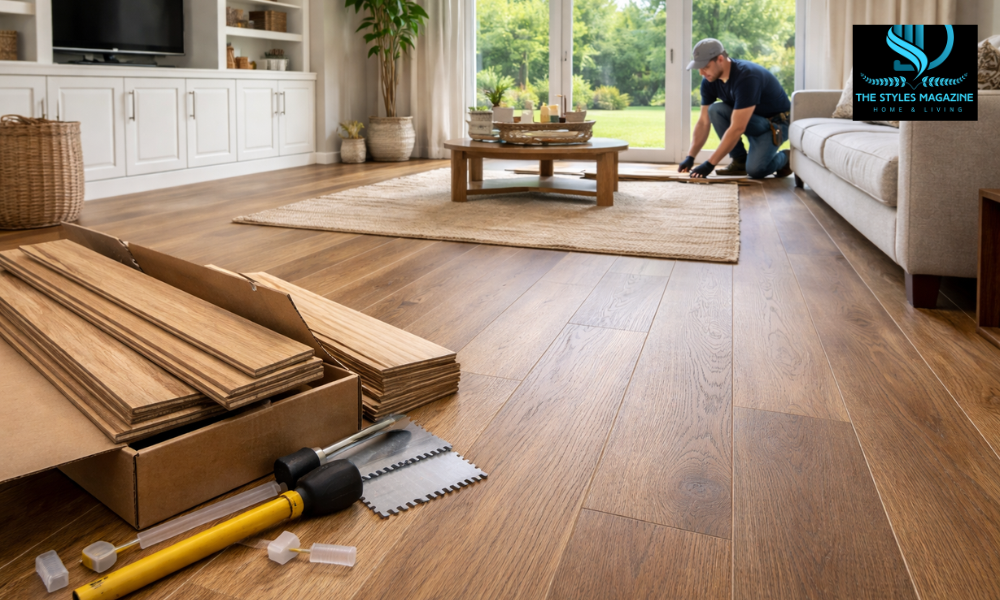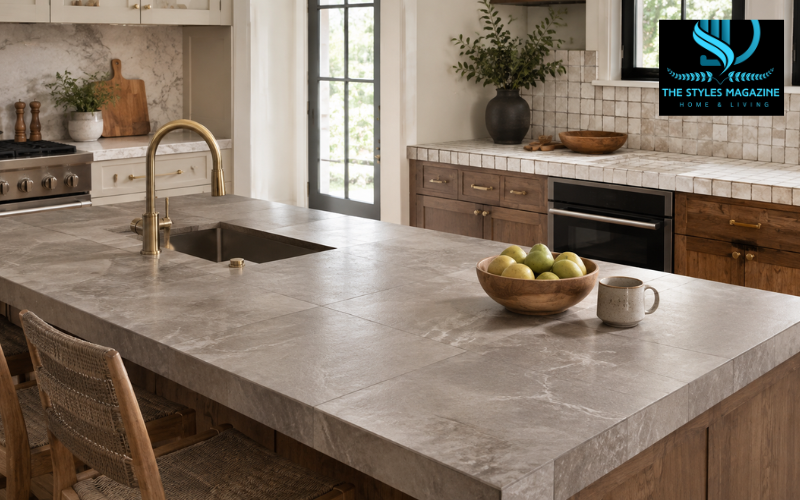
Tile countertops are work surfaces finished with individual tiles or larger tile panels rather than one continuous slab. They are commonly used in kitchens, bathroom vanities, utility areas, and some outdoor spaces when the chosen tile and installation system suit the location.
Homeowners often consider tile countertops because they offer wide design freedom, many affordable material choices, good heat tolerance, and the possibility of replacing a damaged tile instead of the whole counter. Ceramic tile is well suited to countertop applications when the correct product and installation system are used.
The main tradeoff is grout. Joints need cleaning, and poor installation can lead to uneven surfaces, loose tiles, or cracking. This guide explains the main tile types, modern styles, layouts, grout choices, costs, installation needs, cleaning, repairs, and pros and cons so you can decide whether tile fits the way you use your home.
Quick Guide to Tile Countertops
| Feature | Quick Guide |
| Common materials | Ceramic, porcelain, mosaic, handmade tile, large-format porcelain |
| Best for | Kitchens, bathroom vanities, custom and decorative designs |
| Main advantage | Wide choice of colors, patterns, sizes, and price points |
| Main drawback | Grout joints require cleaning and maintenance |
| Heat resistance | Generally good, depending on the tile and installation system |
| Maintenance | Regular wiping, grout cleaning, and sealing when required |
| Modern option | Large-format porcelain for fewer visible grout lines |
| Repairability | Individual damaged tiles can often be replaced |
| DIY friendly? | Possible for experienced DIYers; complex layouts may need a professional |
Quick Steps for Choosing Tile Countertops
- Choose the location – Decide whether the tile will be used in a kitchen, bathroom, or another area.
- Select the right tile – Use tile recommended for countertop applications rather than choosing by appearance alone.
- Consider tile size – Small tiles create more grout lines; larger porcelain tiles provide a cleaner look.
- Choose grout carefully – Consider stain resistance, maintenance requirements, and a color that works with the tile.
- Plan the layout – Think about sinks, cooktops, corners, backsplashes, cuts, and countertop edges.
- Prepare a stable base – A flat, rigid, properly prepared surface helps reduce cracking and movement.
- Plan maintenance – Follow the tile and grout manufacturer’s cleaning and sealing recommendations.
How Tile Countertops Have Changed
Traditional tile countertops are often associated with small square tiles and obvious grout lines. That style still suits retro, cottage, Mediterranean, and handmade-inspired rooms, but it is no longer the only option.
Modern installations can use rectified porcelain, oversized tiles, or porcelain slabs. Large-format products reduce the number of joints across the work surface, while countertop-size porcelain panels can create a calmer, more continuous look than a traditional grid of small tiles. Schluter specifically notes that today’s large-format tiles can create countertops with minimal grout joints.
This difference matters because many everyday complaints about tiled counters relate to the number of grout joints rather than the tile itself. Larger pieces reduce those joints while keeping the color and design choice that make tile appealing. Small tiles still work well when visible pattern and texture are intentional, while large porcelain usually suits a cleaner contemporary style.
Types of Tile Used for Countertops
Ceramic tile countertops are a familiar and flexible option. Glazed ceramic comes in many colors, shapes, and patterns and can work particularly well when a classic, colorful, or handmade appearance is the goal. Ceramic is also generally easier to cut than dense porcelain.
Porcelain is a type of ceramic tile made to meet a very low water-absorption standard. Under current tile-industry standards, porcelain has water absorption of 0.5% or less. It can be glazed or unglazed and is available in designs that resemble marble, concrete, limestone, terrazzo, and other materials.
Mosaics, patterned tiles, and handmade tiles can give a countertop strong character. Zellige-style tile is intentionally irregular in color, surface, and edges, so it is better for people who appreciate a handcrafted look than for someone who expects a perfectly smooth work surface.
Large gauged porcelain panels and slabs provide far fewer visible joints. Whatever material you choose, check that the manufacturer recommends it for the intended countertop use. A tile that looks attractive on a wall is not automatically the right product for a hard-working kitchen surface.
Kitchen Tile Countertops vs. Tile Countertops in Bathrooms
Kitchen tile countertops face food spills, cookware, appliances, frequent wiping, and daily food preparation. A kitchen counter therefore benefits from a flat layout, durable edges, stain-resistant grout, and tile intended for regular surface use. Ceramic and porcelain products can tolerate high temperatures, although using a trivet for very hot cookware remains a sensible habit because the complete countertop assembly includes more than just the tile.
Bathroom tile countertops have different demands. They deal more with water, soap, cosmetics, and repeated moisture around sinks. Vanity tops are often smaller than kitchen counters, so decorative tile can be used without creating as many grout joints across a large working area.
In either room, performance depends on more than the visible tile. Joints, corners, sink cutouts, the supporting surface, and any necessary moisture-control system must all be handled correctly. Current TCNA guidance includes specific considerations for wet areas, substrates, grout joints, and setting materials.
Modern Tile Countertops and Large-Format Porcelain
Modern tile countertops often aim to keep the benefits of tile while reducing the busy grid linked with older installations. Large-format porcelain is central to this look. Some products are manufactured as very large panels or countertop slabs, allowing a long surface to be covered with only a small number of joints.
Design choices are also broad. Marble-look porcelain can provide a stone-like appearance, while concrete-look and solid-color surfaces fit minimal interiors. Other products imitate quartzite, terrazzo, metals, and softly textured natural stone.
Current porcelain countertop products are available with strong resistance to heat, stains, and scratches. Daltile, for example, lists those characteristics for its porcelain countertop surfaces. Resistance does not mean the material is impossible to damage: exposed edges can still be vulnerable, and fabrication and installation quality remain important.
Large panels also require careful handling and cutting, making professional installation practical for many projects. For homeowners who like tile but dislike frequent grout lines, large-format porcelain provides a useful middle ground between classic tile and a visually continuous slab.
Tile Sizes, Patterns, and Countertop Layouts
Tile size affects both appearance and daily use. Small square tiles create a clear grid that fits naturally in retro kitchens. Rectangular tiles can be arranged in stacked, offset, or geometric layouts, while checkerboard, mosaic, and handmade designs make the counter a stronger visual feature.
Larger tiles create a quieter surface because they use fewer joints. However, they also demand careful surface preparation and accurate cutting around sinks, cooktops, corners, walls, and countertop edges. Current tile-installation guidance specifically addresses substrate flatness and grout-joint planning because both can affect the finished result.
Layout planning should happen before installation begins. A dry layout helps show where cuts will fall and whether awkward narrow pieces will appear near a wall or edge. It can also help align joints with sinks, backsplashes, and other visible details.
The best layout is therefore not simply the prettiest pattern. It should also suit the counter dimensions and the way the surface will be used.
Tile Countertops Colors, Grout, and Design Coordination
Tile countertop colors can change the mood of an entire room. White and warm neutrals keep the surface light, while clay, sand, muted green, and other earth tones create a softer look. Dark tile adds contrast, and patterned or hand-painted designs can turn a smaller counter into a focal point.
Grout color matters almost as much as the tile. Grout close to the tile color makes the grid less noticeable, while contrasting grout highlights each joint. That can strengthen a checkerboard or geometric design, but it may also make an already busy countertop feel more crowded.
The rest of the room should guide the decision. A strongly patterned counter often works better with quieter cabinets and walls, while simple tile can sit comfortably beside a more decorative backsplash.
Edge details deserve attention too. Finished metal profiles, matching trim pieces, mitered edges, or specialty edge tiles can protect exposed tile edges while making the countertop look complete. Tile manufacturers offer dedicated edge profiles for this purpose.
Tile Countertops Pros and Cons
The main advantage of tile countertops is flexibility. Homeowners can combine colors, sizes, patterns, and finishes in ways that are difficult with many slab materials. Ceramic tile can be budget-friendly, many tile products have good heat tolerance, and one damaged tile may be replaceable. A skilled DIYer may also reduce labor costs on a straightforward small-format project.
The disadvantages are important too. Grout can collect dirt or discolor, individual tiles can chip or crack, and poor installation can create an uneven work surface. Small-format tile also has far more joints to clean than large-format porcelain.
Problems underneath the surface should not be ignored. TCNA notes that movement in a wall, floor, or countertop can damage grout or tile, which is one reason proper support and movement accommodation matter.
Tile countertops Reddit discussions and other homeowner forums often repeat concerns about grout cleaning, uneven work surfaces, DIY quality, and long-term durability. Those experiences can reveal real-life frustrations, but they should be treated as personal reports rather than technical installation guidance.
Tile is not automatically outdated or low-maintenance. Its success depends heavily on tile format, grout choice, installation quality, and the homeowner’s tolerance for visible joints.
Groutless Tile Countertops: What “Groutless” Really Means
When people search for groutless tile countertops, they usually want a surface that looks nearly seamless. That is different from simply pushing ordinary tiles tightly together. Tile installations still need properly planned joints, and the assembly must allow for normal movement.
Large and rectified porcelain products can help reduce the visual effect of the joints. Very large porcelain panels can reduce their number even further, sometimes leaving only a few across a countertop. Schluter specifically identifies minimal grout joints as a benefit of today’s large-format countertop installations.
Removing grout lines by ignoring recommended joint widths is not a good shortcut. Tile size, manufacturing variation, surface flatness, temperature changes, and the installation system can all influence joint planning. TCNA also states that expansion and movement accommodation remains necessary in tile installations; membranes do not automatically remove that requirement.
If a completely joint-free appearance is essential, traditional tile may not be the right surface. If the goal is simply to make joints less noticeable, large porcelain and a closely matched grout color offer more realistic options.
What Tile Countertops Cost
The cost of tile countertops depends on much more than the price of the tile. Standard ceramic can keep material costs relatively modest, while handmade tile, mosaics, premium porcelain, and large slabs can move the project into a much higher price range.
Labor can be just as important. A simple rectangular counter with standard tile is very different from a project with an undermount sink, several corners, detailed patterns, mitered edges, or large porcelain panels that need specialist fabrication. Large gauged porcelain panels have their own installation and workmanship requirements, including substrate, coverage, and handling considerations.
The total project may also include surface preparation, a tile-ready backing system, membranes where needed, mortar, grout, edge profiles, sink cutouts, and finishing work.
DIY can reduce labor expense, but only when the work is done correctly. Fixing an uneven base, cracked grout, poor cuts, or unfinished edges can quickly remove those savings.
For a fair comparison, look at the total installed cost rather than the tile price alone. Ask exactly what preparation, fabrication, edge treatment, grout, and finishing are included in each quote.
Getting the Installation Right
A tile countertop needs a stable, flat, properly prepared base. Tile is hard but not flexible, so movement underneath can contribute to cracked grout or damaged tile. TCNA’s installation guidance emphasizes that tile systems require a properly designed, constructed, and prepared supporting structure.
The correct build-up depends on the cabinet structure, tile type, panel size, local requirements, and installation system. A project may use a suitable structural base with cement backer board, a tile-ready building panel, a membrane, or another approved system. Products such as tile-ready building panels are specifically designed to serve as tile substrates, but no single construction method is correct for every counter.
The mortar or adhesive must also be compatible with the chosen tile and substrate. Flatness, mortar coverage, movement accommodation, and careful layout become especially important with large tile and gauged porcelain panels. Current ANSI standards contain separate installation requirements for several tile and panel systems.
Edges should be planned early. Metal profiles, specialty trim, mitered tile, or fabricated slab edges can protect exposed edges and give the counter a finished appearance. Large panels and complicated sink cutouts usually benefit from experienced fabrication.
Choosing Grout and Keeping It Clean
Grout choice has a major effect on how easy a tile countertop is to maintain. Traditional cement-based grout is widely available and comes in many colors, but cement grout still requires routine care and is not completely stain-proof. Some products may also benefit from sealing, depending on their formulation and manufacturer instructions.
Epoxy grout is often chosen for demanding areas because it has very low absorption and strong stain resistance. Some current epoxy systems specifically state that they do not need sealing. LATICRETE, for example, says its epoxy grouts have an absorption rate below 0.5% and do not require sealing.
The tradeoff is that epoxy can be less forgiving during installation and cleanup, especially with textured or porous tile. Joint width should not be selected only for appearance either. Narrow joints can look cleaner, but the tile dimensions, surface flatness, and product instructions still need to support that choice.
For everyday care, wipe spills promptly and use cleaners recommended for the tile and grout. Avoid assuming harsh chemicals or aggressive scrubbing are always better. TCNA recommends cleaning methods that remove dirty cleaning water rather than simply moving it around the grout surface.
Repairs, Longevity, and Deciding Whether Tile Is Right for You
One practical benefit of a tiled countertop is that localized damage may be repairable. If a single tile chips or cracks, it may be possible to remove and replace that piece rather than replacing the entire countertop. Keeping several spare tiles from the original installation makes matching easier if the design is later discontinued.
Grout problems should be diagnosed instead of simply covered. Discoloration may require proper cleaning, while repeated cracking can point to movement, weak support, or another installation issue. TCNA notes that countertop movement can contribute to grout or tile damage, so repeatedly replacing cracked grout without correcting the underlying cause may not solve the problem.
Tile works especially well for homeowners who value color, pattern, custom design, retro character, or localized repairability. Large-format porcelain can also suit modern homes where fewer visible joints are preferred.
A continuous slab may be better for someone who wants the smoothest possible work surface and strongly dislikes grout maintenance. Before deciding, consider cooking habits, cleaning expectations, design style, DIY skill, budget, and how much surface texture you are comfortable with.
Conclusion
Tile countertops now offer far more than the small square surfaces many people remember. Ceramic tile can create an affordable, colorful, or nostalgic counter, while modern large-format porcelain can deliver a cleaner appearance with far fewer visible joints.
Their strengths include design freedom, heat tolerance, broad material choice, and the possibility of repairing isolated damage. Their tradeoffs include grout care, possible chipping or cracking, and the need for careful preparation and installation.
A good result starts with choosing tile that is suitable for the job, building a stable base, selecting grout that matches your maintenance expectations, and planning joints and edges correctly. Current tile-industry standards continue to place strong emphasis on the supporting structure and correct installation method.
For the right household, tile countertops can be practical, distinctive, and long-lasting. The best choice is not simply the design that looks best in a photo, but the surface that fits how you actually cook, clean, maintain, and use the room.
FAQs
Are Tile Countertops Good For Kitchens?
Yes. Tile countertops can work well in kitchens because they offer good heat resistance, many design choices, and repairable sections. However, grout maintenance and proper installation are important for long-term performance.
What Is The Best Tile For Countertops?
Ceramic and porcelain are common choices. Porcelain is often preferred for modern countertops because it is dense, available in large formats, and comes in many stone, concrete, and solid-color designs.
Can Tile Countertops Be Groutless?
Most tiled countertops still require joints. Large-format porcelain and rectified tiles can greatly reduce the number and visibility of grout lines, creating a near-seamless appearance without eliminating necessary joints completely.
Are Tile Countertops Difficult To Clean?
The tile surface itself is usually easy to wipe, but grout can require more attention. Choosing stain-resistant grout and cleaning spills promptly can make everyday maintenance much easier.
How Long Do Tile Countertops Last?
A properly installed and maintained tile countertop can remain useful for many years. Its lifespan depends on tile quality, substrate stability, grout condition, installation workmanship, and how the surface is used.
Enjoyed it? Find more exclusive content on The Styles Magazine.
Disclaimer: This article provides general information about tile countertops, including materials, installation, maintenance, and design considerations. Product requirements and installation methods can vary, so always follow manufacturer instructions, local building requirements, and professional advice for your specific project.