A whole house dehumidifier is a system designed to control excess moisture throughout a home instead of treating only one room. Most whole-home models use ductwork to pull humid indoor air into the unit, remove moisture, and return drier air to the living space. ENERGY STAR defines a whole-home dehumidifier as a ducted system that supplies treated air to one or more areas of the home.
This is different from a portable dehumidifier, which normally sits in a bedroom, basement, or other single area. Portable models can be useful for localized moisture problems, but controlling humidity across several rooms may require multiple units.
A whole-house system is designed for more consistent humidity control. It usually has automatic drainage, so there is no water bucket to empty every day. Many units can connect to central HVAC ductwork, while some can also operate with their own dedicated ducts. Current systems from manufacturers such as Bryant, AprilAire, and American Standard support ducted whole-home applications.
Quick Guide Table
| Feature | Whole House Dehumidifier |
| Coverage | Multiple rooms or entire home |
| Installation | Usually connected to HVAC ductwork |
| Drainage | Automatic drain line |
| Humidity Control | Built-in humidistat |
| Best For | Persistent whole-home humidity |
| Maintenance | Filter and drain-line checks |
| Cost | Higher than portable units |
Key Benefits
- Controls humidity across the entire home
- Automatically drains collected moisture
- Works quietly in the background
- Can integrate with central HVAC systems
- Helps reduce damp, musty indoor conditions
- Requires less daily attention than portable units
How a Whole House Dehumidifier Works
The basic process is similar to what happens inside a portable dehumidifier, but on a larger scale. A fan pulls humid air through the system and passes it across a cold refrigerated coil. As the air cools, water vapor condenses into liquid.
That collected water flows into a drain system instead of remaining in a removable bucket. Depending on the installation, it may drain by gravity or use a condensate pump when a suitable drain is not nearby.
After moisture is removed, the air passes across the warm side of the refrigeration system. This means air leaving a dehumidifier is usually somewhat warmer and much drier than the air entering it. It is then returned to the home through ductwork. ENERGY STAR describes refrigerated coils, a fan, a refrigeration system, and a way to collect or dispose of condensate as key parts of a dehumidifier.
A built-in humidity control, often called a humidistat, monitors moisture levels and starts the unit when humidity rises above its set point.
Whole House Dehumidifier for HVAC System Integration
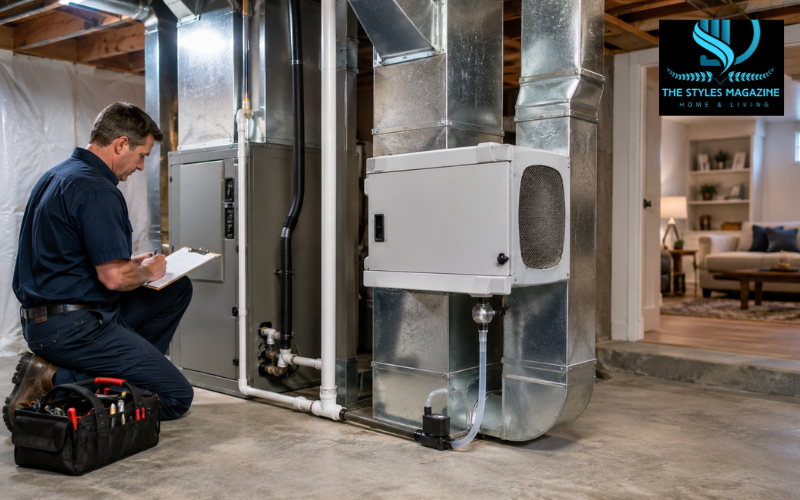
A whole house dehumidifier for HVAC system use can often be connected to a home’s existing ductwork. However, the exact arrangement depends on the HVAC equipment, available duct space, airflow, and the dehumidifier manufacturer’s installation instructions.
One option is to draw air from the HVAC return and send treated air back into the duct system. Another is a dedicated return, where the dehumidifier has its own intake grille positioned in a central area of the house.
Dedicated ducting can be useful when the dehumidifier needs to operate independently from the main HVAC blower or when existing return ductwork cannot provide suitable airflow. Some models can also be remotely mounted when mechanical-room space is limited. Bryant, for example, currently lists its DEHXX whole-home models as compatible with furnaces and fan coils and suitable for integrated or standalone installation.
There is no single duct arrangement that is best for every house. Airflow direction, static pressure, HVAC fan operation, and manufacturer requirements should all be considered before deciding where the ducts connect.
Signs Your Home May Need a Whole House Dehumidifier
High humidity is easiest to confirm with a hygrometer rather than relying only on how the air feels. The U.S. EPA recommends keeping indoor relative humidity below 60 percent and ideally between 30 and 50 percent when possible.
A home may benefit from additional dehumidification when humidity regularly remains high during warm weather despite normal air-conditioning use. Other warning signs include condensation on windows or pipes, musty odors, damp-feeling rooms, and recurring moisture in basements or crawl spaces.
The air may also feel sticky or uncomfortable even when the temperature is reasonable.
Before adding equipment, however, look for the source of the moisture. Plumbing leaks, groundwater entry, poor drainage, wet crawl spaces, missing exhaust ventilation, or significant outdoor-air leakage should be corrected where possible. A dehumidifier controls moisture in the air; it does not repair the underlying source of a water problem.
Choosing the Right Size for Your Home
Whole-house dehumidifier size is usually expressed in pints of moisture removed per day. A higher pint rating means the unit can remove more water under standardized test conditions. ENERGY STAR notes that larger or wetter spaces generally need greater moisture-removal capacity.
Square footage is useful, but it should not be the only sizing factor. Climate, indoor humidity, air leakage, insulation, basement or crawl-space conditions, occupancy, and the home’s HVAC design can all change the actual moisture load.
For example, AprilAire currently rates its E100 at up to 100 pints per day and markets it for whole-home, basement, and crawl-space applications up to 5,500 square feet. Its E130C can remove up to 130 pints per day and is listed for spaces up to 7,200 square feet. Those coverage figures are useful for initial comparison, but real homes can require different capacities.
An undersized unit may run for long periods without reaching the target humidity. Oversizing can add unnecessary purchase cost and may not solve problems caused by poor duct design or moisture entering the building.
Whole House Dehumidifier Installation Options
Whole house dehumidifier installation commonly takes place near a furnace, air handler, basement mechanical area, attic, crawl space, or another location with access to ductwork and drainage.
The unit needs enough airflow through its intake and outlet ducts. It also needs a reliable way to remove the water it collects. A nearby floor drain may allow gravity drainage, while some installations require a condensate pump.
Electrical requirements vary by model. For example, Bryant’s current DEHXX units use a 120-volt electrical supply, while American Standard notes that its whole-home dehumidifier needs a suitable electrical outlet and drain.
Although experienced homeowners may be capable of certain installations, professional installation is usually sensible when a unit is being integrated with central HVAC ductwork. Poor duct placement or airflow can reduce performance, while incorrect drainage can create water problems.
Whole House Dehumidifier Cost and Installed Price
The whole house dehumidifier cost varies considerably because equipment capacity, brand, ductwork, controls, drainage, electrical work, and labor are different from one home to another.
Bryant’s 2026 cost guide estimates approximately $1,500 to $2,800 for a whole-home unit, with professional installation commonly adding about $500 to $1,000. That produces an estimated total of roughly $2,000 to $3,800.
A separate 2026 HomeGuide estimate places typical installed whole-house systems at around $1,500 to $3,500, while noting that more complex projects may cost more.
Therefore, the whole house dehumidifier cost installed should be based on an actual home assessment rather than an online average alone. New ductwork, difficult access, a condensate pump, additional electrical work, premium controls, or a larger-capacity unit can increase the final quote.
When comparing estimates, homeowners should check exactly what equipment and installation work are included.
Whole House Dehumidifier Pros and Cons
The main advantage of a whole-house system is consistent moisture control across a much larger area than a typical portable unit. Because it can drain automatically and operate from a humidity setting, daily involvement is minimal.
It can also be less noticeable because the equipment is usually located away from bedrooms and main living areas. Current Bryant systems, for example, are designed for quiet operation and automatic humidity control.
Another benefit is comfort. Removing excessive moisture can make warm indoor conditions feel less clammy.
The disadvantages are mainly cost and complexity. A whole-home system has a higher initial price than a small portable dehumidifier and still requires electricity, filter care, drain maintenance, and occasional servicing.
These whole house dehumidifier pros and cons mean the system makes the most sense when humidity is a widespread or persistent home problem rather than an occasional issue limited to one small room.
Energy Use, Comfort, and Indoor Air Quality
A dehumidifier consumes electricity whenever it operates, so adding one does not automatically guarantee lower utility bills. Any energy savings depend on the house, climate, HVAC system, thermostat settings, and how much dehumidification is required.
However, reducing excessive humidity can improve comfort and may allow some homeowners to feel comfortable at a slightly higher cooling temperature. Manufacturers including AprilAire and Bryant describe reduced dependence on excessive air-conditioning as a potential benefit of improved humidity control.
Energy efficiency is therefore an important buying factor. ENERGY STAR’s Version 6.0 dehumidifier requirements took effect October 1, 2025 and include specific efficiency standards for whole-home models.
Humidity control may also make indoor conditions less favorable for mold and dust mites. The EPA advises keeping relative humidity below 60 percent, ideally 30–50 percent.
A dehumidifier should not, however, replace bathroom exhaust fans, kitchen ventilation, leak repairs, proper air sealing, or regular HVAC maintenance.
Best Whole House Dehumidifier Features to Look For
There is no single best whole house dehumidifier for every home. The better approach is to choose features that match the building and moisture problem.
Start with appropriate moisture-removal capacity and energy efficiency. ENERGY STAR certification can make efficiency comparisons easier because qualifying whole-home models must meet defined performance requirements.
Automatic humidity control is another valuable feature because it allows the unit to operate only when needed. Continuous drainage is essential for convenient whole-home operation.
Also consider filter access, replacement cost, duct connection options, equipment dimensions, controls, noise, warranty terms, and local service availability.
Filtration differs between systems. Bryant’s current DEHXX uses a MERV 8 filter, while American Standard advertises MERV 13 filtration on its current whole-home dehumidifier line.
A higher specification is not automatically better if the equipment is poorly sized or installed. Capacity, airflow, efficiency, and suitability for the home should come first.
Aprilaire Whole House Dehumidifier and Other Common Options
An Aprilaire whole house dehumidifier is one of several established choices for ducted humidity control. AprilAire’s current range includes E050, E070, E080, E100, and E130 families, with models intended for whole homes, basements, and crawl spaces.
For larger applications, the current E100 removes up to 100 pints per day, while the E130C is rated for up to 130 pints per day. Both use automatic controls and continuous drainage rather than a bucket that needs regular emptying.
Other current options include Bryant’s DEHXX line, available in capacities up to 80 or 100 pints per day, and American Standard whole-home systems with ducted or standalone installation options and MERV 13 filtration.
Instead of selecting a product only because a brand is popular, compare moisture capacity, tested efficiency, airflow requirements, physical size, controls, filter type, warranty, and installer support.
A well-matched system from several reputable manufacturers can perform better than an expensive unit that is incorrectly sized or poorly connected to the ductwork.
Maintenance and Long-Term Care
Whole-house dehumidifiers are relatively hands-off, but they are not maintenance-free.
The air filter should be inspected and cleaned or replaced according to the manufacturer’s schedule. A dirty filter restricts airflow and can reduce performance. AprilAire, for example, uses removable filters in its current E-series systems, while other brands have their own replacement requirements.
The drain line should also remain clear so condensate can leave the unit safely. Homeowners should watch for water around the equipment, unusual sounds, unexpected increases in humidity, frequent cycling, or a noticeable drop in moisture removal.
It also makes sense to check the humidity setting seasonally. A setting that works well during a humid summer may not be appropriate in colder conditions.
When the dehumidifier shares ductwork or controls with the main HVAC system, having it inspected during routine HVAC service can help catch airflow, drainage, or control problems early.
What Homeowners Say About Whole House Dehumidifiers
Searches such as “whole house dehumidifier Reddit” can be useful for discovering the practical questions homeowners face, but forum experiences should be treated as personal anecdotes rather than sizing or installation instructions.
Discussions on HVAC and home-improvement communities frequently center on homes that remain above 60 percent humidity, whether the installed cost is worth it, how AprilAire units should be ducted, and whether the unit is sensing humidity correctly. Recent and older threads also show that homeowners can have very different results depending on climate, house layout, system capacity, controls, and installation design.
That is why another homeowner’s successful setup should not automatically be copied.
Before installation, useful questions for an HVAC contractor include what humidity problem they measured, why they selected a particular pint capacity, where the intake and outlet ducts will connect, how condensate will drain, and whether the dehumidifier can operate independently when the air conditioner is off.
Conclusion
A whole house dehumidifier can be a practical solution when excess humidity affects multiple areas of a home and normal air-conditioning does not keep moisture under control. It offers centralized operation, automatic drainage, and more consistent humidity management than relying on several portable units.
The decision should begin with actual humidity measurements and an inspection for moisture sources. Home size matters, but climate, air leakage, basement or crawl-space conditions, HVAC design, drainage, and moisture load are just as important when choosing capacity.
Installed cost can reach several thousand dollars, so comparing equipment specifications and detailed installation quotes is more useful than simply looking for the cheapest unit or most familiar brand.
For homes with persistent high humidity, proper sizing and thoughtful installation can make a whole-house system a convenient long-term way to maintain a drier, more comfortable indoor environment.
FAQs
Is A Whole House Dehumidifier Worth It?
It can be worthwhile when high humidity affects several rooms or continues despite air conditioning. It provides automatic, centralized moisture control but costs more to purchase and install than portable units.
What Humidity Should A Whole House Dehumidifier Maintain?
Many homes are comfortable around 30–50% relative humidity. The ideal setting can vary with climate, season, building conditions, and personal comfort.
Can A Whole House Dehumidifier Work With Existing HVAC?
Yes. Many whole-house models are designed to connect with existing HVAC ductwork, although compatibility, airflow, available space, drainage, and installation layout should be checked first.
How Much Does A Whole House Dehumidifier Cost Installed?
Installed prices commonly reach several thousand dollars. The final cost depends on unit capacity, brand, duct modifications, electrical work, drainage requirements, labor, and the home’s HVAC layout.
Does A Whole House Dehumidifier Use A Lot Of Electricity?
Energy use depends on capacity, humidity levels, runtime, and efficiency. An appropriately sized efficient unit generally uses less energy than one that runs continuously because it cannot handle the moisture load.
Enjoyed it? Find more exclusive content on The Styles Magazine.
Disclaimer: This article provides general information only. Dehumidifier sizing, installation, electrical work, drainage, and HVAC compatibility can vary by home. Consult a qualified HVAC professional for recommendations specific to your property.