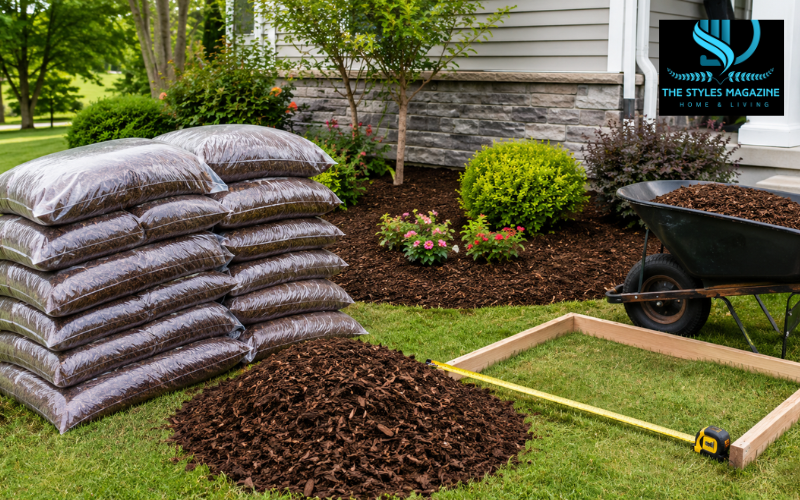
Buying mulch sounds simple until you need to decide between bags and a bulk delivery. A store may sell mulch in 1.5-, 2-, or 3-cubic-foot bags, while landscape suppliers usually measure bulk mulch by the cubic yard. Knowing how these measurements connect can help you buy enough material without paying for far more than your project needs.
A cubic yard is a volume measurement. Picture a box that is 3 feet long, 3 feet wide, and 3 feet high. The space inside that box equals one cubic yard, or 27 cubic feet. Because bagged mulch is labeled in cubic feet, the number of bags in a yard depends on the amount printed on each package.
This guide explains how many bags of mulch are in a yard, how much ground one yard covers, how to convert a large number of bags into yards, and how to estimate costs. It also includes simple formulas for rectangular, circular, and irregular garden beds so you can plan a real landscaping project with less guesswork.
Quick Guide: Mulch Bags in One Yard
| Bag size | Exact bags per yard | Bags to purchase |
| 1.5 cubic feet | 18 | 18 |
| 2 cubic feet | 13.5 | 14 |
| 3 cubic feet | 9 | 9 |
Quick Answer: How Many Bags of Mulch Are in a Yard?
One cubic yard contains 27 cubic feet of material. To find the number of bags in a yard, divide 27 by the volume of one bag.
A yard equals exactly 18 bags when each bag holds 1.5 cubic feet. It equals 13.5 bags when each bag holds 2 cubic feet, so you should normally purchase 14 bags. If each bag contains 3 cubic feet, 9 bags make one cubic yard.
For a fast reference, one yard is 18 small 1.5-cubic-foot bags, about 14 standard 2-cubic-foot bags, or 9 large 3-cubic-foot bags. Always check the package before buying because brands and stores do not all use the same bag size.
Mulch Bag Conversion Chart by Bag Size
The following chart shows the most common bag sizes and the number needed to equal one cubic yard.
| Mulch bag size | Exact bags per cubic yard | Practical number to purchase |
| 1.5 cubic feet | 18 | 18 |
| 2 cubic feet | 13.5 | 14 |
| 3 cubic feet | 9 | 9 |
The calculation is based on volume, not weight. Two bags can have the same cubic-foot size but different weights because wet mulch, dry mulch, bark nuggets, shredded wood, rubber mulch, and other materials have different densities. For yard calculations, use the cubic-foot figure on the package rather than pounds or kilograms.
Why Mulch Bag Size Changes the Total
A cubic foot measures volume, while a cubic yard is a larger volume made up of 27 cubic feet. The bag count changes because each package holds a different portion of that total.
For example, a 3-cubic-foot bag contains twice as much mulch as a 1.5-cubic-foot bag. You therefore need only 9 large bags instead of 18 small ones to reach the same total volume. The amount of mulch is equal even though the number of packages is different.
Do not assume every bag at a home-improvement store is the standard 2-cubic-foot size. Some products come in smaller bags because the material is heavy or easier to handle that way. Others are sold in larger bags. Before comparing prices or calculating coverage, read the label and confirm whether the package contains 1.5, 2, 2.5, or 3 cubic feet.
The Simple Formula for Calculating Mulch Bags
The basic calculation is:
27 ÷ bag size in cubic feet = bags needed for one cubic yard
For a 1.5-cubic-foot bag, divide 27 by 1.5. The answer is 18 bags. For a 2-cubic-foot bag, 27 divided by 2 equals 13.5 bags. For a 3-cubic-foot bag, 27 divided by 3 equals 9 bags.
When the result includes part of a bag, round up because stores generally sell full bags. Rounding 13.5 down to 13 would leave you half a bag short of a complete yard. For an actual garden project, it can also be sensible to add a small allowance for low spots, uneven soil, settling, spillage, or measurement errors. A spare bag is often easier to return or use later than an unfinished section of landscape bed.
Mulch Bags per Square Foot at Different Depths
The area covered by one yard depends on how deeply you spread it. The same volume covers a larger space in a thin layer and a smaller space in a thick layer.
| Mulch depth | Approximate coverage from 1 cubic yard |
| 1 inch | 324 square feet |
| 2 inches | 162 square feet |
| 3 inches | 108 square feet |
| 4 inches | 81 square feet |
You may see 100 square feet used as a rounded estimate for a 3-inch layer. The mathematical coverage is 108 square feet, but using 100 can provide a practical cushion for uneven ground and minor waste.
For landscaping beds, a layer of about 2 to 3 inches is commonly recommended because it can help reduce weeds and moisture loss without creating an unnecessarily deep pile. Penn State Extension recommends a 2- to 3-inch layer for many applications, while University of Minnesota Extension gives a broader 2- to 4-inch range depending on the site and purpose. Keep mulch away from direct contact with trunks and plant stems.
To connect bags with square feet, consider a 2-cubic-foot bag. At a depth of 1 inch, it covers about 24 square feet. At 2 inches, it covers about 12 square feet. At 3 inches, it covers about 8 square feet, and at 4 inches, it covers about 6 square feet. These figures make it easier to estimate how many bags of mulch in a yard per square foot for the depth you plan to use.
How Many 1.5 Cubic Feet Bags of Mulch Are in a Yard?
There are exactly 18 bags of mulch in a cubic yard when each bag contains 1.5 cubic feet. The calculation is simple: 27 cubic feet per yard divided by 1.5 cubic feet per bag equals 18.
One 1.5-cubic-foot bag covers approximately 18 square feet at 1 inch deep, 9 square feet at 2 inches, 6 square feet at 3 inches, or 4.5 square feet at 4 inches. All 18 bags together provide the same total coverage as one cubic yard.
Suppose a small garden bed measures 12 feet long and 6 feet wide. Its area is 72 square feet. At a depth of 3 inches, each 1.5-cubic-foot bag covers about 6 square feet. Dividing 72 by 6 gives 12 bags. You would not need a full yard for this bed; 12 bags equal 18 cubic feet, or two-thirds of a cubic yard.
Converting 60, 70, and 100 Bags of Mulch into Yards
To convert bags into cubic yards, multiply the number of bags by the cubic feet in each bag. Then divide the result by 27.
The formula is:
Number of bags × bag volume ÷ 27 = cubic yards
Because bag volume changes the answer, a statement such as “60 bags of mulch equals how many yards” is incomplete unless the bag size is known.
| Number of bags | 1.5-cu.-ft. bags | 2-cu.-ft. bags | 3-cu.-ft. bags |
| 60 bags | 3.33 yards | 4.44 yards | 6.67 yards |
| 70 bags | 3.89 yards | 5.19 yards | 7.78 yards |
| 100 bags | 5.56 yards | 7.41 yards | 11.11 yards |
These are volume conversions, not recommendations for how much to purchase. Your actual order should be based on the measured area and intended depth. When comparing a large number of bags with bulk mulch, also consider whether you have the vehicle space, lifting ability, storage area, and time needed to move dozens of separate packages.
How to Use a Mulch Bag Calculator
A mulch calculator needs four main details: the length of the bed, its width, the desired depth, and the cubic-foot size of the bag. Begin by calculating the surface area. For a square or rectangular bed, multiply length by width.
Next, convert the desired depth from inches to feet by dividing it by 12. Multiply the bed area by that depth to find the cubic feet of mulch required. Divide the cubic feet by 27 to get cubic yards, or divide by the volume of one bag to get the bag count.
For example, a bed that is 20 feet long and 10 feet wide has an area of 200 square feet. A 3-inch depth equals 0.25 feet. Multiplying 200 by 0.25 gives 50 cubic feet. That is about 1.85 cubic yards. If you are buying 2-cubic-foot bags, divide 50 by 2, which gives 25 bags.
For a circular bed, multiply the radius by itself and then multiply by 3.14. The radius is half the circle’s diameter. After finding the area, use the same depth calculation. For an irregular bed, divide the space into smaller rectangles, circles, or triangles, calculate each part, and add the results. A slightly generous measurement is usually safer than accidentally leaving narrow sections out.
How Much Is a Yard of Mulch?
The price of a yard of mulch is not the same everywhere. It can change according to the material, processing, color, brand, local supply, delivery distance, and time of year. Natural shredded wood, bark, dyed mulch, cedar, pine, and specialty products may all have different prices.
Bagged mulch is priced per package, while bulk mulch is usually priced per cubic yard. To compare them fairly, calculate the number of bags needed to equal a yard and multiply that number by the price per bag. For example, multiply the price of a 2-cubic-foot bag by 13.5 for an exact volume comparison, or by 14 for a realistic purchase comparison.
Do not look only at the advertised material price. A bulk order may include a delivery charge or a minimum order. Bagged mulch may require several vehicle trips, more lifting, and more plastic disposal. Sales can make bags competitive for a small project, while bulk pricing may become more practical as the required volume increases. The best comparison is the total cost of getting the correct amount onto your property.
Bagged Mulch vs. Bulk Mulch for Your Project
Bagged mulch is convenient when you need a limited amount, have several small beds, or want to complete the work in stages. Bags are easier to carry to separate areas, keep contained during storage, and load into many personal vehicles. They can also be useful for topping up thin spots without ordering a large pile.
Bulk mulch is often easier for a large, continuous project. Instead of opening dozens of packages, you receive one loose delivery that can be moved with a wheelbarrow, cart, or buckets. However, you need a suitable place for the delivery pile, and the truck must be able to reach a safe unloading point.
As a simple guide, a few bags usually make sense for containers, small borders, and minor touch-ups. Either option may work for a project close to one yard, depending on delivery costs and transportation. For several yards, bulk mulch may reduce packaging and repeated handling, but it still needs to fit your site and work plan.
Checking Bag Sizes and Mulch Availability Near You
When searching for mulch near you, first check which package sizes local stores actually stock. A calculation based on 2-cubic-foot bags will not be accurate if the available product comes in 1.5-cubic-foot bags. Product photos and online listings can change, so confirm the volume on the current package or store listing before placing an order.
Also check whether the listed price is for pickup or delivery, whether there is a minimum quantity, and where a bulk load can be placed. For bags, consider vehicle capacity and whether the store allows unopened extras to be returned. Keep the receipt and protect bags from tearing or soaking if you may need to take some back.
Availability can vary by season, region, mulch type, and color. It is usually better to calculate your total first and then compare local options in equivalent cubic yards. This prevents a low bag price from looking better simply because the package contains less material.
Common Mulch Calculation Mistakes to Avoid
One common mistake is confusing square feet with cubic feet. Square feet describe surface area, while cubic feet include depth. A 200-square-foot bed does not require 200 cubic feet of mulch unless the material is being applied one foot deep.
Another mistake is entering a depth of 3 as though it means 3 feet instead of 3 inches. Always divide inches by 12 before multiplying by the bed area. Three inches equals 0.25 feet.
It is also easy to assume that every bag holds 2 cubic feet. Read the package carefully, especially when comparing products from different brands. Rounding down is another risk. If the calculation gives 13.5 bags, buying 13 will not provide a full yard.
Finally, measure only the areas that will actually receive mulch. Subtract patios, large rocks, sheds, wide paths, and other unmulched spaces. For planted beds, you do not usually need to subtract every small plant, but large shrubs or fixed features may noticeably reduce the covered area. After making reasonable deductions, add a modest allowance for uneven ground and settling.
Conclusion: Buying the Right Amount of Mulch
The answer to how many bags of mulch in a yard depends on the size printed on the package. One cubic yard equals 27 cubic feet, which works out to 18 bags of 1.5 cubic feet, 13.5 bags of 2 cubic feet, or 9 bags of 3 cubic feet. In practice, purchase 14 standard 2-cubic-foot bags to avoid coming up short.
For a full project estimate, measure the bed’s area, choose the mulch depth, and then convert the required volume into bags or cubic yards. One yard covers about 324 square feet at 1 inch deep, 162 square feet at 2 inches, 108 square feet at 3 inches, or 81 square feet at 4 inches.
Careful measurements and a quick check of the bag label can prevent most buying mistakes. Round up slightly when needed so you have enough mulch to create an even, complete layer across the entire bed.
Frequently Asked Questions
How Many 2-cubic-foot Bags Of Mulch Are In A Yard?
One cubic yard contains 13.5 bags of mulch when each bag holds 2 cubic feet. Because stores sell whole bags, purchase 14 bags to ensure you have enough.
How Many 1.5-cubic-foot Bags Of Mulch Make A Yard?
It takes exactly 18 bags of 1.5 cubic feet to equal one cubic yard. Multiply 18 by 1.5, and the total is 27 cubic feet.
How Much Area Does One Yard Of Mulch Cover?
One cubic yard covers about 324 square feet at 1 inch deep, 162 square feet at 2 inches, 108 square feet at 3 inches, or 81 square feet at 4 inches.
Is It Cheaper To Buy Mulch In Bags Or By The Yard?
Bagged mulch may suit small projects or sale purchases, while bulk mulch can be more economical for larger areas. Compare material, delivery, transportation, and handling costs before deciding.
Should I Round Up When Calculating Mulch Bags?
Yes. Round up whenever your result includes part of a bag. Adding one extra bag can also help cover uneven ground, settling, spills, and small measurement errors.
Enjoyed it? Find more exclusive content on The Styles Magazine.
Disclaimer: Mulch quantities and coverage are estimates. Actual needs may vary based on ground conditions, application depth, settling, product size, and measurement accuracy.