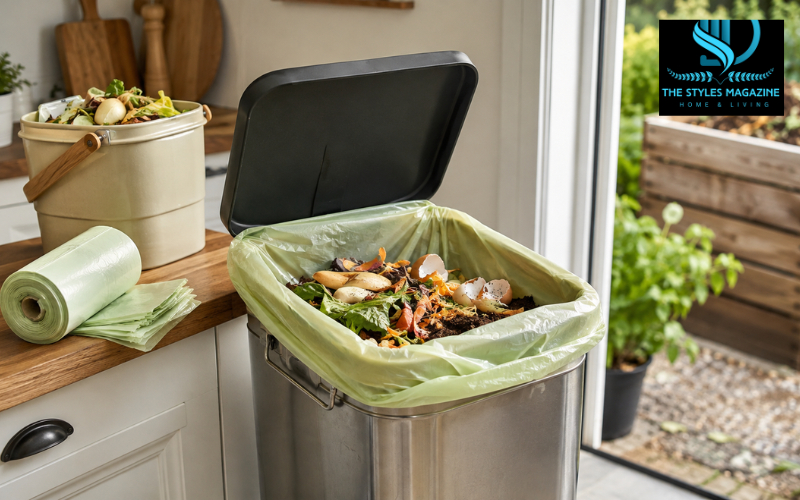
The best compostable trash bags should do two jobs well: hold everyday waste without leaking or tearing, and break down under the composting conditions for which they are certified. Unlike ordinary plastic liners, certified compostable bags are designed to biodegrade and disintegrate in a suitable composting environment rather than remain as conventional plastic waste.
Choosing the right bag is not simply about finding one labeled “eco-friendly.” Strength, seam quality, resistance to wet food waste, size, closure style, and third-party certification all matter. Disposal matters just as much. A bag designed for a commercial composting facility may not be suitable for a backyard compost pile.
Households also use these bags differently. Some need a liner for food scraps going into municipal organics collection, while others want a regular 13-gallon kitchen bag or a small countertop liner. This guide compares Plastno, UNNI, HoldOn, BioBag, and Primode while explaining certifications, sizes, strength, home composting, and practical buying factors.
Most importantly, check your local composting rules. Some community programs accept certified compostable bags, while others do not.
Quick Checklist Before Buying
- Check your bin dimensions, not only the gallon capacity.
- Look for recognized certification such as BPI or OK compost HOME.
- Confirm whether the bag is intended for home or commercial composting.
- Choose stronger seams and puncture resistance for wet or heavy kitchen waste.
- Pick a drawstring if easy tying and carrying are important.
- Check whether your local compost or green-bin program accepts compostable bags.
- Store unused bags in a cool, dry place and avoid buying more than you can reasonably use.
How the Best Compostable Trash Bags Should Be Evaluated
A good compostable bag should be judged by how it performs during normal household use, not simply by environmental claims printed on the box. A bag may be certified for composting but still be frustrating if it slips into the bin, tears around sharp scraps, or leaks before it reaches the collection container.
Thickness is useful to know, but it should not be considered alone. Strong seams, flexibility, puncture resistance, and a secure fit can matter just as much. For tall kitchen cans, a reliable drawstring or well-sized opening may also make carrying a full bag easier.
Certification is another major factor. BPI certification provides independent verification against recognized compostability standards in North America, while TÜV Austria operates certification programs such as OK compost HOME and OK compost INDUSTRIAL.
There is therefore no single perfect bag for everyone. A household collecting light food scraps may have different needs from one regularly throwing away heavy watermelon rinds, coffee grounds, or damp kitchen waste.
Best Compostable Trash Bags at a Glance
The following comparison gives a practical starting point based on currently published specifications and certification information.
| Product | Common Size | Closure | Verified/Published Certification | Thickness | Best For |
| Plastno Waste Bag Tall | 13 gallon | Drawstring | BPI, TÜV OK compost HOME | 1 mil | All-around kitchen use |
| UNNI Tall Kitchen Food Scrap Bag | 13 gallon | Straight top | BPI, OK compost HOME, CMA | 0.9 mil | Home and food-scrap composting |
| HoldOn Tall Kitchen Bags | 13 gallon | Drawstring | BPI industrial composting | 0.98 mil | Convenient drawstring use |
| BioBag Tall Kitchen Bag | 13 gallon | Straight top/star bottom | BPI; CMA also stated by BioBag | 0.68 mil for listed straight-top model | Food scraps and organics |
| Primode | Multiple sizes including 13 gallon | Varies | BPI-listed products | Varies by SKU | Value-focused households |
Plastno currently lists its 13-gallon bag at 24 by 28 inches and 1 mil thick. UNNI lists a 23.8 by 31.5-inch 13-gallon version at 0.9 mil, while HoldOn lists its 13-gallon drawstring bag at 24 by 27 inches and 0.98 mil. BioBag and Primode have multiple certified SKUs, so specifications should be checked for the exact product being purchased.
Plastno Compostable Bags: A Strong All-Around Kitchen Option
Plastno’s Waste Bag Tall is a practical choice for shoppers who want a familiar 13-gallon drawstring format. The current version measures 24 by 28 inches, is 1 mil thick, and contains 30 bags per roll. Its drawstring and standard tall-kitchen shape make it closer in use to a conventional kitchen liner than many simple compost-bin bags.
The material is described as a blend of cornstarch, PLA, and PBAT. It is important not to call that entire blend plant-based: cornstarch is renewable, while PLA and PBAT have different material origins and properties.
Certification is one of Plastno’s strongest points. The company currently lists BPI certification to ASTM D6400 for commercial composting and TÜV Austria OK compost HOME certification for home composting.
Its 1-mil construction makes it worth considering for wet food scraps and normal kitchen waste. However, people with unusually large cans should still measure the bin first, and households that prefer extra-long liners may find another 13-gallon design fits better.
UNNI Compostable Bags for Home Composting
UNNI is particularly relevant for people searching for the best compostable trash bags for home because its current 13-gallon tall kitchen food-scrap bag carries both commercial and home-compost certification claims.
The brand lists its 13-gallon version at 49.2 liters, 23.8 by 31.5 inches, and 0.9 mil thick. UNNI states that it is BPI certified to ASTM D6400 and carries TÜV Austria’s OK compost HOME certification. It is also listed as tested through the Compost Manufacturing Alliance.
UNNI also sells smaller formats, and BPI’s current database lists options including 2.6-, 3-, 4-, 6-to-8-, and 13-gallon food-waste bags.
Do not assume every UNNI product has exactly the same certifications simply because the brand offers certified products. Check the specific size and SKU. This is especially important when shopping through third-party marketplaces where older and newer packaging may appear together.
HoldOn Tall Kitchen Bags for Drawstring Convenience
HoldOn is a useful option for households that do not want to give up the convenience of a traditional drawstring bag. Its current tall kitchen model holds 13 gallons, comes with 40 bags per box, measures 24 by 27 inches, and is listed at 0.98 mil thick.
The drawstring grips the rim of the can and provides an easy way to close and carry the liner. HoldOn also describes the material as multi-way flex with triple-ply construction intended to reduce tears and leaks. Those features make it particularly appealing when a straight-top compost liner feels inconvenient.
There is an important certification detail, however. HoldOn currently describes this 13-gallon product as BPI Certified Industrially Compostable and advises buyers to check whether suitable facilities exist locally.
That means shoppers should not automatically treat the 13-gallon HoldOn bag as a backyard-compost product. It is a stronger fit for households whose organics or compostable liners are collected by a compatible commercial system.
BioBag for Food Scraps and Compost Collection
BioBag has a broad range of compostable liners designed around food and organic-waste collection. Its current catalog includes small food-scrap bags, tall kitchen liners, drawstring models, and larger commercial sizes.
The company uses Mater-Bi, a family of compostable materials developed for applications such as organic-waste collection. For everyday users, the more important detail is how the bag is built. BioBag’s 13-gallon tall kitchen model uses a straight top and star-sealed bottom. A star seal spreads weight across the base instead of relying on one simple seam, which can be helpful when carrying damp food scraps.
The BPI database currently lists several BioBag 13-gallon products, including a 0.68-mil tall kitchen liner and a separate drawstring food-scrap bag.
BioBag can therefore be a sensible choice for dedicated organic-waste collection. People mainly seeking the thickest possible liner or a specific closure should compare the exact BioBag SKU with Plastno or HoldOn before deciding.
Primode Compostable Bags as a Value-Focused Choice
Primode is worth comparing when price per bag matters, especially because the brand appears in BPI’s current certified-products database under THI Supplies. The database lists numerous Primode kitchen-waste and yard-waste bag SKUs, including 13-gallon products.
Retail listings commonly advertise 13-gallon Primode bags in 30-count packages and may describe specific versions as BPI/ASTM D6400 certified. However, product thickness and certification details can differ between SKUs and listings. For that reason, shoppers should use the exact item number and package markings rather than relying on a general claim about the whole brand.
For lighter household waste or food-scrap collection, a lower cost per bag can make sense. For very wet or heavy waste, however, paying slightly more for a better-fitting liner, stronger seam, or drawstring may prevent wasted bags.
When comparing value, divide the package price by the number of bags and then consider performance and certification. The cheapest box is not necessarily the cheapest option if bags regularly split or need to be doubled.
Best Compostable Trash Bags for Home, Kitchen, and 13-Gallon Bins
For many households, the best compostable trash bags for kitchen use are 13-gallon liners because that capacity is common among tall kitchen cans. Still, two bags labeled 13 gallons can have noticeably different dimensions. Plastno, UNNI, and HoldOn demonstrate this clearly, with differences in both height and width despite sharing the same nominal capacity.
Measure the can rather than buying by gallon capacity alone. A liner that is too short may fall inside the bin, while one that is too narrow can stretch excessively around the rim.
Closure also changes the experience. Drawstrings make full bags easier to tie and carry. Handle-tie bags offer another lifting option, while straight-top liners work well when the bag is mainly transferring food scraps into an organics cart.
For heavy mixed kitchen waste, prioritize puncture resistance and fit. For municipal food-scrap collection, certification and acceptance by the local program may matter more than having the strongest possible bag.
4-Gallon Compostable Trash Bags for Small Bins
A large kitchen liner is unnecessary for every room. 4 gallon compostable trash bags can work well in compact food-scrap containers, bathroom cans, small office bins, and countertop or under-sink compost containers.
UNNI’s products listed in the BPI database include a 4-gallon kitchen food-waste format, while BioBag’s certified range also includes smaller household liners.
A properly sized small liner usually stays in place better than an oversized bag folded repeatedly over the rim. It may also encourage users to empty food scraps more frequently. That can be useful because moisture and heat can gradually weaken some compostable films.
Choose between 3-, 4-, or larger sizes by measuring the bin’s width, depth, and height rather than estimating its volume. Certification remains just as important for a small bag as for a 13-gallon liner, particularly when the bag itself will enter the compost stream.
Compostable Trash Bags vs. Biodegradable Trash Bags
“Compostable” and “biodegradable” should not be treated as interchangeable shopping terms. BPI explains that compostable products are biodegradable under specified composting conditions, but something marketed simply as biodegradable is not automatically suitable for composting. The term alone may not tell you where breakdown occurs or how long it takes.
That is why biodegradable trash bags with vague environmental claims deserve closer inspection. Look for a recognized compostability certification and identify whether it applies to commercial or home composting.
The same caution applies to oxo-degradable or additive-based plastic claims. Breaking a plastic product into progressively smaller fragments should not be confused with meeting a recognized compostability standard. U.S. environmental marketing guidance also requires degradable claims to be supported by reliable evidence rather than broad, unqualified promises.
A simple rule helps: look beyond words such as “green,” “natural,” or “biodegradable” and verify the certification mark, standard, and intended disposal environment.
BPI, ASTM D6400, TÜV Austria, and Home vs. Commercial Composting
BPI is a major third-party certification body for compostable products in North America. BPI currently uses ASTM D6400 as its base assessment standard, with other standards used where applicable.
A significant 2026 detail is that BPI now describes two certification paths: Commercial Only and Commercial & Home. Commercial Only products are intended to break down in commercial composting facilities, while Commercial & Home certification also addresses properly managed home composting conditions.
The difference matters because home compost piles normally operate at lower temperatures. BPI states that its commercial and home testing use different temperatures and time frames to reflect those conditions.
TÜV Austria’s OK compost HOME mark similarly identifies products assessed for home-compost conditions.
Even certified bags are not accepted everywhere. EPA guidance notes that community programs vary: some allow or require compostable bags, while others reject them. Always check the rules of your curbside service, municipal green bin, compost facility, or backyard system before disposal.
Strength, Shelf Life, Cost, and Where to Buy
Finding the strongest compostable trash bags is more complicated than choosing the largest thickness number. Thickness can help, but seam construction, flexibility, puncture resistance, fit around the can, and the closure all affect real-world strength. A thick bag stretched tightly over the wrong bin can still fail.
Compostable bags also should not be stored forever. UNNI recommends cool, dry storage and says to use its bags within a year of purchase, preferably buying only what can be used in about nine months. Plastno lists an approximate 12-month shelf life, while HoldOn similarly recommends cool, dry storage to maintain strength.
For shoppers searching compostable trash bags 13 gallon Costco, Costco currently lists MyEcoWorld 13-gallon compostable food-waste bags in a 72-count package. The listing states BPI and TÜV certification and suitability for home, curbside, and industrial composting. Availability may vary by location or over time.
Before buying, check:
- Bin dimensions and capacity.
- Dry, wet, light, or heavy waste.
- Home or commercial composting destination.
- Current third-party certification.
- Straight-top, handle, or drawstring preference.
- Price per bag rather than package price alone.
Conclusion
The best compostable trash bags are the ones that combine reliable performance with a certification that matches where the bag will actually go. Plastno offers a practical combination of a 13-gallon drawstring and both commercial and home-compost credentials. UNNI has several certified food-scrap sizes and is especially relevant for home-compost shoppers. HoldOn focuses on familiar drawstring convenience, while BioBag has a broad range aimed at organic-waste collection. Primode offers certified options worth comparing when value is important.
No product should be chosen on branding alone. Check the dimensions, expected waste weight, seams, closure, certification, and storage instructions. Most importantly, confirm whether your local composting program accepts compostable bags before putting one into a green bin. EPA notes that acceptance varies between community programs and facilities.
A well-matched bag makes food-waste collection cleaner and easier. A properly certified bag sent to the correct composting system also gives the product the opportunity to reach the end-of-life pathway it was designed for.
FAQs
Are Compostable Trash Bags Better Than Regular Plastic Bags?
Compostable bags can be a useful alternative for collecting organic waste when they are accepted by an appropriate composting system. Their environmental benefit depends greatly on proper disposal and local composting facilities.
Can Compostable Trash Bags Go In A Backyard Compost Pile?
Only bags specifically certified for home composting should be considered for a backyard pile. Commercially compostable bags usually require conditions that ordinary home compost systems may not consistently provide.
What Is The Best Size For A Kitchen Compostable Trash Bag?
A 13-gallon compostable trash bag fits many standard tall kitchen cans. However, bag dimensions differ between brands, so measuring your bin before purchasing helps prevent slipping, stretching, and tearing.
Are Biodegradable Trash Bags The Same As Compostable Bags?
No. “Biodegradable” is a broad term and does not automatically mean a bag is suitable for composting. Certified compostable bags are tested to break down under defined composting conditions.
Which Certification Should I Look For On Compostable Trash Bags?
Look for recognized certifications such as BPI for eligible compostable products or TÜV Austria OK compost HOME for products assessed for home composting. Always verify the certification on the specific product.
Enjoyed it? Find more exclusive content on The Styles Magazine.
Disclaimer: This article is for general informational purposes only. Product specifications, certifications, prices, sizes, and availability may change over time. Composting requirements also vary by location and facility. Always check the current product packaging, certification database, and your local composting or waste-collection rules before purchasing or disposing of compostable trash bags.