When most people think about home security, they picture front doors, window locks, and maybe a camera by the porch. The garage door rarely makes the list, yet it’s often the easiest way into a house. Learning how to secure garage door means looking at it from two angles: the physical side (locks, hardware, and reinforcement) and the digital side (the opener, remote, and any smart features it connects to). Both matter, and neither one alone is enough.
Garages are consistently one of the most common entry points burglars use, mainly because they’re overlooked. A door left slightly open “for air,” an old opener with a weak signal, or a garage that hides someone from the street can all turn a two-minute break-in into an easy one. None of this is meant to alarm you — it’s simply context for why this topic deserves more attention than it usually gets.
This guide walks through everything involved in how to secure garage door, from small weekend fixes to bigger upgrades worth planning for, so you come away with a clear, realistic picture of what your garage actually needs.
Quick Guide Table
| Security Layer | Method | Cost | Best For |
| Emergency release | Zip-tie, PVC tubing, or shield cover | Low | Blocking the wire-hook trick |
| Manual lock | Slide bolt or padlock-through-track | Low | Vacations, power outages |
| Track/frame | Vice grips, C-clamps, slide locks | Low–Medium | Temporary or permanent reinforcement |
| Opener | Rolling code check, remote off visor | Free–Low | Preventing signal replay attacks |
| Exterior deterrents | Motion lighting, cameras, window film | Medium | Reducing visibility and cover |
| Smart controller | App monitoring, auto-close timer | Medium–High | Remote oversight and alerts |
| Security bar | Interior brace bar | Medium | Roll-up doors, forced-entry resistance |
| Interior door | Solid-core door, deadbolt, strike plate | Medium | Closing the garage-to-house gap |
Step-by-Step: Shielding the Emergency Release (Quick Guide)
- Locate the red emergency release cord near the opener motor.
- Choose a method: zip-tie loop, PVC tubing sleeve, or a shield cover.
- Attach it so the cord still pulls freely by hand from inside.
- Test that a hook or wire can no longer reach it through the door gap.
- Recheck it works normally during an actual power outage.
Why Garage Doors Are a Weak Point in Home Security
Attached garages create what security professionals sometimes call a “security funnel.” Once someone gets inside the garage, they’re hidden from the street. Neighbors can’t see them, passing cars can’t see them, and they have all the privacy they need to work on the interior door that leads into the house. That interior door is often far less secure than the garage door itself, which makes the garage a kind of shortcut into the home.
A few things tend to make this worse than it needs to be. Doors get left unlocked out of habit, especially if the household assumes the garage door itself is “locked enough.” Lighting around the garage is often dimmer than the front of the house, giving intruders more cover after dark. Windows near the door are sometimes left uncovered, letting anyone glance in and see whether a car is home or something is worth stealing. And older openers, especially ones that haven’t been updated in a decade or more, can be easier to bypass than most homeowners realize.
None of this is complicated to fix. Garage door security isn’t about spending a lot of money — it’s about knowing where the weak spots are and addressing them one at a time.
Fixing the Emergency Release Vulnerability
Almost every garage door has a red emergency release cord hanging near the opener. It’s there so you can manually open the door during a power outage, and by law it can’t be removed or disabled. Unfortunately, this same cord is also the target of a well-known break-in method: someone slides a thin tool, often a bent wire hanger, through the gap at the top of the door and hooks the release cord to pull it and open the door manually.
The good news is that while the release can’t be removed, it can be shielded. A simple zip-tie trick works surprisingly well: loop a zip tie through the release mechanism in a way that still lets you pull it by hand from inside, but prevents a hook from catching it through the gap.
Another option is running a short length of PVC tubing over the release cord and mechanism, which makes it much harder for a hook or wire to snag the lever from outside while leaving the release fully functional in an emergency. For a more polished solution, garage shield covers are inexpensive plastic guards designed specifically to block the release mechanism from being reached through the door gap.
Whichever method you choose, the goal is the same: keep the release cord doing its job for you in a power outage, while making it unreachable to anyone trying to reach it from outside.
How to Lock a Garage Door Manually from the Inside
Most automatic garage doors rely entirely on the opener for locking, which sounds convenient until you consider what happens if someone finds a way around it. Manual locks add a second layer that doesn’t depend on electronics at all.
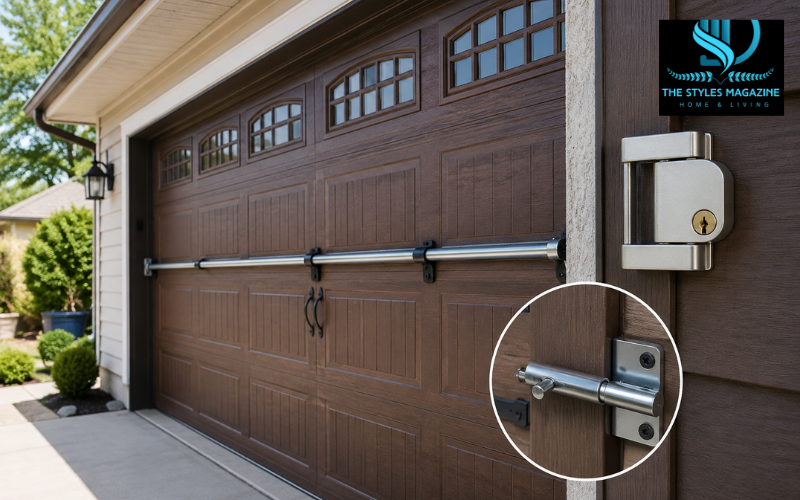
Slide bolts or track locks are one of the simplest additions. These mount directly onto the door’s track and, when engaged, physically block the door from sliding open even if the opener is triggered. They’re affordable, easy to install, and give real peace of mind.
Another approach is the padlock-through-track method, where a padlock is placed through one of the holes in the door’s track, above a roller, so the roller can’t travel past it. It’s a low-cost, almost improvised solution, but it’s genuinely effective and takes just a couple of minutes.
Manual locks are especially useful in specific situations: heading out on vacation, dealing with a power outage where the opener won’t work anyway, or simply wanting extra assurance overnight. They’re not meant to replace your everyday opener, but rather to back it up when it matters most.
Reinforcing the Garage Door Track and Frame
Locks matter, but they’re only as strong as the track and frame holding the door in place. If someone can pry the door away from its track, a lock on the track won’t help much.
Track slide locks, similar to the ones mentioned above, are a good starting point because they reinforce the exact area most vulnerable to prying. For a quick, temporary boost — say, while you’re away for a weekend — vice grips or C-clamps can be clamped onto the track just above a roller on each side of the door, stopping it from being lifted or slid open in seconds.
It’s also worth doing a simple walkthrough every few months to check for weak points: rollers that are worn, rusted, or loose, and any gaps, cracks, or soft wood in the frame that could make prying easier. Small issues like these rarely stay small — they tend to get worse right when you need the door to hold.
How to Secure Garage Door from Outside
Protecting the outside of the garage is just as important as reinforcing the inside. Most of these steps are about visibility and deterrence rather than hardware.
Motion-activated lighting is one of the simplest upgrades you can make. It removes the cover of darkness that many intruders rely on, and it doubles as a convenience feature when you’re unloading groceries at night.
Blocking sightlines is another easy win. If your garage has windows, frosted window film, blinds, or curtains can prevent anyone from looking in to see whether a car is missing or anything worth targeting is inside. It’s a small change, but it removes a lot of the information an intruder would otherwise use to size up your garage.
Visible deterrents also go a long way. A camera near the garage, even a basic one, makes most people think twice, and the same goes for alarm system decals or a small monitoring sign — a genuinely useful layer in the overall approach to how to secure garage door.
How to Secure Your Garage Door Opener
The opener itself is where a lot of garage security either succeeds or fails, since it controls both the physical door and, in many cases, a digital connection into your home.
Older openers sometimes use fixed code technology, meaning the remote sends the exact same signal every time, which can be captured and replayed by anyone with basic equipment. Rolling code technology, standard on most openers made in the last couple of decades, generates a new code with every use, making that kind of interception far less useful. If you’re not sure which type your opener uses, check the manual or the manufacturer’s website.
A surprisingly common mistake is leaving the remote clipped to the car’s sun visor. If the car is ever broken into or stolen, the remote hands over direct access to the garage — and often a house key is inside too. Keeping the remote on a keychain instead removes this easy connection between “car access” and “home access.”
For garages with a keypad, a little maintenance goes further than people expect. Wipe down the buttons occasionally, since worn or dirty ones can hint at the code, and change the code every so often, especially if it’s ever been shared with someone who no longer needs it.
Upgrading to a Smart Garage Door Controller
For anyone wanting a more modern layer of protection, smart garage door controllers add a level of oversight that traditional openers can’t offer. These devices connect the door to an app on your phone, letting you check its status and control it from anywhere with a signal.
App-based monitoring and alerts are the main draw. Instead of wondering whether you closed the garage door on your way to work, you can check instantly, and many systems notify you any time the door opens or closes.
Auto-close timers are another useful feature, automatically shutting the door if it’s been left open for a set period — solving one of the most common real-world security gaps: doors left open by accident.
Many smart controllers also integrate with broader home security systems, so garage activity shows up alongside other alarms and cameras in one place. This isn’t a requirement for good garage security, but for households already using a smart setup, it’s a natural extension.
Best Garage Door Security Locks and Hardware
With so many products marketed as garage security solutions, it helps to understand the main categories before choosing anything.
Slide bolts are simple, affordable, and effective for manually locking the door from inside. Shield locks specifically cover and protect the emergency release mechanism discussed earlier. T-handle locks are common on garages with a manual handle and provide a keyed locking option built into that handle. Security bars, covered in more detail next, physically block the door track from being forced open.
When choosing between these, durability comes first — hardware exposed to a garage needs to hold up to temperature changes and regular use without rusting or loosening. Ease of use matters too, since a lock that’s inconvenient to engage eventually gets skipped. And compatibility is worth checking carefully, since not every lock fits every door type, which the final section covers in more depth.
Adding a Garage Door Security Bar
A security bar is one of the more heavy-duty options for reinforcing a garage door, and it works by physically bracing the door from the inside so it can’t be forced up or slid open, even if the lock or opener is defeated.
These bars tend to work best on roll-up doors, where they can span the width of the door and lock into brackets on either side of the frame. On sectional doors, a bar can still be effective, though it typically needs pairing with track locks to fully block movement, since sectional doors bend at the panel seams in a way single-piece doors don’t.
For the strongest setup, security bars work well alongside other locks rather than as a standalone solution. Pairing a bar with a track lock or slide bolt creates layered security, so that even if one method is bypassed, another is still in place — the core idea behind protecting the space well.
Securing the Interior Door Between Garage and Home
It’s easy to focus entirely on the garage door itself and forget about the door that connects the garage to the house. This is a mistake, because that interior door is often the final barrier between an intruder and the rest of your home — and it’s frequently far weaker than the front door.
The simplest fix is to start treating this door exactly like an exterior door, because functionally, that’s what it is. A solid-core door holds up to force far better than the hollow, lightweight doors sometimes installed here by default. Adding a proper deadbolt gives it a locking mechanism strong enough to resist forced entry, rather than relying on a basic doorknob lock. And an anti-kick strike plate reinforces the frame around the lock, which is usually the point that fails first when a door is kicked in.
Upgrading this single door is one of the most overlooked steps in garage door security, yet it closes a gap most other improvements don’t address.
Smart Habits That Reduce Garage Door Risk
Not every improvement involves buying something. A few daily habits make a real difference in how secure a garage actually is.
Leaving the garage door cracked open for ventilation, even by a few inches, is one of the most common habits worth breaking. It looks harmless, but it gives easy visual and physical access to anyone walking by.
During extended trips, disconnecting the opener’s power is a simple extra step that prevents any remote or signal-based method from opening the door while you’re away, especially combined with a manual lock.
Finally, a regular inspection of the hardware and sensors keeps small issues from becoming real vulnerabilities. Checking that sensors are aligned, locks move smoothly, and nothing looks worn takes just a few minutes every couple of months, but catches problems while they’re still easy to fix.
Choosing the Right Security Setup for Your Garage Door Type
Not every garage door works the same way, so the right combination of upgrades depends partly on which type you have.
Sectional roll-up doors, the most common type in many homes, respond well to track slide locks, security bars, and shielding the emergency release, since their multi-panel design makes track-based locks particularly effective.
Single-piece up-and-over doors swing outward on a pivot rather than sliding along a full track, so security bars and slide bolts near the base tend to offer the most reinforcement, since there’s less track to work with overall.
Roller shutter doors, often found on detached garages or older properties, benefit most from strong bottom locks and reinforced guide rails, since their rolling mechanism creates different pressure points than the other two types.
Matching your upgrades to your specific door type avoids wasted money on hardware that isn’t suited to how your door actually moves, and it ensures whatever you install will do its job properly.
Bringing It All Together
Securing a garage door isn’t about finding one perfect product or single fix — it’s about layering a few different protections so that no single weak point can be exploited on its own. Physical locks, a well-protected opener, good lighting, smart monitoring, and a few consistent habits all work together, and each one covers a gap the others might miss.
If this all feels like a lot at once, that’s completely normal. There’s no need to tackle every section here in one weekend. Start with one or two changes that address your biggest concern, whether that’s shielding the emergency release, adding a manual lock, or finally sorting out that interior door. Once those feel manageable, move on to the next. Over time, these small, steady improvements add up to a garage — and a home — that’s genuinely well protected.
FAQs
Is It Legal To Block My Garage Door’s Emergency Release?
No — you can’t disable it, since it’s a required safety feature for outages. You can only shield it with a zip tie, PVC tubing, or cover so it stays reachable from inside but hidden from outside.
Do Rolling Code Openers Really Stop Break-ins?
They make a big difference. Rolling code generates a new signal every time the remote is used, so a captured code can’t be replayed later — unlike older fixed-code openers, which are far easier to bypass.
What’s The Single Best Upgrade For Garage Door Security?
There’s no single “best” fix — layering matters more. If you can only do one thing, shielding the emergency release or adding a manual track lock offers strong protection for very little cost.
Should I Secure The Interior Door Too, Not Just The Garage Door?
Yes. That door is often the weakest link in the whole house. Treat it like a front door: solid core, a real deadbolt, and an anti-kick strike plate close a commonly overlooked gap.
Are Smart Garage Door Controllers Worth It?
They’re a helpful add-on, not a requirement. App alerts and auto-close timers reduce the risk of doors left open by accident, and they pair well with an existing home security system.
Enjoyed it? Find more exclusive content on The Styles Magazine.
Disclaimer: This article is provided for general informational purposes only and does not constitute professional security, legal, or safety advice. Garage door hardware, opener technology, and local building codes vary by manufacturer, region, and property, so results may differ. Always consult a qualified locksmith, garage door technician, or licensed security professional before making structural changes, installing new hardware, or altering safety-related components such as the emergency release mechanism. The author and publisher are not responsible for any damage, injury, or loss resulting from the use of this information.