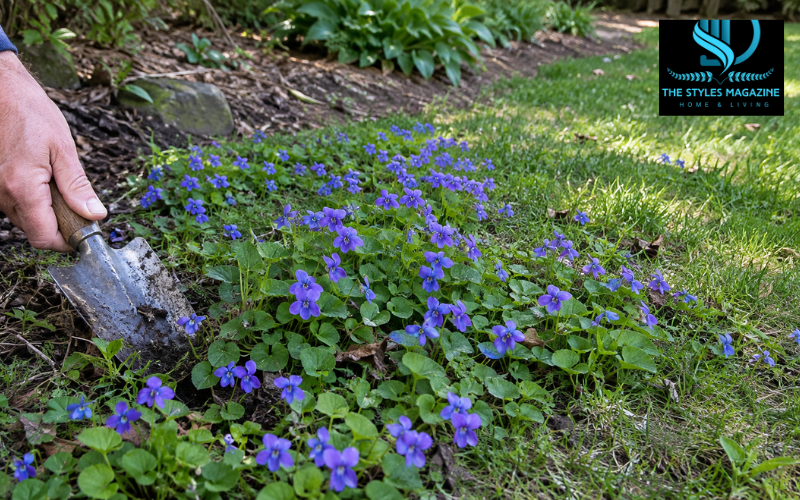
Wild violets are small perennial wildflowers that often appear naturally in lawns, garden beds, woodland edges, and shaded areas. In much of eastern and central North America, the plant people commonly call a wild violet is the common blue violet, Viola sororia. It grows close to the ground, produces heart-shaped leaves, and usually blooms with purple or blue-violet flowers in spring.
Whether wild violets are welcome depends largely on what you want from your yard. Some homeowners dislike them because they can spread through turf and return after pulling. Others intentionally keep them because they provide early flowers for insects, support wildlife, tolerate shade, and work as a natural ground cover where grass may struggle.
Wild violets can therefore be both useful native plants and difficult lawn weeds. Understanding how to identify them, how they spread, their ecological and edible value, and the safest ways to manage them makes it easier to decide whether they belong in your landscape.
Quick Guide to Wild Violets
| Feature | Quick Information |
| Botanical name | Viola sororia is a common species |
| Plant type | Low-growing perennial wildflower |
| Flower color | Purple, blue-violet, white, or mixed |
| Leaves | Heart-shaped with rounded or scalloped edges |
| Preferred conditions | Partial shade and moist, fertile soil |
| Spreading method | Seeds and underground rhizomes |
| Wildlife value | Supports pollinators and fritillary butterflies |
| Edible parts | Correctly identified leaves and flowers |
| Lawn behavior | Can form persistent spreading patches |
| Removal | Dig out rhizomes or use suitable labeled lawn treatments |
Quick Steps for Managing Wild Violets
- Identify the plant correctly before keeping, eating, or removing it.
- Keep small patches if you want native ground cover and wildlife benefits.
- Remove isolated plants early by digging beneath the roots and rhizomes.
- Maintain healthy, dense turf to reduce open spaces where violets can establish.
- Recheck the area because remaining rhizome pieces may produce new growth.
- If herbicides are necessary, choose a product labeled for wild violets and your turf type and follow all label directions.
What Wild Violets Are and What the Name Means
The common blue violet, Viola sororia, is a low-growing herbaceous perennial in the violet family, Violaceae. It is native to eastern and central North America and naturally grows in places such as woods, thickets, shaded areas, and along streambeds. Unlike annual weeds that disappear after one growing season, wild violets survive from year to year.
The wild violets meaning is broader than one specific plant. “Wild violet” is a common name that can be applied to several naturally occurring species in the genus Viola. These species may have purple, blue, white, yellow, or mixed-color flowers. Because several violets look similar, the botanical name becomes important when precise identification is needed.
A plant is also not automatically harmful simply because it is called a weed. A violet growing intentionally beneath trees may be useful ground cover. The same plant spreading across a carefully maintained turf lawn may be considered unwanted. In other words, its value often depends on where it grows and what the homeowner wants from that space.
How to Identify Wild Violets
Common blue violets are fairly easy to recognize once you know what to look for. Their leaves grow from the base of the plant rather than along a tall leafy stem. They are generally heart-shaped, with rounded or scalloped teeth around the edges. Wild violet leaves can also have a smooth, slightly waxy surface.
The flowers usually grow individually on thin stalks above the leaves. A typical violet flower has five petals. On Viola sororia, the blossoms are often about 2 centimeters across and range from purple or violet-blue to white. Fine hairs can also occur near the base of the side petals.
Below the soil, wild violets develop rhizomes. These underground structures can produce new growth and help established plants survive attempts at removal.
Identification should not rely on flower color alone. Leaf shape, growth pattern, flower structure, habitat, and botanical characteristics should all be considered, especially because different violet species can look surprisingly similar.
Purple, Blue, and White Wild Violets
Purple and blue-violet flowers are the colors most people associate with wild violets, but color can vary considerably. Even within violet species that normally produce purple flowers, occasional white forms may appear. Viola sororia itself can produce flowers ranging from purple to white.
This means that white wild violets are not necessarily a completely different type of plant. Some are simply naturally occurring color variations, while others belong to different Viola species.
Look beyond color when identifying them. Typical clues include five petals, heart-shaped leaves growing from the base, scalloped leaf margins, and individual flower stalks emerging close to the ground.
It is also worth remembering that not every plant with “violet” in its common name is a true violet. Common names can be misleading. For example, African violets are unrelated to true Viola species and should not be treated as edible wild violets.
Where Wild Violets Grow and Why They Appear in Lawns
Wild violets are strongly associated with moist, partly shaded areas, but they are surprisingly adaptable. Common blue violets prefer rich, moist soil and dappled light, yet they can grow under several light conditions and tolerate clay and wet soils. They commonly occur in woods, lawns, streamside areas, borders, and beneath trees.
Their presence beneath mature trees is especially common. Turfgrass may become thin in these places because it receives too little sunlight or competes with tree roots for water and nutrients. Compacted soil can make grass establishment even harder. Violets can take advantage of these conditions and fill the open ground.
This is why simply killing violets does not always solve a lawn problem. If the conditions that weakened the grass remain unchanged, the area may stay vulnerable to violets or other plants.
Where a traditional lawn is the goal, maintaining healthy, dense turf is one of the most important ways to reduce future violet encroachment.
How Wild Violets Spread and Keep Coming Back
One reason wild violets can become persistent is that they have more than one way to reproduce.
Established plants form underground rhizomes capable of producing new plants. If someone pulls only the visible leaves and flowers while leaving much of the underground system in place, the violet may grow back. This is why small patches are usually easier to remove by carefully digging beneath the plant rather than simply pulling the tops.
Wild violets also reproduce through seeds. Their familiar spring flowers are only part of the story. Later, violets can produce small flowers that remain closed. These are called cleistogamous flowers. They fertilize themselves without opening and still produce fertile seeds.
Seeds can then spread beyond the original plant. Ants may help move violet seeds because they are attracted to a nutrient-rich coating on them.
Mowing alone is therefore unlikely to eliminate an established colony. Wild violets can adapt to mowing by remaining low to the ground.
Wild Violets Benefits for Pollinators and Wildlife
The ecological role of these plants is one of the strongest reasons to reconsider removing every violet from a yard.
Among the important wild violets benefits is their early flowering period. Their blooms can provide nectar and pollen for native bees, flies, and other visiting insects at a time when fewer flowering plants may be available.
Violets are particularly important to fritillary butterflies. Several fritillary species use violets as host plants, meaning their caterpillars feed on violet foliage during development. Penn State’s host-plant guidance lists violets for butterflies including variegated, great spangled, and meadow fritillaries.
The seeds also provide food for some birds and small mammals, while the plant contributes additional low-growing vegetation to a diverse landscape.
A homeowner does not need to convert an entire lawn into violets to gain some of these benefits. Allowing a controlled patch in a suitable area can provide wildlife value while keeping more formal parts of the landscape tidy.
Wild Violets as Ground Cover
Wild violets can be useful in areas where maintaining conventional lawn grass requires constant effort. Their low-growing habit, shade tolerance, and ability to spread make them suitable for woodland-style gardens, understory areas, path edges, and informal borders.
NC State Extension notes that common blue violet can be used in lawns, borders, rock gardens, along paths, and as a ground cover, particularly in open woodland gardens where it has room to spread naturally.
This can be especially practical beneath trees. Instead of repeatedly reseeding turf in a location that does not receive enough light, some gardeners choose to accept violets as part of a more natural planting.
There is a tradeoff, however. The same ability that makes wild violets effective ground cover can make them troublesome in formal beds. They freely self-seed in favorable conditions and can compete with other plants.
For this reason, keeping a defined violet area and removing unwanted seedlings early is often easier than allowing unrestricted spread.
Are Wild Violets Edible? Uses and Foraging Safety
Correctly identified common blue violets have a history of culinary use. Both the leaves and flowers of common blue violet are considered edible, while the roots should not be eaten.
Flowers can be used fresh as colorful garnishes or incorporated into syrups, infused vinegar, preserves, and similar preparations. Leaves may be eaten in salads or cooked like other greens. Missouri conservation guidance also describes the flowers being used for jelly, candies, garnishes, and salads.
Foraging, however, requires more caution than simply recognizing a purple flower. Violet leaves can resemble other plants, including plants that should not be eaten. Minnesota Extension recommends that inexperienced foragers stick to easily identified violet flowers until they are confident about distinguishing the leaves from lookalikes.
Never eat violets from lawns or roadsides where unsuitable pesticides, herbicides, or other contaminants may have been applied. Only harvest plants you can identify confidently and that come from a clean, legally accessible location.
Growing Wild Violets Intentionally in the Garden
Wild violets require relatively little attention when planted in conditions they naturally prefer. Moist, reasonably rich soil with partial or dappled shade is ideal for common blue violet, although established plants can tolerate a wider range of conditions.
They fit particularly well in woodland gardens, around shaded paths, beneath deciduous trees, in naturalized borders, and in wildlife-friendly landscapes. Their spring flowers can provide color before many summer plants begin blooming.
The main task is controlling where they spread. Removing young plants from unwanted areas is generally easier than waiting until large colonies and established rhizomes develop.
Consider the purpose of the area before planting. In a formal bed with carefully spaced plants, an enthusiastic self-seeder may create unnecessary maintenance. In an informal shaded area where turf repeatedly fails, wild violets may provide a more practical living ground cover.
Gardeners should therefore treat them as a design choice rather than assuming they are always either desirable or undesirable.
Wild Violets for Sale: What to Check Before Buying
When searching for wild violets for sale, pay attention to the scientific name instead of buying according to flower color or a common name alone. If common blue violet is what you want, look specifically for Viola sororia. This helps avoid accidentally buying a different species with different growing habits or native range.
Wild violets may be offered as nursery plants, divisions, or seeds. A live plant can establish a small garden patch quickly, while seed may make more sense when naturalizing a larger suitable area.
Consider your local climate, soil moisture, light conditions, and the amount of space available before planting. Viola sororia naturally favors moist, rich soil and dappled light but can adapt to several conditions.
Nursery-grown plants are generally a better choice than digging violets from natural areas. Removing wild plants may damage local populations, disturb habitat, or violate rules governing collection on public or protected land.
How to Get Rid of Wild Violets Without Damaging the Lawn
Learning how to get rid of wild violets starts with deciding whether removal is actually necessary. A few violets beneath a shaded tree may provide useful ground cover. A rapidly expanding patch in a turf lawn may require management.
For isolated plants, hand digging is usually the simplest option. Loosen the soil around the plant and remove as much of the root and rhizome system as possible. Pulling only the leaves is unlikely to provide lasting control. Check the area later and remove new growth that appears. Minnesota Extension notes that hand removal can work for small patches but often needs to be repeated.
Lawn health matters as well. Dense turf leaves fewer open spaces for violets to establish. Use mowing heights, watering practices, fertilization, grass species, and soil management appropriate for your region rather than trying to force turf into conditions where it cannot thrive.
In deeply shaded areas, changing the planting plan may sometimes be more practical than repeatedly fighting violets.
Wild Violet Killer Options and Responsible Herbicide Use
Established violets can be challenging to control with herbicides because their leaves have a waxy surface that can limit herbicide absorption. Their underground rhizomes also help plants survive incomplete control, meaning one treatment may not solve the problem.
There is no single wild violet killer that is appropriate for every lawn. Selective post-emergent broadleaf herbicides are commonly considered when violets are growing among turfgrass. Minnesota Extension currently identifies triclopyr as often being among the most effective active ingredients for wild violet control, while several other broadleaf herbicide ingredients may provide some control.
However, the correct product depends on the turf species, location, local rules, and label directions. Extension guidance also notes that repeat treatments may be necessary and currently recommends treatment during active growth periods such as early spring or late summer.
Never assume that more herbicide means better control. Follow the product label exactly and keep treatments away from desirable broadleaf plants unless the label says otherwise. Once violets have been treated with lawn herbicides, they should not later be harvested as food unless the specific product label clearly permits that use.
Conclusion
Wild violets are more complicated than their reputation as common lawn weeds suggests. The common blue violet, Viola sororia, is a native perennial with recognizable heart-shaped leaves, spring flowers, underground rhizomes, and an impressive ability to survive and reproduce.
In the right location, wild violets can provide attractive ground cover, support early-season pollinators, and serve as host plants for fritillary butterflies. Correctly identified common blue violet flowers and leaves also have culinary uses. At the same time, their rhizomes and seed production can make established colonies difficult to remove when they spread into places where they are not wanted.
The best approach is to identify the plant correctly before taking action. Consider where it is growing, whether it provides useful ground cover or wildlife value, and how closely managed you want that part of the landscape to be. Keep wild violets where they work, control their spread where necessary, and remove them carefully when they conflict with your lawn or garden goals.
FAQs
Are Wild Violets Weeds?
Wild violets are native perennial wildflowers, but they may be considered weeds when they spread into maintained lawns or garden beds where they are unwanted.
Are Wild Violets Edible?
Correctly identified common blue violet leaves and flowers are generally used as edible plants. Avoid the roots and never eat violets exposed to unsuitable pesticides, herbicides, or other contaminants.
Why Do Wild Violets Keep Coming Back?
Wild violets develop underground rhizomes that can survive incomplete removal. They also reproduce from seeds, so established patches may return even after the visible leaves are removed.
Are Wild Violets Beneficial For Wildlife?
Yes. Their flowers provide resources for some pollinating insects, while violet plants are particularly important host plants for fritillary butterfly caterpillars.
How Can I Get Rid Of Wild Violets Naturally?
For small patches, carefully dig out the entire plant, including as much of the underground rhizome system as possible. Follow-up removal and maintaining dense turf can help reduce regrowth.
Enjoyed it? Find more exclusive content on The Styles Magazine.
Disclaimer: This article provides general information about identifying, growing, using, and managing wild violets. Always confirm plant identification before eating any wild plant. If using herbicides, follow the product label, local regulations, and turf-specific instructions carefully.