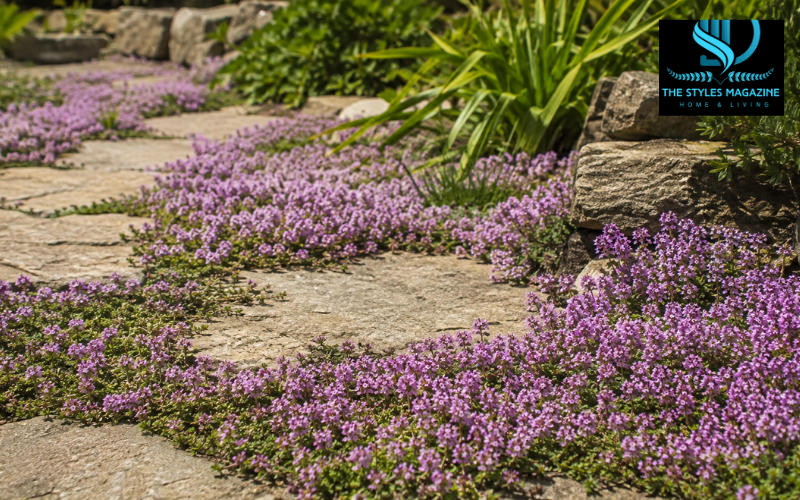
Creeping thyme is a low-growing perennial plant that spreads across the soil to form a dense, fragrant mat. Unlike upright culinary thyme, it is commonly grown as an ornamental ground cover. Several plants are sold under the general name creeping thyme, especially Thymus serpyllum and Thymus praecox, so the exact appearance, size, and hardiness can vary from one variety to another.
Gardeners use creeping thyme in many places where traditional grass or taller plants may not be practical. It can grow along pathways, between paving stones, over sunny slopes, around rock gardens, at border edges, and in containers. Some types are also used as small lawn alternatives where foot traffic is limited.
Its tiny aromatic leaves create year-round or semi-evergreen interest in suitable climates, while small pink, purple, red-pink, or white flowers can cover the plant during summer. These flowers are attractive to bees, butterflies, and other pollinators.
Creeping thyme is relatively simple to maintain once established, but success depends heavily on sunlight, drainage, correct variety selection, and realistic expectations about traffic and moisture.
Quick Guide Table
| Feature | Creeping Thyme Guide |
| Plant Type | Low-growing perennial ground cover |
| Best Light | Full sun |
| Soil | Well-drained, sandy, rocky, or loamy soil |
| Typical Zones | Often USDA Zones 4–9, depending on species and cultivar |
| Water Needs | Regular while establishing; lower once established |
| Flowers | Pink, purple, red-pink, or white |
| Foot Traffic | Light to moderate, depending on variety |
| Best Uses | Pavers, borders, slopes, rock gardens, containers, small lawn areas |
| Maintenance | Low once established |
| Main Concern | Poor drainage and consistently wet soil |
Simple Steps for Growing Creeping Thyme
- Choose a sunny location with excellent drainage.
- Remove grass, weeds, and competing roots before planting.
- Select a creeping thyme variety suited to your climate and intended use.
- Space plants according to their expected mature spread.
- Water regularly during establishment, but avoid soggy soil.
- Reduce watering once plants are well rooted.
- Trim lightly when needed to keep growth neat and contained.
What Creeping Thyme Looks Like and How It Grows
Creeping thyme grows horizontally rather than forming a tall, upright plant. Its stems travel over the soil surface and gradually create a low mat. Some stems can root where they touch the soil, allowing the plant to spread naturally into nearby open spaces. Thymus praecox, for example, is described by NC State Extension as having horizontal stems that root easily on contact with soil.
The creeping thyme leaves are small and closely spaced. Their exact appearance varies by species. T. serpyllum has tiny blue-green to green leaves that are aromatic, while T. praecox may have fuzzy bluish-green leaves with a spicy fragrance.
Height and spread also differ considerably. NC State lists T. serpyllum at roughly 2–3 inches tall, while T. praecox may reach around 3–6 inches. Individual cultivars can spread much farther than their height suggests.
Flowers usually appear in summer. Depending on the plant, blooms may be pink, lavender-purple, deep pink, red-toned, or white. In mild climates, foliage may remain evergreen, while colder winters can leave some types semi-evergreen.
Popular Creeping Thyme Varieties and Their Differences
There is no single creeping thyme that suits every landscape. Choosing by botanical name and cultivar is more reliable than buying a plant simply labeled “creeping thyme.”
Red creeping thyme commonly refers to red- or deep-pink-flowering selections of Thymus praecox. These plants are popular where gardeners want stronger flower color over a low green carpet. Current nursery listings, for example, include T. praecox sold as Red Creeping Thyme.
Elfin thyme is a particularly compact form. NC State describes Thymus serpyllum ‘Elfin’ as only around 1–3 inches high, with a spread of roughly 1–1.5 feet, making it useful around rocks, small spaces, and paving.
White-flowered creeping thyme offers a softer appearance, while woolly creeping thyme (Thymus pseudolanuginosus) is valued more for its distinctive foliage. It has tiny, soft, hairy gray-green leaves and pale pink summer flowers. NC State lists woolly thyme for Zones 5–8.
Before buying, compare mature height, spread, flower color, leaf texture, hardiness, and intended landscape use rather than choosing on flower color alone.
Creeping Thyme Benefits and Realistic Limitations
One major attraction of creeping thyme is its low growth. Once an area has filled in, regular mowing is generally unnecessary. Established plants are also drought tolerant when grown in suitable soil, making them useful in sunny, relatively dry areas.
The summer flowers provide another benefit. Both T. serpyllum and T. praecox are documented as attracting bees and butterflies, so flowering patches can contribute nectar resources within a garden.
A mature mat can occupy exposed soil and leave less open space for weeds, but creeping thyme should not be described as completely weed-proof. Young plantings normally need weed control until they become established.
Certain types also tolerate some foot traffic. That makes them useful around stepping stones and lightly walked garden areas. However, frequent running, playing, or repeated heavy traffic can damage them.
The biggest limitations are shade and excessive moisture. Creeping thyme is not a good solution for a dark, damp lawn or poorly drained clay that remains wet for long periods.
Sun, Soil, Drainage, and the Right Creeping Thyme Zone
Sun and drainage are two of the most important factors when growing creeping thyme. Both NC State Extension and the Royal Horticultural Society recommend full sun and well-drained conditions for commonly grown thyme species. Sandy, gritty, rocky, or light soil can work very well.
Rich soil is not essential. In fact, attempting to create very fertile, moisture-retentive soil can work against a plant that naturally performs well in leaner, freely draining ground. Wet soil, particularly during cool weather, can lead to weak growth and root problems. T. praecox is specifically described as intolerant of poorly drained or wet soil.
The correct creeping thyme zone depends on the exact plant. NC State lists T. serpyllum for USDA Hardiness Zones 4–9 and T. praecox for Zones 5–8. Individual cultivars sold by nurseries may have slightly different advertised ranges.
For that reason, check the label on the specific plant you intend to buy rather than assuming every creeping thyme has identical cold tolerance.
Is Creeping Thyme Invasive or Simply a Spreading Ground Cover?
The question “Is creeping thyme invasive?” needs more care than a simple yes or no. A spreading ground cover is not automatically an invasive plant. “Invasive” normally refers to a non-native plant that causes ecological problems in a particular region, while a vigorous garden plant may simply expand beyond its intended border.
Creeping thyme is naturally designed to spread. In T. praecox, horizontal stems may root after touching the soil, gradually extending the mat into nearby open ground.
That behavior can be useful on slopes or between stones but less convenient beside small, slow-growing plants. If it moves beyond its allotted space, trimming the edges, lifting unwanted rooted sections, or using defined borders can keep it manageable.
Gardeners should still check local invasive-species guidance before introducing any non-native ground cover, particularly near natural habitats. Regional rules and ecological concerns can differ, so a plant’s behavior in one state or country should not automatically be applied everywhere.
Creeping Thyme Seeds vs. Plugs and Potted Plants
Creeping thyme seeds may appear attractive when covering a large area because seed usually costs less per potential plant. However, growing a uniform carpet from seed requires more time and attention. Germination and early growth can be uneven, and young seedlings face competition from weeds.
This is one reason plugs are often practical for landscape projects. Small rooted plants already have an established root system and can be positioned at controlled distances, making the final layout easier to plan.
University of Minnesota Extension previously studied creeping thyme for bee lawns but now says it is no longer recommended in its standard bee-lawn mixtures because of long-term observations and limited seed availability.
Larger potted plants cost more but provide faster visual impact, especially in small beds, containers, or gaps between existing plants.
Whichever option you choose, check the botanical name. Seed labeled simply “thyme” may be an upright culinary type rather than the low-growing species you expected.
How to Plant Creeping Thyme Successfully
Start by choosing a sunny site where rain and irrigation water can drain away easily. Remove existing grass, perennial weeds, and roots before planting. Creeping thyme has a better chance of forming an even carpet when it does not have to compete with established vegetation.
If the soil is heavy and remains wet, improving drainage is more useful than simply adding fertilizer. A raised planting area or container may be a better option where naturally waterlogged ground cannot be corrected. RHS guidance similarly recommends raised beds or containers when garden soil stays damp.
Spring is a convenient planting period in many climates, although local frost patterns should guide timing. Plant after severe freezing conditions have passed but early enough to allow roots to establish before stressful heat or cold.
Spacing should follow the mature spread of the cultivar. RHS gives a general thyme spacing range of around 8–12 inches, but compact and wide-spreading varieties differ.
After planting, water thoroughly and continue providing moisture while roots establish, without keeping the soil continuously saturated.
Watering, Feeding, Pruning, and Everyday Care
New creeping thyme needs more attention than an established patch. Water newly planted thyme deeply enough to reach its root zone, then allow the soil to move toward drier conditions rather than staying constantly wet. Even drought-tolerant perennials need regular watering during establishment.
Once established, creeping thyme generally handles dry periods well. Constant moisture is more concerning than slightly lean conditions, especially where winter rain collects around the roots.
Heavy feeding is usually unnecessary in suitable soil. Excessive fertilizer may encourage soft growth instead of the compact habit most gardeners want.
Light pruning can help maintain appearance. NC State recommends pruning T. praecox stems when needed, while RHS advises light trimming of thyme after flowering to maintain neat growth.
Keep removing weeds while young plants are filling gaps. If established thyme begins thinning, check for shade, standing water, compacted soil, winter wetness, or crowding before assuming it needs fertilizer.
Using Creeping Thyme as a Lawn Alternative
A creeping thyme lawn can be attractive in the right location, but it is not a universal substitute for turfgrass. It works best in sunny, well-drained spaces where people walk occasionally rather than areas used constantly by children, pets, sports, or heavy foot traffic.
The main advantages are low height, fragrant foliage, summer flowers, and reduced mowing. T. praecox is specifically listed by NC State for lawn applications and shows tolerance to foot traffic.
For larger areas, plugs or small plants often provide more control than seed because they can be placed evenly and monitored during establishment. Temporary paths can also prevent people from repeatedly stepping on young plants.
There is another consideration during flowering: bees may actively visit the lawn. That can be desirable in a pollinator-friendly garden but may matter where people frequently walk barefoot.
University of Minnesota’s current guidance is also worth noting. Although its research found creeping thyme useful in bee lawns, it no longer recommends the plant in standard mixtures because of longer-term observations and seed availability concerns.
Creeping Thyme Between Pavers, on Slopes, and in Garden Beds
Some of the most natural uses for creeping thyme are smaller landscape spaces rather than whole lawns. Between stepping stones, its low stems can soften hard paving while releasing fragrance when lightly brushed or stepped on. RHS specifically recommends T. serpyllum for rock gardens and paving crevices.
It can also work well on sunny slopes where good drainage is already present. The spreading habit helps cover bare-looking ground, although young plants still need care until they join together.
In garden beds, creeping thyme works best where nearby plants will not shade it heavily. Low cultivars can edge sunny borders, spill over stones, or fill gaps around drought-tolerant plants.
Mature spread matters. A variety that looks tiny in its nursery pot may eventually extend into neighboring plants or across a path. Match the cultivar to the available space and trim it when needed rather than planting densely from the beginning.
Growing Creeping Thyme in Pots and Containers
Creeping thyme in pots can be an excellent choice when garden soil is too wet or space is limited. Containers also allow trailing stems to spread over the edge, creating a soft, natural look.
Choose a pot with unobstructed drainage holes and use a free-draining growing mix. RHS recommends gritty, well-drained compost for container-grown herbs such as thyme.
Place the container in strong sunlight. Although an established plant in the ground can tolerate dry conditions, pots dry out faster because their root systems hold a limited amount of soil. Check moisture regularly during hot weather, but avoid leaving the container standing in water.
Winter care depends on the cultivar, your local hardiness zone, and the size of the pot. Roots in small containers experience colder temperature swings than roots protected by the ground. In colder regions, moving pots to a sheltered location may help protect them from severe freezes and excessive winter moisture.
Buying Creeping Thyme: Nurseries, Home Depot, Lowe’s, and Online Sellers
Before buying creeping thyme, look beyond the photograph. Check the botanical species, cultivar name, mature size, recommended hardiness zone, sunlight requirement, and whether you are purchasing seed, plugs, or an established plant.
As of August 2026, creeping thyme at Home Depot includes live Red Creeping Thyme listed as Thymus praecox. The retailer identifies it as a full-sun, spreading perennial ground cover. Availability and pricing can change by location and season.
Creeping thyme at Lowe’s also appears in current listings. One listing offers a six-pack of pink Thymus serpyllum, while other creeping thyme products may be available as plants or seed products depending on location.
Large retailers are convenient, but local nurseries and specialist growers may provide a wider selection of named cultivars and advice suited to your climate.
Whatever the source, avoid buying only because the flowers look attractive. The right variety should match your winter temperatures, soil drainage, available sunlight, expected traffic, and intended planting area.
Conclusion
Creeping thyme can be a practical and attractive ground cover when its natural preferences match the site. It performs particularly well in full sun and freely draining soil, where its low growth, aromatic foliage, and summer flowers can create an attractive carpet with relatively modest maintenance.
The exact plant matters. Thymus serpyllum, Thymus praecox, Elfin thyme, red selections, white-flowering forms, and woolly creeping thyme do not all have identical heights, textures, spreads, or hardiness ranges. Checking the botanical name before planting can prevent many problems.
For a lawn alternative, creeping thyme is best suited to lighter-use areas rather than heavily traveled yards. Around pavers, rock gardens, sunny borders, slopes, and containers, it can often be easier to place and control.
Most importantly, treat creeping thyme as a living ground cover rather than a maintenance-free carpet. Give it adequate sun, excellent drainage, reasonable establishment care, and enough space to spread. With those conditions in place, it can provide long-lasting foliage, fragrance, flowers, and useful ground coverage without demanding the routine mowing associated with a traditional lawn.
FAQs
Is Creeping Thyme A Good Lawn Replacement?
Creeping thyme can replace grass in sunny, well-drained areas with light foot traffic. It is less suitable for heavily used yards, shaded spaces, or soil that stays wet.
Is Creeping Thyme Invasive?
Creeping thyme naturally spreads, but spreading does not automatically mean invasive. Its status can vary by region, so gardeners should check local invasive-plant guidance before planting near natural areas.
Can You Grow Creeping Thyme From Seeds?
Yes. Creeping thyme seeds are inexpensive for larger areas, but they may establish slowly and unevenly. Plugs or small nursery plants usually provide faster and more predictable coverage.
Can Creeping Thyme Grow In Pots?
Yes. Creeping thyme grows well in containers with drainage holes, a free-draining potting mix, and plenty of sunlight. Container plants may require more frequent watering during hot weather.
Does Creeping Thyme Need Full Sun?
Most creeping thyme varieties perform best in full sun. Too much shade can reduce flowering, create thinner growth, and increase problems if the soil also remains damp.
Enjoyed it? Find more exclusive content on The Styles Magazine.
Disclaimer: This article provides general gardening information about creeping thyme. Growing conditions, hardiness, invasiveness, and care needs can vary by species, cultivar, climate, and location. Always check local gardening guidance and individual plant labels before planting.