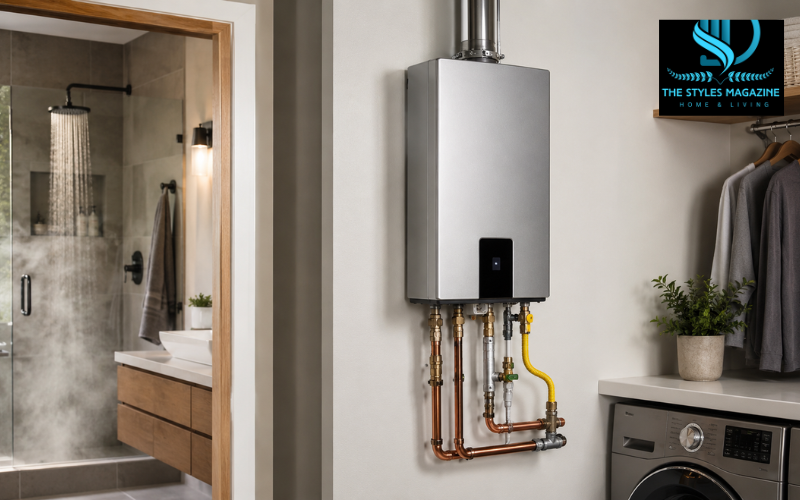
A tankless water heater heats water only when a hot-water tap is opened. Unlike a traditional system, it does not keep a large tank of water hot throughout the day. Cold water enters the unit, passes through a heat exchanger, and leaves at the chosen temperature. This is why it is also called an on-demand water heater.
Homeowners often choose tankless systems for continuous hot water, a compact wall-mounted design, and lower standby energy loss. However, “endless” does not mean unlimited. The heater must be large enough to serve every shower, faucet, and appliance being used at the same time. Installation can also be costly if the home needs new venting, gas piping, electrical circuits, or a service-panel upgrade.
This guide covers tankless water heater types, sizing, costs, leading brands, maintenance, advantages, and common limitations.
Tankless Water Heater Quick Guide
| Feature | Gas Tankless Heater | Electric Tankless Heater |
| Best for | Larger homes and multiple bathrooms | Apartments, small homes, or single fixtures |
| Hot-water capacity | Usually higher | Usually lower |
| Installation | Requires gas supply and venting | Requires strong electrical service |
| Upfront cost | Often higher | Usually lower |
| Space needed | Compact and wall-mounted | Very compact |
| Main concern | Venting and gas-line size | Breaker and panel capacity |
Quick Buying Checklist
- Calculate how many hot-water fixtures may run together.
- Check the required GPM at your local groundwater temperature.
- Confirm whether your home supports gas or high electrical demand.
- Include installation, permits, venting, wiring, and plumbing in the budget.
- Check warranty terms and local repair support.
- Plan for regular flushing if your home has hard water.
How a Tankless Water Heater Works
When a hot-water tap opens, a flow sensor detects moving water. The heater then starts a gas burner or activates electric heating elements. Water passes through the heat exchanger, absorbs heat, and travels to the fixture. When the tap closes, heating stops.
This process avoids most of the standby loss caused by storing hot water. Gas condensing models recover extra heat through a second heat exchanger, but they also produce condensation and need a suitable drain.
“Endless hot water” means the unit can keep heating as long as demand stays within its capacity. An undersized heater may struggle when several fixtures run together. There is also a short wait at the tap because cool water already sitting in the pipe must leave first. Recirculation can shorten that delay but does not replace correct sizing.
Tankless Water Heater Gas vs. Electric
Gas tankless water heaters use natural gas or propane. They normally provide stronger whole-home flow, making them suitable for larger families, cold climates, and homes with high simultaneous demand. Indoor models require safe venting, while condensing units also need condensate drainage.
An electric tankless water heater is usually smaller and does not need combustion venting. It can suit apartments, additions, smaller homes, and point-of-use applications. The main concern is electrical demand. EcoSmart’s current 27-kW whole-home model, for example, requires three 40-amp double-pole breakers and recommends a 200-amp household service panel.
Gas is often practical for multiple bathrooms. Electric can work well where demand is lower, incoming water is warmer, or adding gas service would be difficult. The better choice depends on utility prices, existing services, climate, and household use.
Choosing the Right Size and Flow Rate
Tankless water heaters are sized by flow rate and temperature rise. Flow rate is measured in gallons per minute, or GPM. Add the flow of all hot-water fixtures likely to run together. Temperature rise is the difference between incoming cold water and the desired outlet temperature.
For example, two 2.0-GPM WaterSense showers plus a 1.0-GPM faucet create an estimated demand of 5.0 GPM. If incoming water is 50°F and the heater is set to 120°F, the unit must supply that flow at a 70°F rise. WaterSense showerheads use no more than 2.0 GPM, while standard models may use 2.5 GPM.
Do not choose a unit only by the largest GPM printed on the box. Maximum flow is usually measured at a modest temperature rise, so winter performance may be lower. Navien advises sizing for the highest required flow and maximum expected temperature rise.
Finding a Tankless Water Heater for a Shower
A tankless water heater for a shower may be a point-of-use unit near one bathroom or part of a central whole-home system. Point-of-use models can serve a guest bath, workshop, or distant fixture. Whole-home models are designed for several fixtures.
One WaterSense shower may draw up to 2.0 GPM, while a standard showerhead may use 2.5 GPM. The heater must deliver that flow at the home’s real temperature rise. A unit that performs well in a warm region may provide less flow during a cold winter.
Low-flow showerheads reduce demand, but every heater has a minimum activation flow. If the flow is too low, the unit may cycle off. For two showers at once, add both flow rates and include any sink or appliance likely to run at the same time.
Tankless Water Heater Cost and Installation Budget
In the United States, 2026 consumer estimates place many professionally installed tankless systems between about $1,400 and $5,600. Electric installations often sit toward the lower end, while gas systems and difficult conversions may cost more. Angi reports an average near $2,638, but local labor, permits, equipment, and required upgrades can change the total greatly.
The heater itself is only one part of the budget. Gas installations may need larger fuel lines, venting, condensate drainage, isolation valves, and plumbing changes. Large electric units may need several dedicated circuits, heavy wiring, new breakers, a subpanel, or a main-panel upgrade.
A direct replacement with compatible connections is generally cheaper than converting from a storage tank. Ask for itemized quotes covering equipment, labor, permits, plumbing, venting, electrical work, and old-unit removal. Treat future savings as an estimate because utility prices, water use, efficiency, and maintenance vary by household.
Tankless Water Heater Pros and Cons
The main benefit is continuous hot water within the heater’s rated output. A correctly sized unit can support long showers without emptying a tank. It also saves floor space and reduces standby heat loss. DOE guidance says demand water heaters can be 24% to 34% more energy efficient than conventional storage heaters in homes using 41 gallons or less of hot water daily.
The disadvantages include higher installation costs, fixed flow limits, and regular scale maintenance. An undersized system may produce cooler water when several fixtures operate together. Repairs may also require a technician familiar with the brand.
Tankless does not mean instant water at every tap. Long pipe runs still cause waiting. Recirculation can improve comfort, but it adds equipment and may increase energy use if poorly controlled. The best choice depends on usage habits, utility upgrades, and how long the owner expects to remain in the home.
Energy Efficiency, Operating Costs, and Lifespan
A tankless water heater uses energy during a hot-water draw rather than keeping stored water warm. Actual savings depend on daily use, climate, temperature settings, pipe length, utility rates, and the efficiency of the old system.
Uniform Energy Factor, or UEF, helps compare efficiency among similar water heaters. ENERGY STAR lists certified gas models and requires qualifying products to meet efficiency, delivery, warranty, and safety standards. A high UEF is useful, but correct sizing and total operating cost remain important.
Tankless models often last longer than standard tanks when properly installed and maintained. Rheem gives a typical range of 15 to 20 years or more for tankless systems, compared with about 8 to 12 years for traditional tanks. Water quality, maintenance, usage, and parts availability affect actual service life.
Leading Tankless Water Heater Brands and Models
No tankless water heater brand is ideal for every home. Compare fuel type, output at the required temperature rise, UEF, warranty, local service coverage, recirculation options, and parts availability.
Rinnai’s SENSEI RX and RXP ranges are high-efficiency condensing gas systems. RXP models include a built-in pump, while Smart-Circ can learn usage patterns for timed recirculation. The RX platform is listed at up to 0.98 UEF.
Navien’s NPE-240A2 has dual stainless-steel heat exchangers and an integrated ComfortFlow recirculation system. Its published flow reaches 11.2 GPM at a 35°F rise, so output will be lower when the required rise is greater.
Rheem sells gas and electric tankless models in point-of-use and whole-home sizes. Selected RTG-R gas models include built-in recirculation and Wi-Fi.
For electric options, EcoSmart’s current ECOS 27 uses self-modulating controls. Stiebel Eltron’s Tempra Plus line includes Advanced Flow Control, which reduces flow when demand exceeds capacity to help protect outlet temperature.
Installation Requirements and Safety Considerations
A tankless replacement is rarely a simple plug-and-play job. Gas units need correct fuel pressure, pipe size, combustion air, venting, clearances, and leak testing. Condensing models also need drainage. Electric units require correctly sized wiring, breakers, grounding, disconnects, and enough service capacity.
Professional sizing is important because the installer must evaluate both water demand and the home’s utilities. A powerful heater connected to an undersized gas line or overloaded electrical system will not operate safely or reliably. Permits and inspections may be required, and the manufacturer’s instructions must be followed.
Indoor and outdoor models are not interchangeable. Outdoor units must be approved for weather exposure. Built-in freeze protection may depend on uninterrupted power, so exposed plumbing and outage planning still matter in cold areas.
Hard Water, Descaling, and Routine Maintenance
Hard water contains minerals that form scale when heated. Scale can restrict passages, reduce heat transfer, lower flow, and cause unstable temperatures or error codes.
Many manufacturers recommend descaling at least once a year. Rinnai advises annual flushing, while Stiebel Eltron suggests every six months to one year depending on hardness. Navien also recommends at least annual descaling, with shorter intervals for high mineral content or heavy use.
Routine service may also include cleaning the cold-water inlet filter, checking gas-unit vents and air intake, inspecting condensate drainage, and looking for leaks. A suitable softener or scale-control system may help in very hard-water areas. Keep maintenance records because warranty coverage may depend on following service and water-quality requirements.
Reduced hot-water pressure, changing temperatures, unusual noise, longer heating times, and repeated error codes can signal overdue service.
Common Performance Problems and Practical Solutions
Fluctuating temperature may result from undersizing, changing flow, scale, a dirty inlet filter, low gas pressure, weak electrical supply, or several fixtures opening together. Safe first checks include confirming the temperature setting, recording any error code, and seeing whether the issue affects one fixture or the whole home.
A “cold water sandwich” is a brief cool section between hot-water draws. It may occur when hot water remains in the pipe after one use, followed by cooler water before the heater responds to the next draw. A buffer tank or properly controlled recirculation system can reduce the effect.
Long waiting times usually come from pipe distance rather than slow heating. A point-of-use heater, improved plumbing layout, or recirculation may help. Rinnai and Navien offer models and controls designed around recirculation.
Gas odors, leaks, breaker trips, combustion problems, damaged wiring, and repeated shutdowns require professional attention.
Comparing Online Listings, Amazon Reviews, and Reddit Advice
A tankless water heater Amazon listing can help compare dimensions, advertised output, included parts, and customer feedback. Still, verify the exact model number and every major specification on the manufacturer’s current website. Check fuel type, indoor or outdoor rating, voltage, amperage, breakers, venting, warranty, certification, and seller authorization.
Tankless water heater Reddit discussions may reveal recurring experiences involving panel upgrades, hard-water maintenance, installer quality, waiting time, and cold-weather output. These comments can suggest useful questions, but one homeowner’s setup cannot replace proper sizing, local code knowledge, or official instructions.
Before buying, confirm required GPM at the real temperature rise, total installed cost, utility capacity, warranty terms, and local service support. A low online price can become poor value when a unit is undersized, unsupported, or expensive to install.
Conclusion: Is a Tankless Water Heater Right for Your Home?
A tankless water heater can provide continuous hot water, save space, and reduce standby energy loss. Its success depends on matching the system to the fuel source, simultaneous flow demand, winter groundwater temperature, utility capacity, and installation conditions.
Compare gas and electric options by total project cost rather than appliance price alone. Ask for performance at the required temperature rise, not just maximum GPM. Include maintenance, upgrades, warranty conditions, and local repair support in the decision.
For a home with suitable utilities and steady demand, a correctly sized and maintained tankless system can provide reliable long-term service. Where upgrades are extensive or demand is modest, a storage tank or another efficient water-heating option may be more practical.
Frequently Asked Questions
Does A Tankless Water Heater Provide Unlimited Hot Water?
It can provide continuous hot water as long as demand stays within its rated flow capacity. An undersized unit may struggle when several showers or appliances run simultaneously.
What Size Tankless Water Heater Do I Need?
Add the GPM of all fixtures you expect to use together. Also consider the required temperature rise, because colder incoming water reduces the unit’s available hot-water flow.
Is A Gas Or Electric Tankless Water Heater Better?
Gas models usually support higher household demand, while electric models are compact and need no exhaust vent. The better option depends on utility access, installation costs, and water usage.
How Often Should A Tankless Water Heater Be Flushed?
Many systems benefit from annual flushing, although homes with very hard water may need more frequent service. Always follow the maintenance interval stated in the manufacturer’s instructions.
Does A Tankless Water Heater Save Money?
It may lower standby energy loss, but savings vary by usage, fuel prices, climate, efficiency, and installation cost. Compare the total long-term cost instead of considering energy savings alone.
Enjoyed it? Find more exclusive content on The Styles Magazine.
Disclaimer: This article provides general information only. Tankless water heater sizing, installation, maintenance, and safety requirements vary by property, local codes, and manufacturer instructions. Consult a qualified professional before installation or repair.