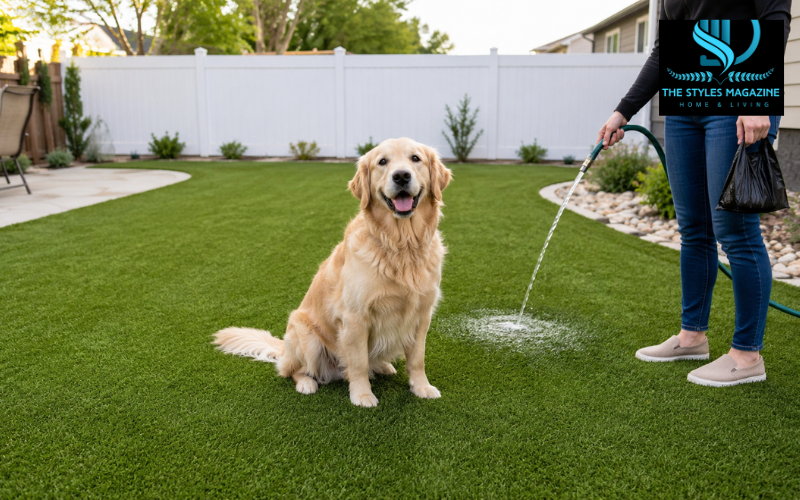
Artificial grass for dogs is a synthetic lawn made to cope with running, urine, solid waste, and frequent cleaning. It can provide a green, mud-free surface where natural grass becomes patchy or difficult to maintain. However, the visible turf is only one part of a successful pet area. The backing, base, drainage route, edges, and cleaning routine all affect how well it performs.
Pet-grade turf is usually designed for faster drainage and easier waste removal than ordinary decorative grass. Some products also contain antimicrobial treatment or use odor-control infill, but these features do not make the lawn self-cleaning. The U.S. Environmental Protection Agency explains that antimicrobial treatment built into a product may only protect the product itself; it should not automatically be viewed as a public-health disinfectant.
Dog-friendly turf can suit family gardens, dog runs, kennels, balconies, and shaded or heavily used yards. It is most successful when the complete system is planned around the dogs, the surface below, the climate, and the available drainage.
Quick Guide to Choosing Artificial Grass for Dogs
| Feature | Recommended Choice | Why It Matters |
| Pile height | 0.6–1.25 inches | Easier waste removal and less matting |
| Blade material | Polyethylene | Soft on paws and durable |
| Backing | Fully permeable or perforated | Helps urine and rainwater drain |
| Face weight | Around 60–90 oz./sq. yd. | Supports frequent running and play |
| Sub-base | Compacted crushed stone | Improves stability and water flow |
| Odor control | Zeolite or pet-specific infill | Helps manage ammonia smells |
| Safety | Lead-free and pet-safe certification | Reduces exposure to harmful materials |
Why Dog Owners Choose Artificial Grass
Artificial turf does not turn into mud after rain, so dogs are less likely to bring muddy paw prints indoors. It also avoids the worn tracks and dead patches that often appear where dogs repeatedly run or urinate on natural grass.
It can reduce lawn work because it does not need mowing, fertilizing, reseeding, or regular watering for growth. Pet-turf systems are commonly used where easy waste removal, drainage, and year-round access matter.
The main limitation is that artificial grass is not maintenance-free. Owners still need to collect waste, rinse toilet areas, remove hair and leaves, and clean the surface. Turf can also become hot in direct sun, while poor installation may cause puddles or odors. Up-front costs can rise when excavation, drainage work, or a raised system over concrete is required.
Pet-Grade Turf vs Standard Artificial Grass
Standard landscape turf is often chosen mainly for softness and appearance. Pet-grade turf gives more attention to drainage, cleanability, blade recovery, strong seams, and resistance to frequent use. A deep, plush pile may look attractive, but it can hide small pieces of waste and flatten in a busy dog area.
Backing design is especially important. Some products drain through spaced holes, while others use a flow-through backing across most or all of the surface. The second design offers more routes for liquid to leave, although real performance still depends on the base and outlet below. K9Grass, for example, uses a knitted flow-through backing, while other pet systems combine perforated turf with a drainage mat.
Ordinary fake grass may fail when laid over dense clay, an uneven base, or flat concrete. For dog-heavy use, the installation should be planned as a washable surface rather than a decorative carpet.
Best Artificial Grass for Dogs: Essential Specifications
The best artificial grass for dogs balances paw comfort with easy cleaning. A short-to-medium pile, often about 0.6 to 1.25 inches, usually makes waste easier to see and remove than a very deep pile. Current pet-turf products commonly fall near this range, with examples using pile heights of about 0.875 to 1.125 inches and face weights of roughly 55 to 75 ounces.
Dense construction may improve resilience, but face weight alone does not prove quality. Yarn shape, stitch rate, backing strength, seams, and installation also matter.
Polyethylene is commonly used for the main blades because it offers a relatively soft feel with suitable durability for landscape use. Some products combine polyethylene blades with polypropylene thatch. Ask for a full product sheet rather than judging a small sample only by color and softness.
Look for a permeable or well-perforated backing and a drainage figure supported by testing. A high laboratory drainage rate will not prevent puddles if the base is blocked or water has no exit. Request evidence behind claims such as lead-free, pet-safe, or low in regulated substances. Broad terms such as “non-toxic” or “hypoallergenic” are more useful when supported by clear test reports.
For dogs that dig or sprint, inspect how firmly the fibers are attached and how edges and joins will be secured. Weak seams can become exposed quickly under repeated paw traffic.
Artificial Grass for Dogs With Drainage
Artificial grass for dogs with drainage allows urine, rinse water, and rain to pass through the turf and move into a suitable layer or outlet below. Fully permeable backings provide drainage routes across a wide area. Hole-punched backings drain through spaced openings, making base preparation and slope especially important.
Drainage must work from top to bottom. Liquid needs to pass through the turf, travel through or across the foundation, and finally leave the area. If one layer blocks the route, water can remain trapped even when the turf itself drains quickly. Pet-turf manufacturers therefore pair permeable surfaces with aggregate bases or drainage mats.
On soil, the installer should consider ground type, rainfall, low points, and nearby drains. A gentle fall toward a suitable outlet is more reliable than a completely flat surface.
Slow drainage, standing water, squelching, and smells that return soon after cleaning may point to a blocked outlet, compacted base, poor slope, or trapped urine. These warning signs should be investigated rather than covered with more deodorizer.
Best Artificial Grass for Dogs to Pee On
The best artificial grass for dogs to pee on is not necessarily the softest option. It should let liquid pass through, make waste easy to spot, and tolerate regular rinsing. Shorter, upright blades generally leave fewer places for residue to hide.
Some products contain antimicrobial additives in their fibers. These treatments may help limit bacteria, mold, or mildew growth on the turf and support odor control. Smart Turf markets Microban protection integrated into its blades, while K9Grass describes antimicrobial protection and an infill-free system. Such features are product-specific and do not remove the need for washing.
Use also matters. One small dog on a large lawn creates less pressure than several large dogs sharing one narrow toilet zone. Busy areas may require shorter turf, stronger seams, more open drainage, and easier access for flushing.
Dog behavior should also guide the choice. A dog that scratches after toileting may place extra pressure on seams and edges, while a heavy-shedding dog may require more frequent brushing to stop hair from collecting between the blades.
Building the Right Sub-Base
A stable, drainable sub-base keeps the turf level and gives water somewhere to move. Installing it directly over loose soil can lead to dips, movement, weeds, and uneven drainage. Dense clay is a particular problem because water may pass through the turf and stop at the ground below.
A soil installation normally removes natural grass and loose organic material before adding compacted aggregate. Crushed stone or a suitable road-base material can provide stability while allowing water movement. The correct material and depth depend on the soil, rainfall, traffic, and local building practice.
Some installers use decomposed granite, but not every type is suitable for pet areas. Material that compacts too tightly may restrict drainage. One current pet-turf installation guide recommends freely draining crushed rock or clean road base instead of tightly compacted decomposed granite for urine-heavy areas.
A weed barrier may help separate soil from aggregate, but it must remain water-permeable. It should not create a sealed layer beneath the grass. High-use toilet zones may need extra drainage, a deeper aggregate layer, or access for future deep cleaning.
Infill and Odor-Control Options
Infill is loose material brushed between artificial grass blades. Depending on the turf, it may add weight, support the fibers, and improve surface stability. Some pet systems do not require infill, so the turf manufacturer’s instructions should always come first.
Zeolite is commonly used in dog areas because varieties such as clinoptilolite can capture ammonium through ion exchange. This can help reduce ammonia-related odors when the correct material is used as part of a well-drained system.
Standard silica sand mainly adds weight and supports the blades. It should not automatically be treated as an odor-control product.
The correct infill amount depends on pile height, density, and system design. Too little may leave the surface unstable, while too much can bury the blades and trap debris. Ask for the exact application rate for the selected product. Some installations blend zeolite with another infill, while systems such as K9Grass are designed to be infill-free.
Infill cannot repair poor drainage. It may help manage smell, but urine still needs to be diluted and flushed away through an open base.
Artificial Grass for Dogs on Concrete
Artificial grass for dogs on concrete can work on patios, kennels, balconies, and rooftops, but concrete cannot absorb water. If turf is attached directly to a flat slab, urine may collect underneath and become difficult to remove.
The first step is to identify where liquid will go. The slab should have a usable fall toward a drain or open edge. In many pet installations, a raised drainage mat or tile creates a gap below the turf and a route for rinse water. Smart Turf’s perforated mat is designed for this purpose, and its installation guidance recommends raised drainage instead of bonding pet turf flat to concrete.
Edges and seams must be secure without sealing every drainage route. Adhesive should be applied according to the turf-system instructions rather than spread in a way that blocks water movement.
On balconies, check building rules, waterproofing, drain capacity, and runoff control before installation. Wastewater should not be allowed to drip onto neighboring property or collect against the building. Enclosed concrete areas usually need more frequent cleaning because they receive less rain and airflow.
Cleaning Fake Grass for Dogs to Pee On Outside
Remove solid waste as soon as possible, before it is stepped on or pressed into the pile. Rinse any remaining residue with water and a cleaner approved for the turf.
Frequently used toilet areas need regular flushing. The schedule depends on the number of dogs, weather, drainage, and size of the space. A small run used many times each day may need much more attention than a large yard used by one dog.
For deeper cleaning, choose an enzyme or biological cleaner labelled for pet waste and compatible with synthetic turf. Follow its dilution and contact-time directions, and never mix cleaning products. ForeverLawn’s maintenance guidance recommends removing waste, treating organic material, and rinsing the area with water.
Remove hair, leaves, and dust with a blower, plastic rake, or stiff non-metal brush. Brushing against the direction of the pile can lift flattened blades and redistribute suitable infill.
Avoid wire brushes, strong solvents, and harsh chemicals that may damage the fibers or leave unsafe residue. Fragranced products that only cover the smell are not a substitute for removing its source. Keep dogs away until the area has been rinsed and is safe according to the cleaner’s label.
Heat, Paw Comfort, and Seasonal Safety
Artificial turf can become much hotter than natural grass in direct sunlight. Research has found higher daytime temperatures on synthetic surfaces, and a 2024 systematic review concluded that synthetic sports surfaces can raise surface and nearby air temperatures compared with natural grass.
Test the surface before allowing a dog to remain on it. Place the back of your hand on the turf for about five seconds. If it feels too hot for your hand, it is too hot for paws. This is also the ground-temperature check recommended by the RSPCA.
Shade from trees, sails, or umbrellas can reduce direct heating. A quick rinse may cool the surface temporarily, but it can warm again, so check it more than once. During extreme heat, provide a cooler shaded surface or indoor option instead of relying on turf alone.
Dogs that are elderly, very young, flat-faced, overweight, or affected by health problems may have greater difficulty coping with heat. Owners should supervise them carefully and avoid outdoor activity during the hottest part of the day.
In other seasons, clear leaves before they decay, keep drainage outlets open during heavy rain, and remove snow with tools that will not cut the fibers.
Where to Buy Artificial Grass for Dogs
A search for “artificial grass for dogs near me” may show specialist installers, landscape contractors, home-improvement stores, and online suppliers. A specialist is often better placed to assess drainage, while a store-bought roll may suit a small removable toilet tray or temporary area.
Before deciding where to buy artificial grass for dogs, ask whether the warranty covers pet use, urine exposure, digging, fading, seams, and installation. Request the pile height, face weight, yarn material, backing type, drainage test, infill instructions, and cleaning guide in writing.
Ask the installer who will be responsible if the finished area fails to drain correctly. A turf warranty may cover the product without covering problems caused by the foundation or installation.
Order samples before making a large purchase. Pour water through them, inspect the backing, separate the blades, and see how easily small debris can be removed. A sample cannot prove full installed performance, but it can reveal differences hidden by product photographs.
Comparing Products, Installers, and Owner Reviews
Compare complete systems, not just turf samples. A useful quotation should explain excavation, base material, depth, slope, drainage outlet, seams, edging, infill, and cleaning access. When two installers offer the same turf with different foundations, the base design may be the more important difference.
Read warranty exclusions carefully. Some warranties cover fading or fiber breakdown but exclude animal damage, poor drainage, unsuitable cleaning products, or installation by another company.
Artificial grass for dogs Reddit discussions and other owner forums can reveal common complaints about heat, smell, loose edges, and disappointing installers. They may also provide practical cleaning ideas from people who have lived with the surface for several years.
However, forum posts rarely confirm the exact turf product, climate, sub-base, number of dogs, or maintenance history. Treat these discussions as supporting feedback rather than technical proof.
Be cautious with promises such as “completely odor-free,” “zero maintenance,” or “always cool.” Antimicrobial fibers, odor-control infill, and fast drainage can improve performance, but they cannot replace cleaning or correct a blocked foundation.
Conclusion: Choosing a Dog-Friendly Turf System That Works
Artificial grass for dogs can create a cleaner and more consistent outdoor area, but success depends on more than the visible blades. The system needs reliable drainage, a stable and permeable base, secure edges, sensible odor control, and maintenance suited to the way the dogs use the space.
No artificial lawn stays fresh simply because it contains antimicrobial treatment or zeolite infill. Solid waste still has to be removed, toilet zones must be flushed, and deeper cleaning should be completed when needed. Heat also requires active attention during sunny weather.
The best choice is a system designed for the number and size of the dogs, the soil or concrete below, local rainfall and summer temperatures, available drainage, and the owner’s budget. Careful planning and honest product comparison are more valuable than choosing artificial turf on appearance alone.
Frequently Asked Questions
Is Artificial Grass Safe For Dogs?
Yes, quality pet turf is generally safe when it is lead-free, non-toxic, securely installed, and regularly cleaned. Always check product testing and supervise dogs during very hot weather.
Does Artificial Grass Smell When Dogs Pee On It?
It can develop odors if urine becomes trapped. Proper drainage, frequent rinsing, suitable infill, and enzyme-based cleaning help prevent smells from building up over time.
Can Artificial Grass For Dogs Be Installed On Concrete?
Yes, but concrete requires a slope, drainage channels, or a raised drainage mat. Turf should not be sealed flat where urine and rinse water can collect underneath.
How Often Should Dog-friendly Artificial Grass Be Cleaned?
Remove solid waste immediately, rinse busy toilet areas weekly or more often, and use a turf-safe enzyme cleaner when odors or urine residue begin to appear.
Does Artificial Grass Get Too Hot For Dogs?
Artificial turf can become hot in direct sunlight. Check it with the back of your hand, provide shade, rinse it for temporary cooling, or use another surface during extreme heat.
Enjoyed it? Find more exclusive content on The Styles Magazine.
Disclaimer: This article provides general information only. Product performance and installation needs vary by turf type, surface, climate, and number of dogs. Follow manufacturer instructions and consult a qualified installer when necessary.