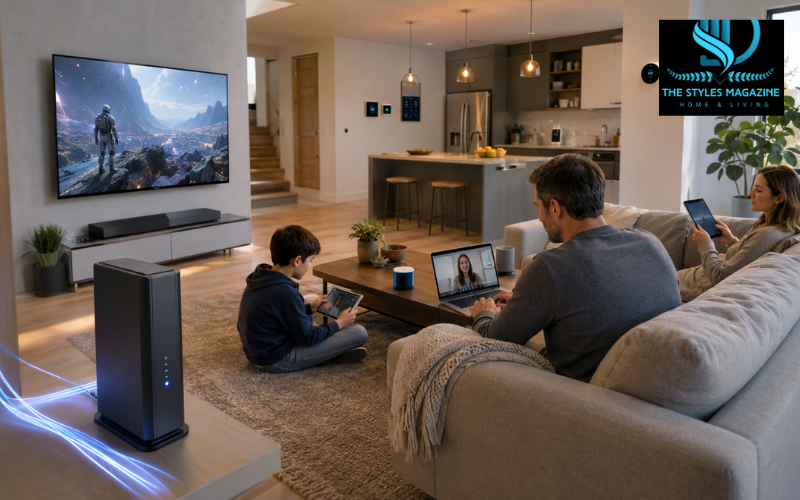
A household today typically has far more devices competing for bandwidth than it did even five years ago, phones, laptops, smart speakers, streaming boxes, security cameras, sometimes all running at once. That shift alone explains a lot about why so many households are moving away from cable and DSL toward fiber.
For households across Houston, where new construction and growing neighborhoods have brought a wave of these same connectivity demands, understanding exactly what fiber is, and why it holds up so much better under this kind of everyday load, makes clear why it’s become the preferred choice for homes that expect more from their internet than a basic connection can realistically provide.
What Is Fiber Internet?
Fiber internet delivers data as pulses of light through thin glass or plastic strands, rather than as electrical signals through copper wiring the way cable and DSL do. This fundamental difference in how the signal travels is what gives fiber its advantages in speed, consistency, and resistance to interference compared to older technologies.
Because fiber doesn’t rely on electrical signals, it isn’t affected by the same interference, degradation, and congestion issues that copper-based connections face, which is a big part of why fiber networks tend to perform more consistently day to day, especially as more devices and higher-bandwidth activities become part of normal household life.
Why Modern Homes Are Choosing Fiber Specifically
Understanding what fiber actually is only explains part of the shift. Here’s what’s actually driving households to prefer it over cable or DSL right now.
1. Homes Now Run More Connected Devices at Once
A modern household routinely runs smart thermostats, video doorbells, streaming devices, and multiple personal devices simultaneously, all competing for the same bandwidth. Older internet technologies weren’t built with this level of simultaneous demand in mind, and it shows in slower performance once several devices are active at the same time. Fiber’s higher capacity handles this kind of concurrent, everyday load without the noticeable slowdown that a strained cable connection often produces.
2. Working From Home Has Made Upload Speed Genuinely Important
According to the Federal Communications Commission, the agency raised its national benchmark for high-speed fixed broadband to 100 Mbps download and 20 Mbps upload in March 2024, a four-fold increase from the 25/3 Mbps standard it had used since 2015, citing changing consumer usage patterns as a key factor behind the update.
Video calls, cloud file uploads, and remote access to work systems all depend on upload speed just as much as download speed, something older internet plans were never really designed around. Fiber commonly offers symmetrical speeds, meaning uploads perform as well as downloads, which directly addresses this shift in how people actually use their home internet during the workday. This matters considerably more now that remote and hybrid work have become a permanent part of many households’ routines.
3. Streaming Quality Depends on More Consistent Bandwidth
Multiple household members streaming in 4K simultaneously requires sustained bandwidth that doesn’t waver, and cable connections shared across a neighborhood can slow down noticeably during peak evening hours when everyone is home and streaming at once. Fiber connections are typically structured to avoid this kind of shared congestion, maintaining more consistent speeds during exactly the hours households actually need them most. This reliability during peak use is one of the most noticeable differences households report after switching.
4. Smart Home Devices Have Multiplied Bandwidth Demands
The typical connected household now manages a meaningful number of smart devices running continuously in the background, each one adding a small but constant draw on available bandwidth. A network that struggles under this cumulative load can cause noticeable lag even for a household’s primary streaming or work activities. Fiber’s higher overall capacity absorbs this background demand far more comfortably than older technologies built for a much lighter device load.
5. Reliability Has Become Non-Negotiable for Many Households
As more essential activities move online, from banking to healthcare appointments to schoolwork, an unreliable connection has become a bigger daily disruption than it used to be. Fiber’s resistance to the interference and degradation that affect copper-based connections translates into fewer dropped calls and fewer frustrating outages. For households where reliable internet has become a genuine necessity rather than a convenience, this consistency is often the deciding factor.
Choosing the Right Fiber Provider
Not every provider offering fiber actually delivers the same real-world performance, even when advertised speeds look similar on paper. Factors like network congestion, customer support quality, and whether speeds hold up consistently during peak hours can vary considerably between providers serving the same area.
It’s worth checking a provider’s stated reliability figures and asking directly about symmetrical upload speeds, since these details matter more day to day than the headline download number most plans lead with. A provider transparent about these specifics upfront is generally a better sign than one that only advertises a single top speed. For households researching fiber internet in Houston, checking availability and comparing these specifics directly is a more useful step than assuming any provider offering fiber performs identically.
Frontier is one option available in parts of Houston, offering symmetrical speeds up to 7 Gbps and a stated 99.9% reliability across its fiber network for households whose address qualifies.
What to Ask Before Committing to a Planfiber
Beyond checking availability, a few direct questions help a household choose the right plan rather than defaulting to whichever one is listed first. It’s worth asking how speeds are affected during peak evening hours specifically, since that’s when a household’s actual bandwidth needs are highest.
It’s also worth confirming whether installation is self-service or requires a technician visit, and how long service typically takes to activate once ordered. Getting clear answers to these questions upfront avoids surprises during the first few weeks after switching, when a household is still getting used to a new connection.
What Switching to Fiber Actually Looks Like
Moving from a cable or DSL connection to fiber typically involves either a straightforward self-installation or a scheduled visit from a technician, and most providers keep existing service active until the new connection is confirmed working. This means the transition rarely involves an extended period without internet access, which is often one of the bigger hesitations households have before making the switch.
Final Thoughts
Fiber internet has become the preferred choice for modern homes because the way households actually use the internet has changed considerably, more devices, more simultaneous streaming, more remote work, and a much lower tolerance for unreliable connections. Choosing a plan sized to actual household use, and taking a few minutes to prepare before switching, is what turns this shift from a general trend into a smooth, practical upgrade rather than a stressful one.
Enjoyed it? Find more exclusive content on The Styles Magazine.