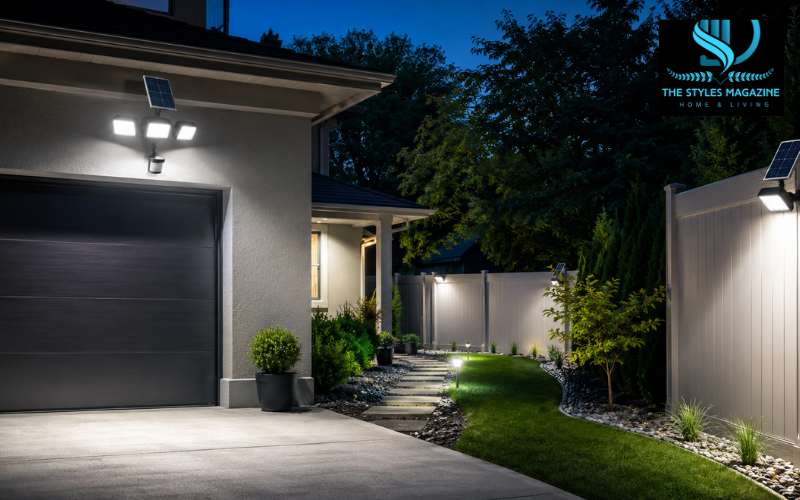
Solar flood lights are outdoor lighting fixtures that collect energy from sunlight during the day and use it to produce light after dark. Each unit normally includes a small solar panel, a rechargeable battery, LED bulbs, and a controller. The solar panel changes sunlight into electricity, the battery stores that energy, and the LEDs use it at night. This basic design allows the light to work without being connected to household wiring. Solar photovoltaic cells produce direct-current electricity from sunlight, while batteries make that energy available when the sun is no longer shining.
People install solar flood lights around driveways, garages, backyards, gates, paths, sheds, and parking spaces. They improve visibility and may discourage unwanted activity. However, product photos can be misleading. Brightness, runtime, weather resistance, panel position, and mounting angle all affect performance.
Quick Guide to Solar Flood Lights
| Feature | Best Choice | Why It Matters |
| Brightness | 250–500 lumens for paths; 1,000–2,500 lumens for large areas | Determines how much space the light can illuminate |
| Lighting mode | Motion, dusk-to-dawn, or dim-to-bright | Controls runtime and battery use |
| Weather rating | IP65 or higher | Protects the fixture from dust and rain |
| Solar panel | Large, adjustable monocrystalline panel | Supports faster and more reliable charging |
| Battery | Higher-capacity or replaceable battery | Helps the light operate longer at night |
| Lamp design | Adjustable multi-head fixture | Provides wider and more flexible coverage |
| Installation area | Direct sunlight with minimal shade | Improves daily charging and nighttime performance |
How Solar Flood Lights Work
During daylight hours, the solar panel absorbs sunlight and produces electricity. That electricity passes through a small controller and charges the internal battery. At night, a light sensor detects the darker conditions and allows the stored energy to power the LEDs. The same cycle begins again the next morning.
Energy collection depends on panel size, sunlight strength, and how long the panel remains unshaded. Clouds may not stop charging completely, but they usually reduce it. A light may therefore run for fewer hours after a dull winter day than after a bright summer day.
Motion-activated lights stay off or operate at a low level until movement is detected. Continuous models switch on at dusk and remain on until the battery runs low or daylight returns. Motion operation usually saves more energy, while continuous lighting provides steady visibility.
Main Benefits of Outdoor Solar Flood Lights
The greatest advantage of outdoor solar flood lights is simple installation. Because they do not need a mains power cable, there is usually no need to dig a trench, add an outdoor socket, or hire an electrician for a basic wall-mounted unit. This makes them useful in distant corners of a property where wired lighting would be difficult or expensive.
They use stored solar energy rather than household electricity, which can reduce ongoing costs. However, manufacturing, batteries, and disposal still have environmental effects. Their value is strongest when the fixture is durable and remains useful for years.
Solar lighting improves visibility around steps, entrances, gates, and parking spaces. It should support security, not replace locks, cameras, or alarms. Poor aiming can create glare and disturb nearby homes.
Types of Solar Flood Lights
Solar flood lights with motion sensor controls are popular for doors, garages, fences, and side passages. They provide stronger light when a person, vehicle, or animal enters the detection area. Dusk-to-dawn models are designed to remain on throughout the night, usually at a moderate output to preserve battery power.
Dim-to-bright lights combine both approaches. They stay on at a low level after sunset, then become brighter when motion is detected. This mode can provide gentle background lighting while keeping enough stored energy for brighter security lighting when needed.
Integrated products place the panel above the lamp, so both must share one position. Separate-panel designs use a cable, allowing the panel to face the sun while the lamp covers a shaded doorway. Decorative models focus on appearance, while high-powered solar flood lights use larger panels, batteries, and heads.
Choosing the Right Brightness and Coverage
Brightness is measured in lumens, not by the number of LED chips or the watt-equivalent language used in some listings. A lumen measures light output, while watts describe electrical power use. For LED products, comparing lumens is the clearer way to judge brightness.
As a practical starting point, around 250 to 500 lumens may be enough for steps, short paths, and decorative areas. Patios, entrances, and small gardens often need a medium output. Driveways, larger yards, and security areas may require roughly 1,000 to 2,500 lumens or more, depending on the beam shape, mounting height, and size of the space.
A wide beam covers more space but may look less intense, while a narrow beam concentrates light. Adjustable heads can cover several directions. Treat unusually high advertised lumen figures carefully, especially when no testing details are provided.
Solar Flood Lights with Motion Sensor
A motion sensor helps conserve battery power by using full brightness only when it is needed. Before buying, check the stated detection distance and angle, but remember that real performance can change with mounting height, weather, movement direction, and nearby objects. A person walking across the sensor’s field is often easier to detect than someone moving directly toward it.
Useful controls include sensitivity, lighting duration, and mode selection. Good positions include garage doors, gates, side walls, and sheds. Aim the sensor toward the route people are expected to cross.
Moving branches, passing traffic, pets, heating vents, and poorly chosen angles can cause unwanted activation. If false triggers continue, lower the sensitivity, change the direction, remove nearby obstructions, or move the light farther from a road.
Solar Flood Lights That Stay On All Night
Solar flood lights that stay on all night use a dusk-to-dawn controller. They switch on when natural light falls below a set level and turn off after sunrise. Unlike motion-only lights, they use energy continuously, so they need a suitable balance of panel size, battery capacity, brightness, and expected runtime.
Many all-night products reduce output after several hours. This can be sensible: moderate light lasting through the night may be more useful than maximum brightness that quickly drains the battery.
Cloudy weather, shade, short winter days, dirt on the panel, and an aging battery can reduce overnight performance. Continuous lighting is most useful for entrances, signs, parking areas, and paths that need steady visibility. For a quiet side yard or rarely used gate, a motion or dim-to-bright model may provide better battery life.
High-Powered and Brightest Solar Flood Lights
High-powered models usually have a larger solar panel, a higher-capacity battery, stronger LED output, and several adjustable lamp heads. These features can improve coverage, but they also make the fixture larger and often more expensive. A separate solar panel is especially useful because it can be placed in direct sunlight while the lamp covers a darker area.
The brightest solar flood lights with motion sensor controls are not always best for a home. Usable illumination depends on direction, not only total lumens. Even driveway coverage may be more helpful than one harsh bright spot. Emitted lumens also do not show whether light reaches the intended area.
Choose a high-output light when the area is genuinely large or when the fixture must be mounted high. For a narrow path, doorway, or small patio, lower brightness with better aiming can give a more comfortable result and reduce glare.
Weather Resistance and Outdoor Durability
An IP rating describes how well an enclosure resists the entry of solids and water. The first number relates to solid objects such as dust, while the second relates to moisture. IP65 is commonly suitable for exposed outdoor lighting because it offers strong dust protection and resistance to water jets. IP67 provides greater water protection and includes temporary immersion under defined test conditions.
An IP rating does not guarantee overall durability. Seals, cable entries, switches, brackets, and panel frames also matter. Look for UV-resistant housing, coated hardware, sealed connections, and secure mounts.
For wet gardens, low mounting positions, or areas exposed to wind-driven rain, stronger protection is valuable. Coastal locations may also require corrosion-resistant fasteners. Weatherproof should never be read as permission to place a light underwater or in a location outside the conditions stated by the manufacturer.
Solar Panel and Battery Performance
Monocrystalline solar panels are common because they can produce useful power from a relatively small surface area. The U.S. Department of Energy reports that monocrystalline silicon is now the dominant material in global solar shipments and is widely used because of its strong efficiency and reliability.
Battery capacity affects runtime, but it is not the whole story. A large battery with a small panel may not recharge fully, while a powerful lamp can drain energy quickly. Good designs balance panel output, battery size, and lighting mode.
Direct sunlight gives the strongest charging. Advertised charging times can change with weather and placement. Replaceable batteries may extend product life when the correct type is available. Sealed batteries can improve weather protection but may make repair difficult.
Best Places to Install Solar Flood Lights
Driveways benefit from wide, downward-facing coverage that avoids nearby windows. Seating areas need softer light, while paths and steps should be illuminated evenly to avoid distracting bright and dark patches.
Fences, gates, sheds, and garages are also practical locations, especially when no power connection is nearby. A separate-panel fixture can light the shaded side of a building while its panel is installed on a sunny roof edge or fence post.
White outdoor solar flood lights can blend with pale walls, modern fences, and light-colored trim, but fixture color should not be confused with light color. Aim the lamp downward and away from neighboring properties. Responsible outdoor-lighting guidance recommends directing light only where it is needed and reducing glare and spill beyond the target area.
Installation and Placement Tips
Start by watching the proposed panel location during the day. A place that looks sunny in the morning may be shaded by a roof, wall, or tree later. Give the panel the clearest possible view of the sky and follow the manufacturer’s recommended direction and angle for your region.
Mount the lamp high enough to spread light, but not so high that it becomes difficult to adjust or clean. Pointing it slightly downward usually improves useful coverage and limits glare. Motion sensors should face the expected travel path and remain clear of leaves, flags, vents, and moving branches.
Before drilling, charge the unit and test the position for several nights. Check coverage, sensor response, and runtime after sunny and cloudy days. Move the panel or lamp if needed.
How to Compare the Best Solar Flood Lights
The best solar flood lights are not simply the products with the highest lumen claim. Compare realistic coverage, panel size, battery capacity, operating modes, sensor controls, IP rating, mounting hardware, cable length for separate panels, and the quality of the warranty.
Look for clear brightness and runtime test details. Separate runtimes for low and high modes are more useful than an unexplained “all-night” promise. LED count alone is weak evidence of performance.
Consider repair and replacement options. A light with a replaceable battery, available mounting parts, and responsive support may offer better long-term value than a cheaper sealed unit. Price matters, but expected service life matters more.
Buying Solar Flood Lights on Amazon and Other Marketplaces
When searching for solar flood lights on Amazon or another marketplace, read the full listing rather than relying on the title image. Check whether the price is for one lamp or a multi-pack, whether the panel is included, and whether the stated dimensions fit the planned mounting surface.
Read recent verified reviews, especially lower-rated comments. Watch for repeated reports of battery failure, water entry, weak winter performance, broken brackets, or inaccurate brightness. Buyer photos can reveal the fixture’s real size.
Compare the same model across listings because specifications can be copied incorrectly or changed without clear notice. Confirm the warranty, return window, seller identity, and availability of replacement parts before ordering. Avoid making a decision based only on a large discount, LED count, or an unusually high lumen number.
Common Problems and Maintenance
Weak light is often caused by poor charging rather than an LED fault. Clean the panel with a soft damp cloth, remove leaves or bird dirt, and check whether new shade has appeared as plants grow. A short runtime can also point to an aging battery or a mode that uses more power than expected.
If the motion sensor does not respond, confirm that the light is in darkness, the battery is charged, and the selected mode uses motion detection. Then adjust the angle and test by walking across the detection zone. For frequent false activation, reduce sensitivity or redirect the sensor away from traffic and moving vegetation.
Inspect seals, screws, cables, and brackets several times a year. Stop using the unit if water appears inside, the battery swells, wiring is damaged, or the housing cracks.
Conclusion
Choosing reliable solar flood lights requires more than selecting the brightest-looking product. Start with the size and purpose of the area, then compare usable brightness, beam coverage, battery capacity, solar-panel size, lighting modes, sensor controls, and weather resistance.
Motion lights are often suitable for security and occasional use, while dusk-to-dawn models work better where steady overnight visibility is needed. High-powered units make sense for broad driveways and large yards, but smaller spaces usually benefit from moderate light aimed carefully.
The best result comes from matching the fixture to the location and giving its solar panel strong daily sunlight. A well-positioned, weather-resistant light with honest specifications will usually be more dependable than an oversized model chosen only for its advertised lumen figure.
Frequently Asked Questions
Do Solar Flood Lights Work During Cloudy Weather?
Solar flood lights can still charge during cloudy weather, but they collect less energy. Their brightness or runtime may decrease if the panel receives limited sunlight for several days.
How Many Lumens Should Solar Flood Lights Have?
Around 250–500 lumens may suit pathways and small areas. Driveways, garages, yards, and security spaces often need approximately 1,000–2,500 lumens, depending on coverage and mounting height.
Can Solar Flood Lights Stay On All Night?
Dusk-to-dawn solar flood lights can operate throughout the night when fully charged. Actual runtime depends on battery capacity, panel size, brightness level, weather conditions, and daily sunlight exposure.
Where Should Solar Flood Lights Be Installed?
Install them near driveways, gates, garages, paths, sheds, or backyard areas. The solar panel should receive several hours of direct sunlight and remain clear of trees, roofs, and shadows.
Are Solar Flood Lights Waterproof?
Most outdoor models are weather-resistant rather than completely waterproof. An IP65 rating protects against dust and rain, while IP67 offers stronger water protection for wetter or more exposed locations.
Enjoyed it? Find more exclusive content on The Styles Magazine.
Disclaimer: This article provides general information about solar flood lights. Product brightness, runtime, weather resistance, and performance may vary, so always check the manufacturer’s specifications and installation instructions before purchasing.