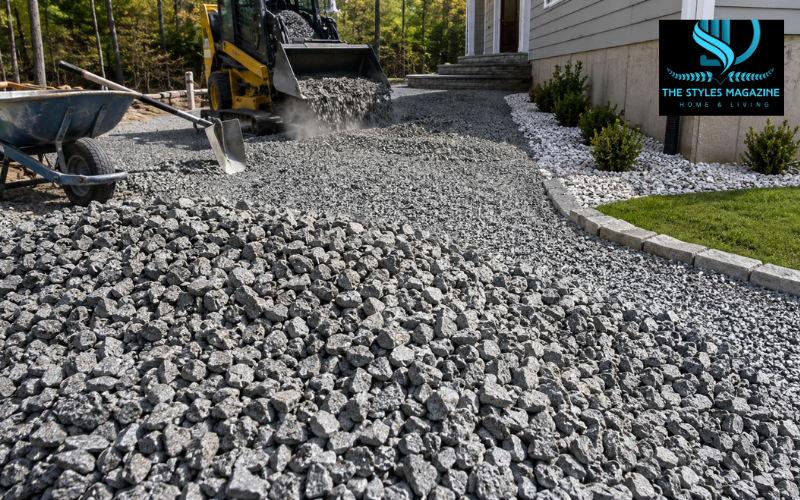
57 stone, also written as #57 stone, is a clean, crushed aggregate used in construction, drainage, driveways, concrete, and landscaping. Quarries produce it by crushing larger pieces of rock and passing the material through screens. These screens separate the stone according to an approved size range.
Most pieces are roughly ½ inch to 1 inch across, although a load may contain some smaller or slightly larger pieces. The stones normally have rough, angular edges rather than the smooth surface found on river gravel. These sharp edges help the pieces fit together and provide a stable layer.
One of the main advantages of 57 stone is its open structure. A properly graded load contains very little stone dust or fine material, so small spaces remain between the stones. Water can move through these spaces instead of collecting on the surface. This makes the material useful in French drains, foundation drainage, pipe trenches, permeable pavement systems, and other areas where water must flow freely. Federal Highway Administration guidance describes open-graded aggregates as free-draining materials with low fine content and useful strength.
This guide explains why the material is called 57 stone, its actual size, common rock types, practical uses, installation methods, prices, and what to check before ordering a load.
57 Stone Quick Guide
| Feature | Quick Information |
| Typical size | About ½ inch to 1 inch |
| Shape | Angular and irregular |
| Common materials | Limestone, granite, trap rock, or recycled concrete |
| Contains fines | Usually very little or none |
| Main benefit | Strong support with excellent drainage |
| Popular uses | Driveways, French drains, foundations, concrete, and landscaping |
| How it is sold | By the ton, cubic yard, or bag |
| Buying tip | Confirm size, rock type, cleanliness, delivery fee, and coverage |
Important Buying Checklist
- Confirm that the product is genuine No. 57 graded stone.
- Ask whether it is washed and free from stone dust.
- Check whether the stone is limestone, granite, or recycled concrete.
- Calculate the required depth and total project area.
- Request the complete price, including delivery and taxes.
- Make sure the delivery truck can safely access the unloading area.
Why Is It Called 57 Stone?
The number “57” does not mean every piece is exactly 0.57 inches wide. It is an aggregate grading designation connected to the screens, or sieves, used to sort crushed rock.
Under a commonly used ASTM No. 57 gradation, all the material must pass through a 1½-inch sieve, while 95 to 100 percent passes through a 1-inch sieve. Between 25 and 60 percent passes through a ½-inch sieve, and only a small amount is allowed to pass through the much smaller No. 4 and No. 8 sieves. This grading creates a mixture of related stone sizes rather than one exact particle size.
Some references also describe #57 as a combined grading made from related aggregate sizes, including No. 5 and No. 7 stone. The important point for homeowners is that “57” identifies a recognized grading range, not a single measurement.
Names and local specifications may differ between states, quarries, and suppliers. A product sold as 57 stone may also be called ¾-inch stone, No. 57 aggregate, clean stone, drainage stone, or 2B stone in certain regions. Before ordering, ask the seller for the actual size range and whether the material is washed, crushed, and free of fines.
57 Stone Size, Shape, and Appearance
The average 57 stone size is commonly described as about ½ inch to 1 inch. Many pieces are close to ¾ inch, making them similar in size to nickels or quarters. Because the stone is screened rather than individually measured, every piece will not look identical.
A formal No. 57 grading can contain particles up to approximately 1½ inches, although almost all of the load normally passes the 1-inch screen. It may also contain a limited amount of material smaller than ½ inch. This is why one supplier may advertise ½-inch-to-1-inch stone while another calls the same grading ¾-inch stone.
Crushed 57 stone normally has jagged edges and flat or irregular surfaces. This differs from pea gravel and river rock, which have been naturally rounded by water. Rounded gravel tends to roll and move under traffic, while angular stone offers more resistance because the pieces press against one another.
Appearance depends on the source rock. The material may be gray, blue-gray, tan, cream, white, brown, or a mixture of several shades. Freshly crushed stone may also appear brighter than older material that has been exposed to rain, dust, and sunlight.
Common Types of 57 Stone
Granite is one of the hardest forms of 57 stone. It is normally gray, silver, or speckled and holds up well under vehicle traffic and changing weather. Its strength makes it suitable for driveways, construction bases, drainage areas, and long-term landscape features.
Limestone 57 stone is often cream, white, tan, or light gray. It is widely available in regions with limestone quarries and is commonly used for concrete, drainage, retaining-wall backfill, and driveways. Fresh limestone may leave a light chalky residue, especially when it is dry or newly crushed.
Trap rock, bluestone, and other dense regional rocks may also be processed into No. 57 grading. Their colors and prices depend heavily on local geology. A stone that is inexpensive near the quarry can become costly when it must be transported over a long distance.
Recycled concrete is sometimes crushed and screened to a similar size. It can be useful for certain base and drainage projects when it meets the required grading. However, it may contain small traces of old mortar or other approved recycled material, so it may not have the clean, consistent appearance wanted for decorative landscaping. Some recycled products are specifically sold as meeting ASTM C33 No. 57 grading.
Key Properties and Performance Benefits
The most recognizable feature of 57 stone is its angular shape. When spread and settled, the rough pieces turn into stable positions and resist movement better than smooth gravel. This property allows the material to support loads in many residential and construction applications.
Another major benefit is drainage. Properly graded 57 stone has very few fine particles filling the spaces between the larger pieces. Water, and some air, can move through the layer with relatively little resistance. This is why No. 57 stone is commonly specified for open-graded drainage systems and permeable pavement bases. FHWA guidance notes that ASTM No. 57 or similar stone is often used in open-graded base reservoirs made mainly from ½-inch-to-1-inch crushed stone.
The material is often called “self-compacting,” but that phrase can be misleading. It settles and nests into place more easily than many mixed-size aggregates, and traditional soil-density testing is not always suitable for it. However, self-compacting does not mean that installation requires no care.
For structural work, stone may still need to be placed in controlled layers and lightly compacted or settled with suitable equipment. A City of Boston specification, for example, directs contractors to install washed No. 57 stone in lifts no deeper than six inches and lightly compact each layer.
The Best Uses for 57 Stone
57 stone works well in projects that need a combination of strength and drainage. Common uses include driveway layers, parking areas, French drains, foundation drainage, concrete mixes, pipe bedding, utility trenches, retaining-wall backfill, and permeable pavement systems.
It can also be used around patios, sheds, walkways, garden borders, and outdoor drainage features. In landscaping, the angular texture creates a more structured appearance than rounded gravel. It can help reduce muddy ground, but it should not be treated as a complete solution for serious erosion or standing-water problems.
The right application depends on what lies below and above the stone. For example, a drainage trench may require washed stone and filter fabric, while a driveway may need a dense, compactable base under the 57 stone. Concrete work must follow the mix design rather than using an estimated amount of aggregate.
Construction suppliers also list No. 57 stone for asphalt, ready-mix concrete, stone driveways, mechanically stabilized earth wall backfill, and areas below artificial turf.
Using 57 Stone for Driveways and Parking Areas
57 stone can create a firm, free-draining driveway surface, particularly on ground that has already been properly prepared. Its angular pieces provide better grip and stability than rounded river gravel, and rainwater can pass through the open spaces.
However, it may not be the best material to place directly over soft soil. Because it contains few fines, it does not form the tightly packed, nearly solid layer created by crusher run or dense-graded aggregate. On weak or wet ground, individual stones can press into the soil, spread outward, or form ruts.
A more reliable driveway usually begins with excavation and a stable subgrade. Geotextile fabric may be installed where soil separation is needed. A compactable base such as crusher run is then placed and compacted before the cleaner 57 stone is added as a drainage or surface layer.
Edging can help keep loose stone from spreading into lawns and garden areas. Even a well-built stone driveway may need occasional raking, grading, or replacement material, especially near turns, slopes, gates, and areas exposed to frequent tire movement.
For heavily used parking areas, steep driveways, or locations supporting large trucks, obtain advice based on the soil, drainage, and expected load rather than relying on a general depth recommendation.
Drainage, Foundations, and Construction Applications
The open spaces inside a 57 stone layer give water a path to travel. In a French drain, washed stone is normally placed around a perforated pipe so water can reach the pipe without becoming trapped in compacted soil. The drain must still have a suitable outlet and enough slope to move water away.
Around foundations and basement walls, the stone may be used as drainage backfill. It can reduce the amount of water held directly against the structure, but it does not replace waterproofing, drainage boards, footing drains, or proper surface grading.
No. 57 stone is also used for pipe bedding and utility trenches because it can be placed around pipes while providing drainage and support. The required material and placement method depend on the pipe type, soil, local code, and engineer’s plan.
Beneath slabs, patios, retaining walls, and permeable surfaces, the stone layer must match the complete design. A free-draining aggregate may perform well in one part of a system but may be unsuitable as the only base where a tightly compacted layer is needed.
Public construction specifications can require clean, washed, fully crushed stone, controlled abrasion resistance, specific fractured faces, geotextile, and planned compaction. These requirements show why structural and municipal work should follow approved drawings rather than general online instructions.
White 57 Stone for Landscaping
The term white 57 stone usually refers to light-colored limestone, marble, or another decorative crushed rock screened to a size similar to No. 57 aggregate. The exact stone varies by supplier, so “white” may mean bright white, cream, pale gray, or a mixed natural shade.
This material is commonly placed around flower beds, trees, walkways, mailboxes, borders, and outdoor features. Its light color can make a landscape look cleaner and brighter, and it creates a strong contrast with dark mulch, green plants, or brick edging.
There are also practical concerns. Limestone may create dust when first delivered, while bright stone can show dirt, leaves, and stains more easily than darker gravel. Weed seeds may collect between stones over time, even when fabric is installed below. Light stone can also reflect strong sunlight and become hot in exposed areas.
When searching for white 57 stone near me, ask whether the product is truly No. 57 grading or simply a decorative stone of a similar average size. Request a sample or view the material in person because online photos may not show its actual color when wet and dry.
How to Install 57 Stone Correctly
Begin by identifying the purpose of the stone. A decorative border, driveway, drainage trench, and structural base all need different preparation and depths. Mark the area and check where water should flow before excavation begins.
Remove grass, roots, loose organic soil, mud, and debris. The ground below should be firm enough for the intended use. If the stone will sit over soft soil, a suitable geotextile can help keep the aggregate and soil from mixing. Fabric must be selected for the project; ordinary landscape fabric is not automatically suitable for structural or drainage work.
Spread the material in an even layer. Deep construction fills are safer and more consistent when installed in smaller lifts rather than dumping the full depth at once. Settle or lightly compact each layer when required by the project specification. The Boston No. 57 stone specification also calls for a firm, stable subgrade without standing water, mud, or muck before placement.
Use sturdy edging along exposed paths and driveways. For drainage systems, prevent soil and sediment from entering the open stone because fine material can slowly block the spaces that allow water to flow.
How Much 57 Stone Do You Need?
Measure the length and width of the area in feet, then decide the required depth. Convert the depth from inches to feet by dividing it by 12. Multiply length by width by depth to find cubic feet. Divide the result by 27 to convert cubic feet into cubic yards.
For example, an area measuring 20 feet long and 10 feet wide at a depth of 4 inches requires about 2.47 cubic yards before adding extra material:
20 × 10 × 0.333 ÷ 27 = approximately 2.47 cubic yards
The number of tons per cubic yard varies with the rock type, moisture, grading, and amount of open space. Do not rely on one universal conversion. Give the supplier your measurements and planned depth, and ask for its current coverage or density figure.
It is sensible to allow a small extra amount for uneven ground, settlement, spreading loss, and final grading. Avoid adding a large waste allowance without reason, because unused stone is heavy and difficult to remove.
57 Stone Price per Ton
There is no single national 57 stone price. The amount you pay depends on the source rock, quarry location, local supply, order size, delivery distance, and whether the stone is washed or decorative.
Ordinary local limestone is often less expensive than imported white stone, granite, or specially selected decorative aggregate. Bulk material from a quarry or landscape yard usually offers a lower unit cost than small bags, but delivery charges and minimum-load rules can change the final total.
Current supplier listings show how local prices can differ. One landscape supplier lists bulk No. 57 limestone at $38.50 per ton, but this is a location-specific example rather than a national average.
The final 57 stone price per ton may include separate charges for delivery, fuel, small-load service, spreading, grading, fabric, or installation. Some sellers price by the cubic yard instead of the ton. Request a written total that shows the material quantity, delivery fee, taxes, and any minimum order.
Where to Find 57 Stone for Sale
The best places to find 57 stone for sale are local quarries, aggregate yards, landscape-material suppliers, concrete companies, masonry suppliers, and construction-material dealers. A local quarry often provides the clearest information about the rock type, grading, and bulk delivery options.
When searching for 57 stone near me, include your city or ZIP code and try alternative names such as “No. 57 aggregate,” “¾-inch clean stone,” “57 limestone,” “2B stone,” or “drainage stone.” Ask whether the quoted product contains fines, because some sellers use similar names for different materials.
Home-improvement retailers may carry bagged or bulk options, although availability is regional. At the time of checking, Home Depot listed a 1,000-pound bag of limestone described as 57 stone or ¾-inch rock for concrete, landscaping, and other construction uses. Its broader online selection also includes crushed and bulk landscape stone, but products and prices depend on the selected store and delivery area.
Before buying, confirm the material type, actual size range, cleanliness, minimum order, delivery method, truck access needs, and total price. Choosing only the lowest quote can lead to unexpected delivery charges or receiving a stone that does not match the project.
Conclusion: Choosing the Right 57 Stone for Your Project
57 stone is a useful crushed aggregate because it combines angular strength with open spaces that allow water to drain. Its typical pieces are around ½ inch to 1 inch, but the number identifies a grading standard rather than one exact stone size.
Granite, limestone, trap rock, and recycled concrete versions can differ in color, hardness, price, and appearance. The best choice depends on whether the stone will be used for a driveway, French drain, foundation, concrete mix, trench, retaining wall, or decorative landscape area.
Good results depend on more than the aggregate itself. Prepare a stable base, use geotextile where appropriate, control the installation depth, provide edging when needed, and follow local engineering or building requirements for structural work.
Before ordering, compare the full delivered price, verify the supplier’s product specification, and calculate the required quantity carefully. These simple checks will help you buy the right 57 stone load without paying for the wrong material or unnecessary excess.
Frequently Asked Questions
What Is 57 Stone Used For?
57 stone is commonly used for driveways, parking areas, French drains, foundation drainage, pipe bedding, concrete mixes, retaining-wall backfill, walkways, and decorative landscaping.
Why Is It Called 57 Stone?
The number 57 refers to an aggregate grading designation based on the sieve openings used to sort crushed rock. It does not mean the stones measure exactly 0.57 inches.
What Is The Standard 57 Stone Size?
Most 57 stone pieces measure approximately ½ inch to 1 inch. Some loads may contain slightly smaller or larger pieces depending on the quarry and local grading requirements.
Is 57 Stone Good For Driveways?
Yes, 57 stone can provide a strong, well-draining driveway surface. However, soft soil may require geotextile fabric and a compactable base beneath the stone to prevent sinking and rutting.
How Much Does 57 Stone Cost Per Ton?
The price varies by material, location, order size, and delivery distance. Local limestone is often cheaper than granite or decorative white stone, so always request a complete delivered quote.
Enjoyed it? Find more exclusive content on The Styles Magazine.
Disclaimer: This article provides general information only. Product grading, prices, installation requirements, and building rules vary by location. Confirm project details with a local supplier, contractor, or engineer before purchasing or installing 57 stone.