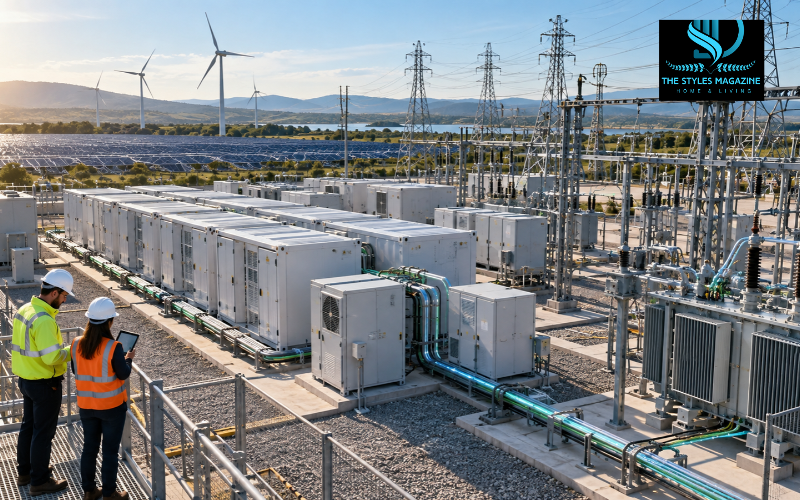
Control performance must be evaluated alongside protection settings, available energy and network strength. This is a familiar challenge in grid-support projects, where decisions made early can restrict operation for years. Failures usually develop at the interface between otherwise competent teams. Reviewing the actual service environment is often more revealing than collecting another impressive efficiency figure.
Start With Network Strength
A strong transmission system and a remote, converter-dominated feeder present different control problems. The engineering team needs short-circuit information, protection settings and operating scenarios before selecting response parameters. Grid-forming functions must be evaluated against the connection agreement; a label on the datasheet is not a substitute for a validated network study.
Define Control Responsibilities
Battery converters, plant controllers and protection relays each influence the response to a disturbance. Their boundaries should be shown in a control architecture with clear priorities for voltage support, frequency response and normal energy dispatch. When several vendors use different assumptions, the combined system may behave differently from any individual product demonstration.
For a broader technical starting point, compare grid forming battery storage with the conditions actually documented in the proposed project. Control performance must be evaluated alongside protection settings, available energy and network strength.
Consider Other Generation
The behavior of a battery changes when it interacts with solar inverters, diesel generators or nearby converter-connected projects. Controls that work alone may require retuning in a mixed plant. Studies should cover simultaneous transitions and credible outages. Owners also need a clear account of which device establishes the reference during any authorized islanded operation.
Grid-forming capability is not a promise that every system can black-start a whole site.
Make Fault Isolation Clear
A storage plant can include multiple converter blocks, transformers, cables and shared auxiliary services. Operators need to know whether a disturbance should trip one section or the whole installation. Protection selectivity and access arrangements affect availability as much as individual component reliability. Emergency and maintenance procedures should follow the final electrical topology.
Check the Point of Connection
The electrical connection determines how much value the battery can deliver. Import and export restrictions, transformer capacity, protective relays and meter placement can constrain otherwise capable equipment. Some projects require updated grid studies when storage is added to an existing solar plant. Engineers should trace where energy is measured and where a fault must be isolated.
The design review for grid forming battery storage should be supported by evidence tied to the delivered configuration. Request project-specific dynamic studies and witness the tests required by the operator.
Test Remote Commands
Commissioning should confirm that supervisory commands reach the intended equipment and that feedback reports the resulting state accurately. Include plausible loss-of-communications scenarios. The test record must distinguish an accepted command from a completed field response. This discipline becomes important when plants are controlled from distant operations centers.
Readers comparing specifications can review information about grid forming battery storage as context, then verify site-specific claims with drawings, tests and commercial terms.
Enjoyed it? Find more exclusive content on The Styles Magazine.