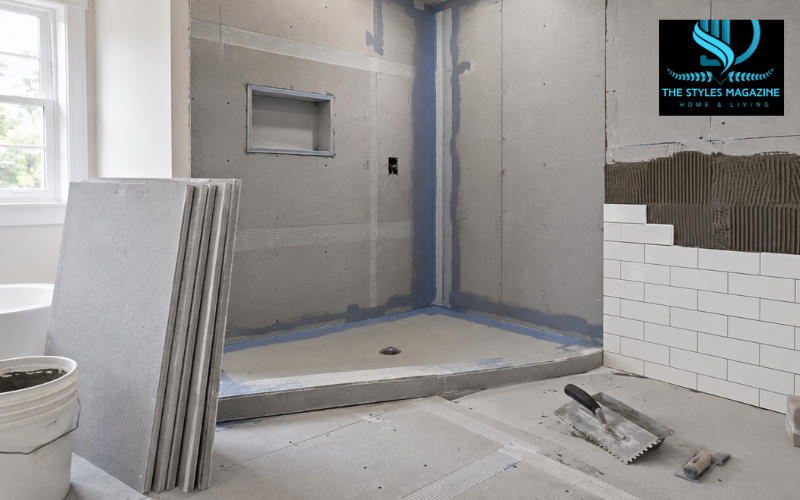
Cement board is a hard, durable panel used to create a stable base for tile and other approved finishes. Made from cement-based materials with reinforcing mesh or fibers, it does not soften or swell as easily as ordinary drywall when exposed to moisture. This makes it useful in bathrooms, kitchens, laundry rooms, and other demanding areas.
Cement board sits behind wall tile, beneath floor tile, or under approved countertop finishes. Its firm, textured face gives thin-set mortar a dependable surface to grip. Products such as HardieBacker, USG Durock, and PermaBASE are sold for a range of interior and, when specifically approved, exterior applications.
This guide explains cement board sizes, thicknesses, common uses, bathroom waterproofing, fire resistance, installation, cutting, leading brands, and current buying considerations.
Cement Board Quick Guide
| Feature | Quick Information |
| Main use | Tile underlayment for walls, floors, and countertops |
| Common thicknesses | 1/4 inch for floors and 1/2 inch for walls |
| Common sheet size | 3×5 feet; 4×8 sheets are also available |
| Water protection | Water-resistant but usually not fully waterproof |
| Fire performance | Many products are non-combustible, but not automatically fire-rated |
| Popular brands | HardieBacker, USG Durock, and PermaBASE |
| Installation materials | Thin-set mortar, approved screws, and alkali-resistant mesh tape |
Basic Cement Board Installation Steps
- Prepare a clean, flat, and structurally sound surface.
- Measure and cut the cement board to fit.
- Apply thin-set mortar beneath floor panels.
- Fasten panels with approved cement-board screws or nails.
- Tape the joints with alkali-resistant mesh tape.
- Apply waterproofing in showers and other wet areas.
- Install tile using a compatible thin-set mortar.
What Cement Board Is and How It Is Made
Traditional cement backer board normally has a Portland-cement-based core with aggregates and reinforcing glass-fiber mesh. The exact recipe and panel design vary by manufacturer. PermaBASE, for example, describes its standard board as a Portland cement, aggregate, and fiberglass-mesh product, while USG Durock uses a cementitious core with reinforced faces and edges.
Standard drywall has a gypsum core with paper facing, which prolonged moisture can damage. Cement board is heavier and harder to cut, but it stays more stable in damp settings and supports tile better.
“Cement board” and “fiber-cement board” are often used loosely as if they mean the same thing. Traditional cement board commonly uses mesh around a cement-and-aggregate core. Fiber-cement backer board uses reinforcing fibers throughout a denser cement-based panel. Their approved uses and installation methods differ, so choose by the product instructions rather than the general name.
Key Benefits of Cement Board
The greatest benefit of cement board is its ability to remain stable in places where moisture is expected. It does not rot like wood-based panels, and quality products are designed to resist warping, delamination, and deterioration during normal use. USG describes Durock as water-durable, while James Hardie markets HardieBacker for moisture-prone rooms such as bathrooms, kitchens, and laundry spaces.
Its rigid surface also helps protect tile installations. Tile and grout are brittle, so movement in the surface below can lead to cracks. Cement board provides a more dependable bonding base for thin-set mortar than ordinary drywall or flexible wood sheathing.
Many cement boards resist mold damage better than paper-faced products. However, surface dirt and nearby materials can still support growth, so ventilation and cleaning remain important.
Some cement boards also pass ASTM E136 non-combustibility testing, but fire performance still depends on the complete tested assembly.
Main Types of Cement Board
Traditional cement backer board is the familiar mesh-reinforced panel used behind ceramic, porcelain, and stone tile. It is strong, moisture-tolerant, and suitable for floors, walls, countertops, and other applications listed by the manufacturer.
Fiber-cement backer board is usually denser and may have a smoother face. HardieBacker is a common example. It is widely used under floor tile and on tiled walls, but buyers should check the exact thickness and installation instructions because the product sold as “1/2 inch” may have a slightly different actual thickness.
Foam-core tile backers are a separate, lighter category. Some become waterproof when seams and fasteners are properly sealed, but they usually cost more than standard cement panels.
Exterior cement panels are made for approved stucco, masonry veneer, soffit, or cladding systems. Interior tile backer should not be assumed suitable outdoors, where the correct weather barrier, flashing, and fasteners are essential.
Cement Board Sizes and Thicknesses
The most common tile-backer sizes in U.S. stores are 3-by-5-foot sheets in nominal 1/4-inch and 1/2-inch thicknesses. A 3-by-5 panel is easier to carry through doorways and often fits bathroom walls with less awkward handling.
A 1/4-inch cement board is commonly used as floor underlayment because it limits height at transitions. It does not strengthen a weak floor; the structure must already meet tile requirements. Some manufacturers restrict 1/4-inch panels to floors and countertops, so they should not automatically be used on shower walls. USG, for example, says its 1/4-inch Durock panel is not for wall or ceiling applications.
Nominal 1/2-inch board is the usual choice for framed walls, shower surrounds, and tub enclosures because it provides a thicker, more rigid tile base. Larger 4×8 cement board sheets reduce seams but are heavy, awkward to move, and easier to damage during transport. Current retail selections include both 3×5 and 4×8 Durock and PermaBASE panels.
Where Cement Board Is Commonly Used
Cement board is most often installed beneath tile on floors and walls. On floors, it creates a compatible surface over a suitable plywood or OSB subfloor. On walls, it provides a firm backing for tile in showers, tub surrounds, bathroom walls, and kitchen backsplashes.
It can also support approved countertop finishes. Around fireplaces, it may serve as a base for tile or stone veneer only when the design follows required clearances. PermaBASE lists fireplaces and heat shields among its applications, while National Gypsum provides dedicated fireplace-surround guidance.
Exterior uses require more care. Certain cement panels are approved beneath stucco, thin brick, masonry veneer, or other exterior finishes. They are not interchangeable with siding, structural sheathing, or a complete weather barrier. Product data should clearly list the intended exterior use before installation begins.
Using Cement Board in a Bathroom
A cement board bathroom installation may include shower walls, tub surrounds, tiled floors, vanity backsplashes, and tiled countertop bases. These areas benefit from a panel that does not lose strength simply because it becomes damp.
The important limitation is that water-resistant does not mean waterproof. Durock, for example, is described by USG as water-durable but not waterproof. Water can pass through joints, fastener holes, corners, and the panel itself, so moisture-sensitive framing and insulation still need a correctly designed protection layer in wet areas.
Common bathroom mistakes include using drywall screws, leaving joints untreated, placing 1/4-inch floor board on walls without approval, skipping waterproofing in a shower, and failing to seal around valves or shower niches. Cement board also cannot repair a flexible or damaged subfloor; it is a tile base, not structural framing.
Good results depend on the full system, including framing, fasteners, waterproofing, mortar, tile, grout, and sealant.
Cement Board Waterproofing Requirements
Cement board waterproofing is one of the most misunderstood parts of tile work. The board may tolerate water, but most standard products do not stop water from reaching the wall cavity. A shower therefore needs a water-management method that follows the board, membrane, shower-pan, and local code requirements.
One common method is a surface-applied waterproofing membrane. This may be a liquid coating rolled or troweled over the board, or a bonded sheet membrane installed with the approved mortar. Seams, corners, fastener heads, niches, benches, drains, and pipe openings must receive the treatment required by the membrane maker. USG’s liquid membrane instructions, for example, call for prepared joints and multiple coats over rough Durock surfaces.
Another method uses a moisture barrier behind the board, draining into the tub flange or shower receptor. Placement depends on the system and local requirements. Do not combine behind-board and surface waterproofing layers unless the membrane and cement-board manufacturers approve the complete assembly.
Steam showers and specialty wet rooms have stricter requirements than ordinary residential showers, so their tested system details should be followed exactly.
Cement Board and Fire Resistance
People often search whether cement board is fireproof. A more accurate description is that many cement boards are non-combustible. For example, 1/4-inch Durock has passed ASTM E136 non-combustibility testing. That means the board itself does not contribute fuel in the same way as combustible materials.
However, a non-combustible panel does not automatically create a fire-rated wall, ceiling, or heat shield. A fire-resistance rating applies to a tested assembly with specified materials and construction details. James Hardie also states that HardieBacker is non-combustible but does not give a wall a fire rating by itself.
For fireplaces, wood stoves, ovens, or other heat-producing appliances, follow the appliance instructions and required clearances to combustible materials. Do not reduce a clearance simply by attaching cement board to wood framing unless an approved assembly specifically allows it. Local building and fire codes may also require permits or inspections.
How Cement Board Is Installed
Installation begins with a flat, clean, and structurally sound surface. On floors, the plywood or OSB must be firmly fastened and suitable for the tile load. A bed of compatible thin-set mortar is spread beneath the cement board to fill small voids and give the panel full support. The mortar is not a substitute for screws or nails; the board is fastened while the mortar is wet. James Hardie recommends mortar beneath floor panels and fasteners at 8 inches on center for its system.
Sheets are staggered as directed, with required gaps at walls, panel edges, and changes of plane. Exact spacing can vary, so the instructions printed for the chosen board should take priority.
On framed walls, panels are attached directly to properly spaced studs with approved cement-board screws or hot-dipped galvanized roofing nails. Drywall screws should not be used because they are not designed for this moisture and cement environment.
After fastening, joints are filled with the specified mortar and reinforced with alkali-resistant cement-board mesh tape before tile is installed.
Cutting, Fastening, and Finishing Cement Board
Straight cuts can often be made by scoring the face several times with a carbide-tipped scoring tool or utility knife and snapping the sheet along a straightedge. Rough edges can be cleaned with a rasp. Holes for pipes and valves may require a carbide hole saw, jigsaw, or another tool approved for the product.
Power cutting creates more dust. Cement and fiber-cement products may contain crystalline silica, which can seriously harm the lungs. OSHA requires specific dust-control methods for covered construction work, including dust collection on certain handheld saws used to cut fiber-cement board. Whenever possible, cut outdoors, use score-and-snap methods, follow the tool and board instructions, and wear suitable eye, hearing, and respiratory protection.
Fasteners should sit flush with the panel without breaking the face. Keep them the required distance from corners and edges, and follow the manufacturer’s spacing pattern. Finish joints with alkali-resistant mesh tape and thin-set mortar—not paper drywall tape or ordinary drywall compound. Before tiling, remove dust and confirm that all waterproofing steps are complete.
Leading Cement Board Brands and Product Differences
James Hardie HardieBacker is a fiber-cement backer board known for a dense, relatively smooth surface and score-and-snap installation. Current U.S. information lists a limited lifetime warranty, subject to its terms and correct installation.
USG Durock with EdgeGuard is a traditional cement board with reinforced edge performance intended to reduce crumbling and fastener spinout. It is available in several sizes and thicknesses, including 3×5 and 4×8 sheets, and current USG information describes a 30-year limited warranty for qualifying interior use.
National Gypsum PermaBASE uses reinforced EdgeTech edges and offers several related products. Standard PermaBASE is available in 1/2- and 5/8-inch thicknesses, while UltraBacker provides a 1/4-inch underlayment option. The company currently lists a lifetime limited warranty for qualifying residential interiors, 30 years for commercial interiors, and 15 years for approved exterior applications.
The best brand is the one approved for the location, finish, membrane, and framing—not simply the cheapest sheet.
Cement Board Price and Where to Buy It
Cement board price depends on thickness, sheet size, brand, region, and store inventory. Larger sheets may reduce seams, while waterproof or foam-core products usually cost more than standard backer panels.
As a current U.S. retail reference in August 2026, Home Depot listings showed 3×5 HardieBacker at about $13.40 for 1/4 inch and $17.50 for the nominal 1/2-inch panel. A 1/2-inch 4×8 Durock sheet was listed around $36. Lowe’s displayed the same approximate HardieBacker prices in recent listings, while many Durock and PermaBASE products required a store selection for local pricing. These figures can change by ZIP code, stock level, taxes, delivery, and bulk quantity.
When searching “cement board near me,” compare Home Depot, Lowe’s, tile suppliers, lumberyards, and local building-material dealers. Confirm the required thickness and undamaged stock before traveling. Budget for screws, alkali-resistant tape, mortar, waterproofing, sealant, tools, and delivery. A cheap panel is not a bargain if it is cracked, stored improperly, or wrong for the application.
Conclusion: Choosing the Right Cement Board
Choosing cement board becomes easier when the project is considered as a complete system. Use a thinner approved panel for floor underlayment when height matters, and use the wall thickness required by the manufacturer for showers, tub surrounds, and other vertical tile work. Select 4×8 cement board only when fewer seams are worth the extra weight and handling difficulty.
In wet rooms, confirm whether the chosen board is water-resistant or truly waterproof, then install the correct membrane or behind-board moisture barrier. For heat-exposed areas, remember that non-combustible is not the same as a complete fire-rated assembly.
Finally, compare product approvals, sheet condition, total accessory cost, warranty terms, and local availability at Home Depot, Lowe’s, or a nearby building supplier. Careful product selection and faithful installation matter more than brand popularity. When the cement board, waterproofing, fasteners, mortar, and tile are compatible, the finished surface has a much better chance of remaining solid and reliable for years.
Frequently Asked Questions
Is Cement Board Waterproof?
Cement board resists water damage, but most standard panels are not completely waterproof. Shower walls and other wet areas normally require an approved waterproof membrane or moisture-barrier system.
Which Cement Board Thickness Should I Use?
A 1/4-inch panel is commonly used beneath floor tile, while nominal 1/2-inch cement board is generally preferred for shower walls, tub surrounds, and other vertical applications.
Can Cement Board Be Installed Over Drywall?
It can be installed over drywall in some approved dry-area applications, but it is normally attached directly to framing in showers. Always follow the selected manufacturer’s installation instructions.
Is Cement Board Fireproof?
Many cement boards are non-combustible, but they are not completely fireproof. A panel alone does not create a fire-rated wall or remove required fireplace and stove clearances.
Can Mold Grow On Cement Board?
Cement board contains few or no organic materials that feed mold. However, mold may still grow on surface dust, soap residue, wood framing, or other nearby materials exposed to moisture.
Enjoyed it? Find more exclusive content on The Styles Magazine.
Disclaimer: This article provides general information only. Product requirements, waterproofing methods, fire clearances, and building codes vary, so always follow manufacturer instructions and consult a qualified professional when necessary.