An arborvitae hedge is a row of closely planted evergreen trees or shrubs used to create privacy, mark a property line, soften a fence, or reduce exposure to wind. Arborvitae belong mainly to the Thuja group and are known for flat sprays of scale-like foliage. Because the plants stay covered through winter, they can provide a living screen throughout the year.
Homeowners often choose arborvitae because the plants naturally grow in dense, upright forms. Once established in a suitable location, many varieties need less regular work than a formal deciduous hedge. Good results still depend on choosing the right variety, allowing room for its mature width, planting it correctly, and keeping the roots evenly moist during establishment. Height, spacing, trimming, winter weather, deer activity, and drainage should all be considered before planting.
Arborvitae Hedge Quick Guide
| Variety | Mature Height | Mature Width | Suggested Hedge Spacing | Best Use |
| Emerald Green | 10–15 feet | 3–4 feet | About 3 feet | Narrow yards and medium privacy screens |
| Green Giant | 30–50+ feet | 12–18 feet | About 5–8 feet | Large properties and tall screens |
| American Pillar | 20–30 feet | 3–5 feet | About 3–4 feet | Tall privacy in limited space |
Why an Arborvitae Hedge Works Well for Privacy
Unlike deciduous shrubs that lose their leaves in autumn, arborvitae usually holds its foliage through winter. A healthy row can hide neighboring windows, screen a patio, or form a green boundary in every season. Its dense branches can also slow wind and make a busy view feel less exposed. A hedge may soften some outside sound, but it is not a soundproof barrier.
Compared with a wooden or vinyl fence, an arborvitae hedge has a softer, more natural appearance. It can grow taller than many fences, provides shelter for birds, and does not need painting or panel replacement. The tradeoff is that a living screen takes time to fill in and needs water, sunlight, and healthy soil.
Arborvitae may not suit deep shade, waterlogged ground, roadsides with heavy salt spray, or places where deer feed heavily. It can be sensitive to deicing salt, and some forms are a preferred winter food for deer.
Best Arborvitae for a Hedge
The best arborvitae for a hedge depends on the height needed, the width available, local climate, and how quickly you want coverage. Always compare the plant’s mature size rather than choosing only by its size at the garden center.
Emerald Green arborvitae, also sold as ‘Smaragd,’ is a strong choice for narrow yards and medium-height screens. It usually grows about 7 to 15 feet tall and 3 to 4 feet wide, with a neat pyramidal shape. It grows more slowly than Green Giant, but its controlled size makes it easier to use near patios, paths, and smaller property lines.
Green Giant is better suited to large properties. In good conditions, it can grow about 3 to 4 feet per year and eventually reach roughly 40 to 60 feet tall and 12 to 18 feet wide. It works well as a tall screen or windbreak, but it can become far too large for a narrow side yard.
American Pillar is a tall, slim option for limited space. Current nursery information describes it as reaching about 25 to 30 feet tall while staying around 4 to 5 feet wide. Its narrow habit can block higher views without spreading as widely as Green Giant.
Arborvitae Hedge vs. Emerald Green Arborvitae
“Arborvitae hedge” is a general term for a hedge made from Thuja varieties. Emerald Green arborvitae is one cultivar within that larger group. This matters because arborvitae varieties do not all grow at the same speed or reach the same size.
An Emerald Green arborvitae hedge is usually better when the planting strip is narrow and the desired screen is around 10 to 15 feet high. Its tidy shape often needs only light trimming. Green Giant may be more suitable when rapid growth and very tall coverage matter more than saving space. American Pillar is useful when the screen must be taller than Emerald Green but much narrower than Green Giant.
The practical comparison is therefore Emerald Green against other arborvitae varieties for a particular yard.
Understanding Arborvitae Hedge Height
Arborvitae hedge height can range from a compact screen to a line of full-sized trees. Emerald Green commonly stays within 7 to 15 feet, Green Giant may reach 40 to 60 feet, and American Pillar can reach about 25 to 30 feet. These are mature ranges, not guaranteed measurements. Climate, sun, soil, water, plant health, and pruning all affect growth.
Choose a variety based on the height you need rather than planning to control an oversized tree forever. Keeping a naturally 40-foot tree at 10 feet creates ongoing work and may lead to uneven growth. A variety that matures close to the desired height is usually easier to manage.
Also check overhead wires, rooflines, nearby trees, and the shade a tall hedge may cast. Planning for the mature plant can prevent expensive removal later.
Correct Arborvitae Hedge Spacing
Correct arborvitae hedge spacing allows neighboring plants to meet without severe competition. Spacing is measured from the center of one trunk to the center of the next.
For a dense Emerald Green arborvitae hedge, about 3 feet on center is commonly used. This lets plants with a mature width of around 3 to 4 feet form a continuous screen. Green Giants are much wider, so a common screen spacing is around 5 to 8 feet, with more room when each tree should keep a separate natural form. American Pillar is often placed about 3 to 4 feet apart. Exact recommendations vary by nursery, climate, and how quickly you want the row to close. General arborvitae guidance advises matching spacing to the mature width of the cultivar.
Planting too close can reduce airflow, increase competition for water, and make future trimming difficult. Planting too far apart can leave lasting gaps. Measure the full row before buying plants so the number matches both its length and the chosen spacing.
Choosing the Right Planting Location
Most arborvitae performs best in full sun to partial shade. A location receiving at least six hours of direct sun normally supports dense growth, while too much shade can produce thin foliage. In very hot climates, some afternoon shade may reduce stress. The soil should stay moist but drain well because roots can decline where water remains pooled.
Before digging, mark buildings, fences, driveways, paths, buried services, and overhead wires. The trunk line should be far enough from a fence or wall to allow at least half the plant’s mature width, plus room for airflow and maintenance.
Avoid low spots that stay wet after rain. Along roads or driveways, consider deicing salt. In snowy areas, select healthy plants with a strong main leader. Where deer pressure is high, plan physical protection before winter.
How to Plant an Arborvitae Hedge
Measure the planting line and place a stake at each end. Run a string between the stakes, then mark each plant position using the chosen center-to-center spacing. Set the potted plants on the marks before digging so you can check the line and make adjustments.
Dig individual holes or a continuous trench. Each hole should be wider than the root ball but no deeper than needed to keep the root flare at or slightly above the surrounding soil. The root flare is where the trunk widens and the main roots begin. Planting too deeply or covering this area with mulch can keep the bark wet and harm the plant.
Remove the container and inspect the roots. Loosen or correct circling roots. Set the plant upright, confirm the height, and backfill with the soil removed from the hole. Firm it gently without packing it into a hard layer.
Water slowly to settle the soil. Add about 2 to 3 inches of organic mulch over the root area while keeping it away from the trunk and root flare. Check the hedge from both ends and straighten the plants before the soil settles fully.
Watering and Feeding a New Hedge
Newly planted arborvitae needs regular, deep watering until its roots expand into the surrounding soil. A fixed rule such as watering twice weekly may work in some gardens but not all. Sandy soil dries quickly, while clay holds water longer. Heat, wind, rainfall, plant size, and drainage also change the schedule.
Check the soil a few inches below the surface. Water when it begins to feel dry, applying water slowly around the root ball and nearby soil. During hot or dry periods, a new hedge may need deep watering once or twice a week. During cool, rainy weather, it may need less. Consistent moisture is important, but standing water can damage roots. University of Minnesota guidance recommends regular watering during establishment and mulch to manage soil moisture and temperature.
Do not fertilize automatically at planting. If growth remains weak after establishment, a soil test can reveal whether nutrients are lacking. When feeding is needed, early spring before new growth expands is generally the most useful time.
Arborvitae Hedge Trimming and Shaping
An arborvitae hedge can be left natural or lightly trimmed for a more even outline. Spring is a practical time for shaping, and a second light trim in mid-summer may be used on formal hedges. Avoid heavy late-summer pruning because new growth may not harden before cold weather.
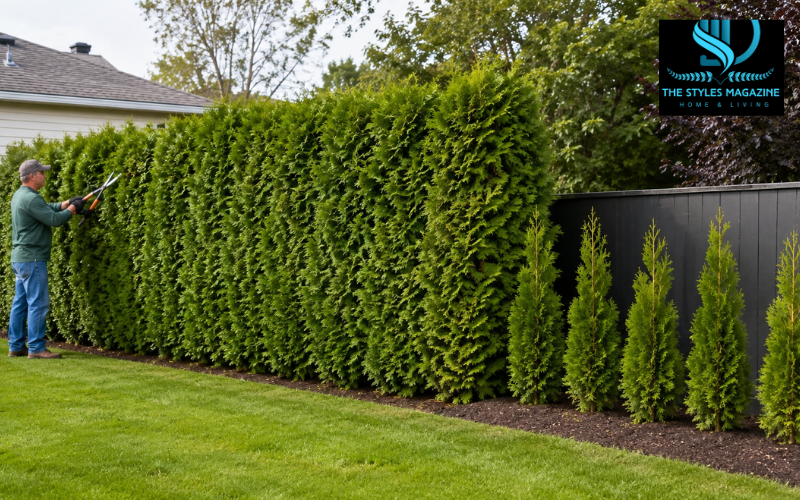
Keep the base slightly wider than the top. This allows sunlight to reach the lower foliage and reduces the chance of a thin bottom. Trim mainly the soft green outer growth and avoid cutting deeply into old, leafless branches because those areas may not fill quickly.
Use clean, sharp hand pruners for small corrections and hedge shears for light surface shaping. Step back often to check the full row. Remove dead, broken, or crossing branches, but do not cut off the main leader simply to make a young plant shorter.
Creating an Arborvitae Square Hedge
An arborvitae square hedge has flat sides and a level top instead of the plant’s natural pointed shape. It can suit a formal garden, but it needs more frequent trimming and is easier to maintain with compact varieties.
Use guide strings along the sides and top to create an even outline. Trim lightly and gradually rather than trying to form sharp edges in one session. The lower part should remain slightly wider than the upper part, even when the hedge looks square from a distance.
Do not cut into bare brown wood to correct an overgrown hedge. Severe gaps may not close. Choosing a naturally suitable variety from the beginning is the best way to keep a formal shape without damaging the plants.
Common Arborvitae Hedge Problems
Browning may result from drought, winter burn, salt exposure, poor drainage, damaged roots, pests, or disease. Winter burn often appears on the side exposed to wind and bright winter sun, while poor drainage may cause broader decline. Some inner foliage also browns and drops naturally with age, so not every brown branch signals a major problem.
Gaps may develop when plants are spaced too far apart, receive uneven sunlight, or lose branches. Because old bare areas may recover slowly, prevention is easier than repair.
Bagworms are a major arborvitae pest. Their hanging bags resemble small cones, and heavy feeding can strip foliage. Spider mites may cause pale, dusty, or bronzed foliage, especially on stressed plants. Penn State identifies bagworms as one of the most common arborvitae pests.
Wet soil can encourage root problems, while stressed foliage may be affected by tip blights such as Pestalotiopsis. Snow and ice can pull apart weak leaders or bend branches. A partly damaged plant may recover if the trunk and enough green foliage remain alive. Severe root rot, a split main trunk, or large dead sections may require replacement. When the cause is unclear, a local extension service or qualified plant professional can help identify it before treatment.
Seasonal Care, Winter Protection, and Deer Damage
A healthy hedge should enter winter with moist soil, protected roots, and mature growth. Continue watering during dry autumn weather until the ground freezes. Maintain a flat mulch layer over the root zone, but leave the trunk uncovered. This helps limit rapid changes in soil moisture and temperature.
In snowy areas, inspect the structure before winter. Plants with one strong leader are less likely to split than those with several weak competing tops. Proper pruning that removes multiple leaders and weak attachments can reduce snow and ice damage. Small vulnerable plants may be loosely supported, but ties should not be tight and must be removed in spring.
Do not beat frozen branches covered with ice because brittle limbs can snap. After a storm, gently lift loose snow with an upward motion when safe. Wait until mid-spring before deciding which browned areas are dead, since living buds may still produce growth.
Deer can remove foliage from the lower hedge and leave a clear browse line. In areas with frequent deer activity, fencing or sturdy mesh barriers are usually more dependable than repellents alone. Inspect the hedge in spring for broken branches, chewed foliage, pest bags, and dry soil, then make small corrections before active growth begins.
Conclusion
A successful arborvitae hedge begins with realistic planning. Choose Emerald Green for a manageable narrow screen, Green Giant for a large, tall boundary, or American Pillar when you need height with less width. Match the variety to the available space instead of depending on constant pruning.
Correct spacing, suitable sunlight, well-drained soil, careful planting, and steady watering during establishment give the hedge a strong start. Light trimming, seasonal checks, and protection from snow or deer can then keep it dense and attractive. By planning for mature height and width before planting, an arborvitae hedge can provide dependable privacy for many years.
Frequently Asked Questions
How Far Apart Should Arborvitae Be Planted For A Hedge?
Emerald Green arborvitae is commonly planted about 3 feet apart from center to center. Larger varieties, such as Green Giant, generally need 5 to 8 feet between plants.
How Long Does An Arborvitae Hedge Take To Fill In?
The time depends on the variety, plant size, spacing, and growing conditions. Fast-growing Green Giants may provide coverage sooner, while Emerald Green arborvitae usually develops a solid screen more gradually.
When Should An Arborvitae Hedge Be Trimmed?
Light trimming is best during spring or early summer. Avoid cutting deeply into old, bare wood because arborvitae may not produce enough new foliage to cover the empty area.
Why Is My Arborvitae Hedge Turning Brown?
Browning may result from dry soil, winter burn, poor drainage, road salt, pests, or root damage. Check soil moisture and growing conditions before applying fertilizer or pest treatments.
Are Arborvitae Hedges Resistant To Deer?
Most arborvitae varieties are not fully deer-resistant. Hungry deer may eat the lower foliage, especially in winter, so fencing or protective mesh may be needed in areas with heavy deer activity.
Disclaimer: This article provides general gardening information. Arborvitae growth, spacing, and care needs may vary by variety, climate, soil, and local conditions. Consult a local nursery or extension service for location-specific advice.