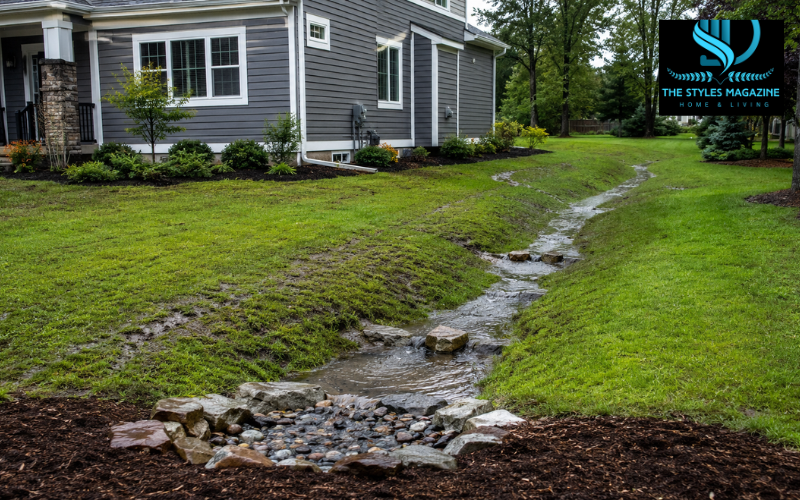
A drainage swale is a broad, shallow channel formed in the ground to manage rainwater moving across a property. It normally follows a gentle downhill path and may be covered with grass, plants, gravel, rocks, or concrete. Unlike a deep trench, a well-designed swale can blend naturally into a lawn or landscape.
When rain falls on roofs, driveways, patios, and compacted soil, some of the water cannot soak into the ground. It begins flowing across the surface as stormwater runoff. A swale receives this water, slows it down, and guides it toward a safer location. Vegetated swales can also trap sediment and give some water time to soak into the soil.
The main purpose of a drainage swale is to prevent uncontrolled runoff from reaching vulnerable areas. It may help protect a home’s foundation, reduce muddy sections of lawn, limit soil erosion, and prevent water from cutting unwanted channels through landscaping.
A swale is mainly a surface drainage feature. It remains open and visible, although a grass swale may be difficult to notice. Underground systems, such as French drains, collect water below ground through stone-filled trenches and pipes. This difference is important when choosing the right solution for a wet yard.
Drainage Swale Quick Guide
| Feature | Quick Explanation |
| Main purpose | Collects and redirects surface runoff |
| Common materials | Grass, plants, gravel, rocks, or concrete |
| Best for | Pooling water, erosion, and runoff moving toward buildings |
| Typical shape | Wide, shallow, and gently sloped |
| Water outlet | Rain garden, approved drain, or stable drainage area |
| Main maintenance | Remove debris, repair erosion, and maintain vegetation |
| Not ideal for | Underground groundwater or serious foundation leaks |
How a Drainage Swale Manages Rainwater
A drainage swale works through careful grading. The land is shaped so that one end is slightly higher than the other. Gravity then moves water along the channel instead of allowing it to spread randomly across the yard.
Its wide, shallow form is equally important. Water moving through a narrow, steep ditch can gain speed and wash away soil. A wider channel spreads the flow over a larger surface, reducing its speed. Grass stems, plant roots, mulch, and stones can slow it further.
As runoff passes through a vegetated swale, soil and plants may trap dirt, leaves, and some pollutants. Part of the water can soak into the ground when the soil is suitable and not already saturated. However, a swale should not depend entirely on infiltration. Once the soil becomes full, the channel must still carry excess water safely away.
The final discharge point is therefore a major part of the design. Water may be guided toward a rain garden, infiltration area, approved storm drain, stable drainage channel, or another location permitted by local rules. It should not simply stop beside a building or flow onto another property.
Common Reasons to Install a Drainage Swale in a Yard
Pooling water after heavy rain is one of the clearest signs that yard grading is not moving runoff effectively. A low section may remain wet for several days, making the lawn muddy, damaging plants, and creating an area that is difficult to use.
Another warning sign is water moving toward a house, garage, shed, or retaining wall. Even when water does not enter the building, repeated soil saturation can place unnecessary pressure on foundations and below-ground spaces. Extending downspouts, correcting the grade near the building, or installing a swale may help, depending on the source of the problem.
A drainage swale in a yard can also control runoff arriving from an uphill area. Water may come from a slope, neighbouring land, a driveway, or a large paved surface. Rather than allowing it to carve a path through the lawn, the swale gives it a planned route.
Swales are especially useful when the main problem is water moving across the surface and the homeowner wants to avoid a long underground pipe system. However, they are not a complete solution for every wet yard. A high water table, failed sewer line, leaking irrigation system, or underground spring may require a different approach.
Main Types of Drainage Swales
A grass-lined swale is often the most suitable choice for a residential lawn. Its bottom and sides are covered with established turf or other dense grass. Once the vegetation fills in, the channel may look like a gentle dip in the landscape. Grass helps control erosion, but it requires mowing, reseeding, and occasional sediment removal.
A rock or gravel swale is often designed to resemble a dry creek bed. It can suit areas where flowing water would damage turf or where the homeowner wants a stronger landscape feature. Rounded stones, larger rocks, and carefully placed outlet protection can help manage faster runoff. Leaves and sediment still need to be removed so they do not block spaces between the stones.
A bioswale uses plants and, in more advanced designs, a prepared soil mixture to improve water storage and filtration. These systems may contain native grasses, sedges, flowering plants, mulch, sand, soil, and an underground gravel layer. They can provide better water-quality benefits than a basic grass channel, but they need thoughtful plant selection and regular care.
A concrete drainage swale provides a hard, durable path for water. It is normally used where the main goal is rapid and controlled movement rather than infiltration. Concrete may be useful in narrow spaces or areas exposed to strong flows, but it can look less natural and may move water quickly enough to cause erosion at the outlet.
Residential Drainage Swale Design Basics
Good residential drainage swale design begins with understanding where the water comes from and where it can legally and safely go. The starting point should intercept runoff before it reaches the problem area. The outlet must be lower than the inlet and stable enough to receive the expected flow.
The channel should usually follow the existing shape of the land rather than fighting against it. A slightly curved route may fit the landscape better and keep water in contact with vegetation for longer. However, every bend must still allow water to continue downhill.
A swale should be broad and shallow, not shaped like a narrow trench. The U.S. Environmental Protection Agency notes that swales often use curved or flat-bottomed profiles with gentle side slopes. Side slopes flatter than three horizontal units for every one vertical unit can increase contact with vegetation and make the area easier to maintain.
Paths, fences, trees, walls, utility lines, driveways, septic components, and future landscaping must all be considered. A swale that is perfectly shaped but blocked by a walkway or fence will not function correctly.
Swale Drainage Design: Slope, Width, and Depth
A continuous downhill grade is essential because even a small low spot can trap water. There is no single slope that works for every residential site. EPA guidance commonly discusses grades of about 1% to 2% for grassed swales, while a 2024 NRCS-supported homeowner guide uses a 2% minimum in its regional examples. Local soil, rainfall, vegetation, and design standards should determine the final grade.
A 1% grade means the channel drops approximately one foot over 100 feet. A 2% grade means it drops about two feet over the same distance. A steeper channel may carry water faster, but excessive speed increases the risk of erosion. Stone check dams can sometimes be added across a steeper swale to slow the flow and create short, flatter sections.
Width and depth depend on how much runoff the swale must handle. Water from a small roof section may require a much smaller channel than runoff from a long driveway and an uphill lawn. Wider is often safer than deeper because width spreads and slows the water.
The cross-section may be gently curved, trapezoidal with a flatter bottom, or occasionally triangular. Whatever the shape, it must remain smooth and consistent. Large drainage areas, steep land, heavy clay, frequent flooding, or runoff that could threaten buildings usually require calculations by a drainage professional or civil engineer.
Choosing the Best Location for a Drainage Swale
The best location is usually along the natural route where water already enters or crosses the property. Watching the yard during steady rain can reveal the flow path, although it should be done safely and without standing near flooding, unstable soil, or electrical equipment.
The swale should collect water before it reaches a building and then carry it away from foundations, basement walls, crawlspaces, retaining walls, and paved areas. There is no universal setback that applies to every property, so local building rules and site-specific advice should take priority over a fixed distance.
Avoid routing a swale through septic drain fields, over buried utilities, or into places where water could weaken a wall or steep slope. In the United States, homeowners should contact 811 several days before digging so underground services can be marked. Exact waiting periods vary by state.
The outlet deserves as much attention as the channel. Redirecting runoff may be restricted if it creates property damage, unsafe conditions, or problems for neighbouring land. EPA homeowner guidance recommends checking local rules before redirecting water to a new location.
Drainage Swale vs Ditch
The difference between a drainage swale vs ditch is mainly found in their shape and purpose. A traditional ditch is often narrower, deeper, and designed to move water away as quickly as possible. It may have steeper sides and little focus on appearance or infiltration.
A swale is generally wider, shallower, and easier to include within a landscape. Vegetation can slow the water, protect the soil, and filter sediment. A grass swale may also be crossed with a mower when its side slopes are gentle enough.
Ditches may be more practical beside rural roads or where large volumes of water must be carried through a limited corridor. Swales often suit residential settings because they look softer and can provide both drainage and landscaping benefits.
Both systems require maintenance. A ditch may collect weeds, sediment, and rubbish, while a swale can develop bare patches, erosion grooves, or blocked outlets. Some old drainage ditches can be improved with flatter slopes, vegetation, and check dams so they behave more like swales.
Swale vs French Drain
In the comparison of a swale vs French drain, the source and location of the water matter most. A swale manages surface runoff that can be seen flowing across the ground. It collects that water in an open channel and carries it along the surface.
A French drain is an excavated trench filled with gravel or crushed stone. Many modern versions include a perforated pipe. Water enters through the open spaces in the stone and then moves toward an outlet below ground.
A swale generally requires more open space but less underground construction. It is easier to inspect because blockages and erosion remain visible. A French drain can fit beneath a narrow strip of land, but excavation, stone, pipe, filter fabric, and proper outlet construction can increase the work and cost.
Choose a swale when rainwater is flowing over the lawn, driveway edge, or slope. Consider a French drain when water is collecting within the soil or when an open channel cannot fit the site. Some properties need both: a swale may capture surface water while a French drain deals with persistent soil moisture or carries water through a restricted section.
Grass, Rock, or Concrete Drainage Swale
Grass offers the most natural appearance and may be the best choice when the yard has gentle flow, enough sunlight, and soil that supports healthy turf. Its roots protect the surface, while the grass blades slow runoff. The main disadvantages are mowing, watering during establishment, and repairing worn areas.
Rock suits locations where grass repeatedly washes away or where a dry-creek appearance matches the garden. It is durable and can handle occasional concentrated flow, but using rock does not remove the need for correct grading. A poorly sloped rock channel can still hold stagnant water or send runoff toward the wrong location.
Concrete provides a clean, fixed route and resists damage from high flow. However, because it is hard and non-porous, it does not provide the same infiltration and plant-based filtering as a vegetated swale. Fast water may also damage soil where the concrete ends, so the outlet often needs stone protection or another energy-reducing feature.
The best lining depends on water speed, soil, sunlight, appearance, space, budget, and maintenance. A mixed design is also possible, such as grass through most of the yard with stone around the inlet, bends, check dams, and outlet.
Drainage Swale Cost and Main Price Factors
The drainage swale cost varies widely because a light reshaping of an open lawn is very different from excavating compacted soil, removing old landscaping, building check dams, and creating an approved outlet.
As a broad U.S. reference, a 2026 consumer cost guide estimates approximately $5 to $15 per linear foot for a basic drainage swale. Another current guide places complete professional yard-drainage projects at an average of about $2,147 to $7,169, although that wider figure includes French drains, catch basins, pipes, and other systems—not only swales. These numbers should be treated as general planning estimates rather than fixed prices.
Cost rises with length, width, depth, difficult equipment access, soil removal, imported topsoil, sod, plants, gravel, concrete, erosion-control fabric, and outlet construction. Engineering, permits, utility marking, tree-root protection, or repairs to paths and lawns may add further expense.
A simple grass swale may be affordable to maintain through normal lawn care. A bioswale needs weeding, plant replacement, and sediment control. Rock channels require debris cleaning, while damaged concrete can be more expensive to repair.
What Drainage Swales Look Like in Real Yards
Many homeowners imagine a large ditch when they hear the term drainage swale. In reality, a grass swale may look like a smooth, almost level depression running between two parts of the lawn. It becomes most obvious during rain, when a shallow sheet of water follows the channel.
Rock swales have a more visible appearance. They may resemble natural stream beds made with different sizes of stone, curved edges, and drought-tolerant planting. A successful dry creek bed still has a clear downhill route beneath its decorative appearance.
Planted bioswales can look like long garden beds. Moisture-tolerant plants may grow in the center, with species that prefer drier conditions along the upper edges. The design should remain open enough for inspection and should not become so overgrown that water flow is blocked.
When reviewing pictures of drainage swales, look beyond appearance. Successful examples have a clear inlet, smooth channel, healthy lining, and protected outlet. Poor examples often show standing water, exposed soil, deep erosion grooves, collapsed sides, displaced stones, or an outlet that ends abruptly.
Installation, Maintenance, and Common Mistakes
Installation normally begins with observing runoff, checking local requirements, marking utilities, and planning a safe outlet. The route is then measured and graded. Soil is removed or moved to create the required shape, and the surface is smoothed so there are no raised areas or hidden depressions.
Grass, sod, plants, rock, or concrete is added after grading. New vegetation must be protected until roots become established because bare soil can wash away during the first heavy storm. Erosion-control matting may be useful during this vulnerable period.
Maintenance includes removing leaves, litter, weeds, and sediment; mowing grass without cutting it too short; reseeding bare areas; and returning displaced stones. The swale should also be inspected after major storms for pooling, gullies, clogged check dams, and erosion at the outlet. EPA guidance stresses maintaining healthy plant cover and correcting erosion or debris buildup.
Common mistakes include making the channel too deep, using steep sides, failing to provide a continuous slope, placing it too close to a foundation, and ending it where water has nowhere safe to go. Driving heavy machinery across the swale can compact soil and reduce infiltration.
Professional help is sensible when water is entering a building, the yard is very steep, runoff comes from several properties, the proposed outlet is uncertain, or the swale must handle a large drainage area. A specialist can identify whether the real problem is surface grading, saturated soil, groundwater, damaged pipes, or a combination of causes.
Conclusion: Deciding Whether a Drainage Swale Is Right for Your Property
A drainage swale can be an effective solution when rainwater is visibly moving across a yard, collecting in low areas, damaging landscaping, or travelling toward a structure. It works best where there is enough space for a wide, shallow channel and a safe downhill outlet.
Proper grading is more important than decorative materials. Grass, plants, rocks, and concrete cannot correct a channel that slopes in the wrong direction or ends beside a vulnerable area. Soil type, runoff volume, land slope, local rules, and future maintenance should all be considered before work begins.
For a small and clearly understood surface-water problem, a simple residential swale may be practical. For repeated flooding, foundation moisture, steep terrain, or uncertain drainage routes, a professional site assessment is the safer choice. The right design should manage water without merely transferring the problem somewhere else.
Frequently Asked Questions
What Is The Purpose Of A Drainage Swale?
A drainage swale guides rainwater away from vulnerable areas, slows its movement, reduces erosion, and may allow some runoff to soak naturally into the ground.
Does A Drainage Swale Hold Water?
A properly designed swale should carry water toward a safe outlet rather than hold it permanently. Temporary water after heavy rain may occur, but long-lasting pooling can indicate poor grading.
Is A Drainage Swale Better Than A French Drain?
A swale is usually better for visible surface runoff, while a French drain manages water within saturated soil. The right option depends on where the water originates.
Can I Install A Drainage Swale Myself?
A simple swale may be suitable for a careful DIY project, but large runoff volumes, steep slopes, foundation problems, or uncertain outlets should be assessed by a drainage professional.
How Do You Maintain A Drainage Swale?
Remove leaves, weeds, sediment, and rubbish regularly. Keep grass or plants healthy, repair bare soil, reposition displaced rocks, and inspect the channel and outlet after major storms.
Enjoyed it? Find more exclusive content on The Styles Magazine.
Disclaimer: This information is for general guidance only. Drainage conditions, property boundaries, soil, utilities, and local regulations vary, so consult a qualified professional before starting major drainage work.